

Before anyone walks into a clinic, they ask: “Where do I go?” Why that question is so hard to answer, what helps today, and the gap Medigize is working on.
Before anyone walks into a clinic, they ask: “Where do I go?” The answer usually comes from relatives, a family WhatsApp group or a trusted pharmacist. These people care, but none of them sees the whole picture.
This works in many cases. In others it stalls: the specialty is unclear, the clinic is far, or the cost is unknown until arrival. This article looks at why that first question is so hard to answer, what helps today, and the gap Medigize is working on.
In short:
- Rule out an emergency first: severe chest pain, trouble breathing, loss of consciousness or signs of a stroke mean an ambulance, not a search.
- If the specialty is unclear, a general practitioner or family doctor is a sensible first stop. They can examine you and refer you on.
- Arrive with the complaint written down, your medicines and allergies, and earlier results with their dates.
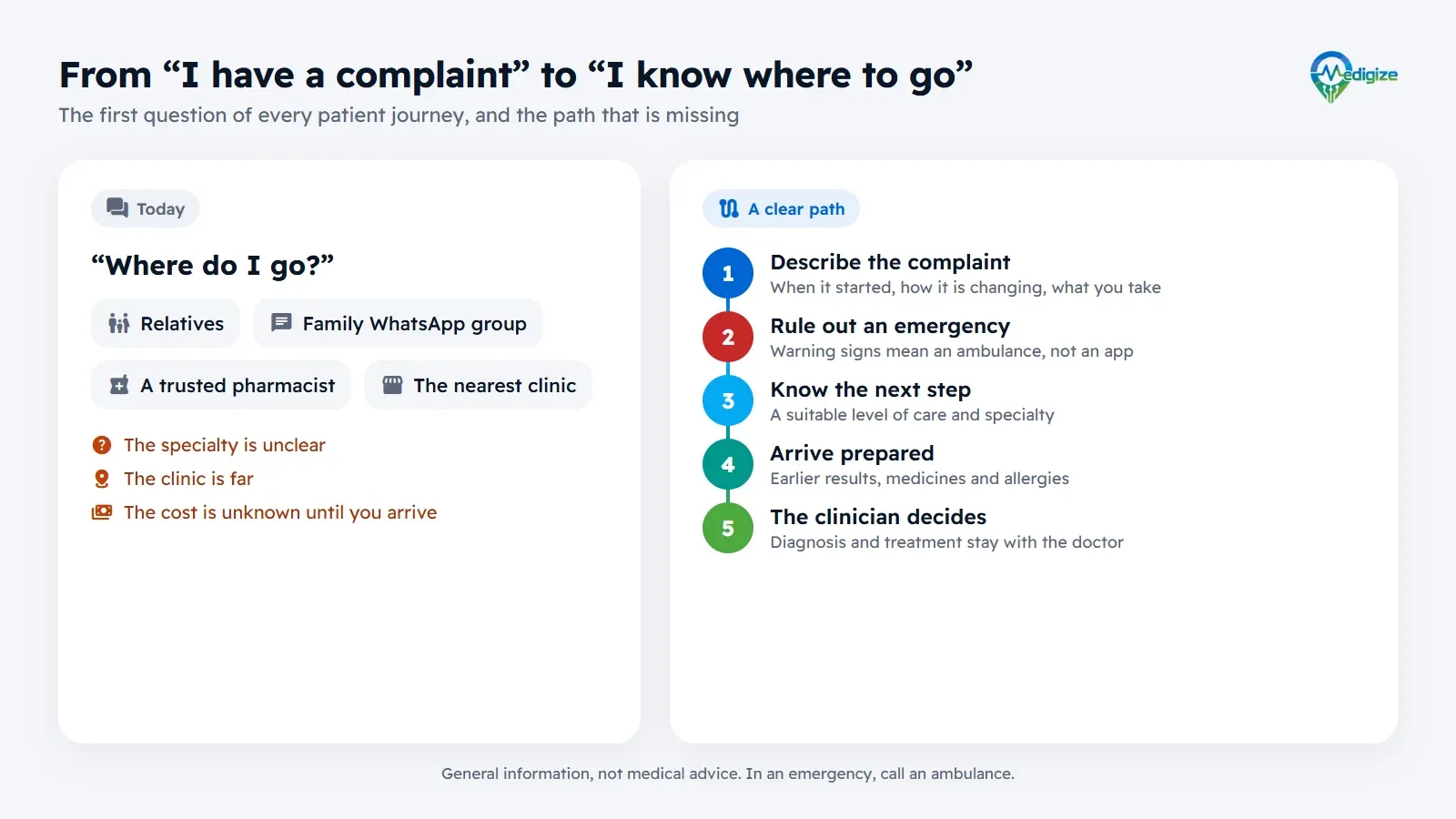
From “I have a complaint” to “I know where to go”: the path that is missing today.
Where the answer usually comes from
For most people in the Middle East and Africa, the first stop is not a booking system. It is someone they trust:
- Relatives who went through something that sounds similar.
- The family WhatsApp group, where a doctor’s name is recommended within minutes.
- A pharmacist who knows the family and is a few steps from home.
Every one of them answers out of care. The limit is not goodwill. It is that none of them sees the whole picture: your history, your earlier results, what has already been tried, and which level of care fits the complaint.
Where the journey stalls
The specialty is unclear
Many complaints do not name their own specialty. Pain, tiredness or a symptom that keeps coming back can sit between several clinics, and starting in the wrong one usually means starting again somewhere else.
The clinic is far
A recommendation is only useful if you can reach it. Distance, transport and opening hours decide as much as the doctor’s name does.
The cost is unknown until you arrive
When a visit is paid out of pocket, not knowing the price of the consultation, the tests or the follow-up in advance makes every decision harder, and sometimes delays it.
The gap: a path, not a fact
The missing piece is not one fact. It is a clear path from “I have a complaint” to “I know where to go and what to bring”.
That path has to stay in the territory of guidance, not diagnosis. The difference matters:
| Guidance can | Guidance does not |
|---|---|
| Help you describe the complaint clearly | Tell you which condition you have |
| Flag warning signs that need an ambulance now | Reassure you that something can wait |
| Point to a suitable level of care and the next step | Replace an examination by a clinician |
| Help you arrive with your history and results | Choose a provider on your behalf |
Not sure which doctor to see? A first-stop checklist
Until that path exists, a few habits make the first question easier to answer. This is general information, not medical advice.
- Rule out an emergency first. Severe chest pain, trouble breathing, loss of consciousness or signs of a stroke mean calling an ambulance or going to the nearest emergency department. Do not search, and do not wait for an app.
- If the specialty is unclear, start with a general practitioner or family doctor. The World Health Organization describes primary health care as the “front door” of the health system: it can assess the complaint and refer you on when a specialist is needed.
- Write the complaint down before you go. When it started, whether it is getting better or worse, whether it has happened before, and any long-term conditions you have.
- List your medicines and allergies, including anything you took on someone else’s advice.
- Bring earlier results with their dates. Lab reports, imaging and discharge letters save time when a new doctor can compare them.
- Ask practical questions before you book: the cost of the visit, what to bring, and how long the wait usually is.
- Leave knowing the next step: what happens now, and when to come back.
General practitioner or specialist: which comes first?
There is no single rule that fits every country or every complaint, but the first stop usually follows the situation you are in:
| Your situation | A usual first stop |
|---|---|
| Signs of an emergency | An ambulance or the nearest emergency department |
| A new complaint, and the specialty is unclear | A general practitioner or family doctor |
| A long-term condition a specialist already follows | The doctor who follows that condition |
| A doctor has referred you | The specialty named in the referral, with the referral letter |
| Results to understand, or a question about a treatment | The doctor who ordered the test or prescribed the treatment |
When none of these fits, the checklist above still applies: rule out an emergency, then start where someone can examine you and point you on.
How to describe your complaint in one minute
A clear description saves time at every stop, from the pharmacist to the specialist. Fill in the blanks before you go, and read it out if you need to:
Since [when], I have had [what] in [where]. It is [getting better / getting worse / about the same]. It [has / has not] happened before. It gets worse when […] and better when […]. So far I have taken [medicines, doses]. I have [long-term conditions, or none], and I am allergic to […, or nothing I know of].
Bring any earlier results with their dates, and ask, before you leave, what the next step is and when to come back.
What Medigize is working on
Medigize is building a navigation and coordination layer for healthcare in the Middle East and Africa. It helps the patient organise the complaint and understand the next step, and it helps providers receive the case already organised. The medical decision stays with the clinician.
- MIHOS, for patients: structured intake, a health record shared only with the patient’s consent, and navigation to the right level of care. Medigize for patients.
- MIPORT, for providers: a case that arrives organised, run from intake to follow-up on top of the systems the provider already uses. Medigize for providers.
We are still building, and we do not promise results before we measure them. Next in this series: what “care operations” means, the layer this work sits in.
Frequently asked questions
Which doctor should I see if I don’t know what is wrong?
If there are no emergency signs and the specialty is unclear, a general practitioner or family doctor is a sensible first stop. They can examine you and refer you to a specialist when one is needed.
Can an app tell me which specialist I need?
A responsible navigation tool can help you describe the complaint, flag warning signs and point to a suitable level of care. It cannot examine you or diagnose you. That decision stays with a clinician.
Does Medigize diagnose?
No. Medigize is a non-diagnostic navigation and coordination tool. It helps organise the journey, and every medical decision stays with a licensed clinician.
Should I see a general practitioner or a specialist first?
If the complaint is new and the specialty is unclear, a general practitioner or family doctor usually comes first. If a specialist already follows a long-term condition, or a doctor has referred you, the specialist is usually the right first stop.
How do I describe my symptoms to a doctor?
Say when it started, what you feel and where, whether it is getting better or worse, whether it has happened before, what makes it better or worse, what you have taken, and any long-term conditions and allergies.
What should I bring to a first appointment?
A short written description of the complaint and when it started, a list of your medicines and allergies, and any earlier results or reports with their dates.
Medigize is a non-diagnostic navigation tool. This is general information, not medical advice. In an emergency, call an ambulance or go to the nearest emergency department.
References
Last updated:
Explore Medigize
Medigize is in development. Explore our current scope and express your interest.