
People hear “care operations” and think hospital administration. The idea is simpler: everything that happens around treatment and shapes it.
People hear “care operations” and think hospital administration. The idea is simpler.
Care operations means everything that happens around treatment and shapes it: intake, routing, scheduling, referral and follow-up. Treatment belongs to the clinician. Care operations decides whether the case reaches that clinician complete and on time, and whether the patient knows where to go after the visit.
In short:
- Care operations has five stages: intake, routing, scheduling, referral and follow-up.
- Treatment and diagnosis stay with the clinician. Care operations decides how well prepared that work is, and whether the next step happens.
- It is not hospital administration. It follows the patient’s path, not the organisation’s budget.
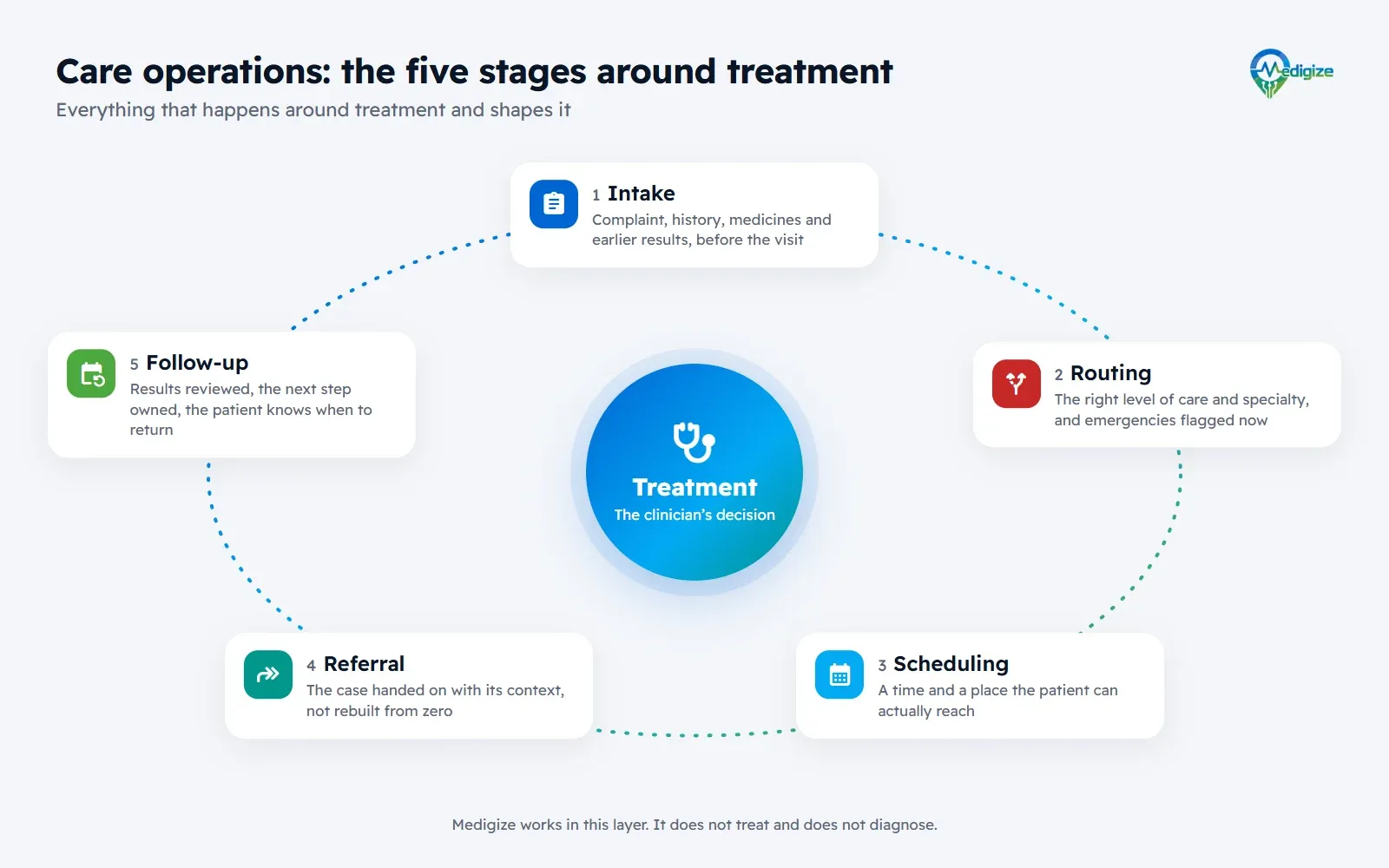
The five stages of care operations, around the one thing that stays with the clinician.
The five stages of care operations
1. Intake
Collecting the complaint, the history, current medicines and earlier results before the patient is seen. When intake is weak, the visit opens with paperwork and the clinician starts from zero.
2. Routing
Deciding which level of care and which specialty the case should go to, and flagging the cases that need emergency care now. Weak routing is how a patient ends up in a neighbouring specialty and has to start again.
3. Scheduling
Turning a decision into a time and a place the patient can actually reach. A good route with no available appointment is still a stalled journey.
4. Referral
Handing the case to another clinician or service with its context attached, so the next person does not have to rebuild it. Much of what goes missing between providers goes missing here.
5. Follow-up
Making sure the next step happens: results are reviewed, someone owns what comes next, and the patient knows when to come back. Without it, care ends at the clinic door.
One patient, five stages: an example
Take a composite case, built from many and with no identifying detail: a patient whose complaint keeps coming back contacts a clinic. The same visit can go two ways.
| Stage | When it works | When it breaks |
|---|---|---|
| Intake | The complaint, medicines and last year’s results are collected before the visit | The patient fills in the same form again and the results stay at home |
| Routing | The case goes to the specialty that fits, and warning signs are flagged | It lands in a neighbouring specialty and starts again |
| Scheduling | A time and place the patient can reach | The right clinic, with no slot for weeks |
| Referral | The next clinician receives the case with its history | The patient tells the story from the beginning |
| Follow-up | Results are reviewed and the patient knows when to return | Nobody owns the next step, and it does not happen |
The doctor and the treatment are the same in both columns. Only the operations around them changed.
Care operations vs. clinical care
Treatment belongs to the clinician. But a clinician cannot work well if the case arrives incomplete, or if the patient does not know where to go after the visit. The two are different kinds of work:
| Clinical care | Care operations | |
|---|---|---|
| Who owns it | The licensed clinician | The provider’s team and the systems it uses |
| What it decides | Diagnosis and treatment | Where, when, and with what information |
| An example | Choosing a treatment plan | Making sure the earlier lab report reaches the clinic before the visit |
The line matters. A tool that works in care operations should leave the clinician better prepared. It should never take the clinical decision.
Care operations vs. hospital administration
Hospital administration runs the organisation: finance, staffing, procurement and facilities. Care operations follows the patient’s path through it. Two facilities with similar budgets and equally good doctors can still feel very different to a patient, depending on how that path is organised.
Care operations, care coordination and patient navigation
These terms overlap, and they are often used for one another. A working distinction:
| Term | What it covers | Seen from |
|---|---|---|
| Care operations | The whole path around treatment: intake, routing, scheduling, referral and follow-up | The provider running that path |
| Care coordination | Making sure the people and services involved in one patient’s care work from the same information | The handoffs between them |
| Patient navigation | Helping a patient find the right service and get past the barriers on the way | The patient |
| Case management | Ongoing management of care for a patient with complex or long-term needs | One patient over time |
Medigize works across the first three: navigation for the patient, and operations and coordination for the provider.
Why it matters
A system full of good doctors can still leave patients lost if the journey is not organised. This layer is invisible in the picture, yet it decides whether the experience is smooth or exhausting.
The World Health Organization makes a related point in its practice brief on continuity and coordination of care: integrated, people-centred services depend on care that connects across providers and settings, not only on what happens inside each visit.
When the layer is weak, the signs are familiar: forms that ask the same questions every time, tests repeated because the earlier ones are on paper somewhere else, and patients who leave without knowing the next step.
How to measure care operations
A provider does not need a new system to start. It needs a baseline: how the path behaves today, before anyone promises to improve it. Four measures say a lot:
- Case completeness at first review: how often the clinician has what they need when they first open the case.
- Manual handoffs per case: how many times information is copied, retyped or carried between people.
- Time to the next step: how long a patient waits between one decision and the next action.
- How often follow-up disappears: the share of cases where the agreed next step never happens.
Measure these first, then change something, then measure again. That is the order we hold ourselves to as well: we will not claim an improvement before we know the starting point.
Where Medigize sits
Medigize works in this layer with two products, on top of a governed operations layer:
- MIHOS, for patients: helps the patient organise the complaint, keep a record that is shared only with their consent, and reach the right level of care.
- MIPORT, for providers: helps the provider run the case from intake to follow-up, on top of the systems they already use.
We do not treat and we do not diagnose. Every clinical decision stays with the licensed clinician. See how Medigize works and the platform.
Run a clinic, lab, imaging centre or hospital? Talk to us about measuring your baseline.
The first article in this series: Every patient journey starts with a question.
Frequently asked questions
What is care operations in healthcare?
Care operations is the work that happens around treatment and shapes it: intake, routing, scheduling, referral and follow-up. Treatment itself belongs to the clinician.
Is care operations the same as hospital management?
No. Hospital management runs the organisation: finance, staff and facilities. Care operations organises the patient’s path through it, from the first contact to follow-up.
What are examples of care operations?
Collecting a patient’s history and earlier results before the visit, sending the case to the specialty that fits, booking a time the patient can reach, handing the case to another clinician with its context, and making sure results are reviewed and the next step happens.
How do you measure care operations?
Start with a baseline: case completeness at first review, manual handoffs per case, time to the next step, and how often follow-up disappears. Change one thing, then measure again.
What is the difference between care operations and care coordination?
Care coordination is one part of care operations: making sure everyone involved in a patient’s care works from the same information. Care operations also covers intake, routing and scheduling, before coordination begins.
Does Medigize treat or diagnose patients?
No. Medigize builds navigation and care operations tools. It does not treat and does not diagnose, and the clinical decision stays with the licensed clinician.
References
Last updated:
Explore Medigize
Medigize is in development. Explore our current scope and express your interest.