

Results arrive as numbers, arrows and English terms. Most of us worry at the red numbers or relax at the green ones. Neither is enough. Here is what to ask instead.
Results arrive as numbers, arrows and English terms. Most of us look at the red numbers and worry, or at the green ones and relax. Neither is enough.
Interpretation is the doctor’s job. What you can do is understand how the report is laid out, keep it safely, and ask good questions.
In short:
- A lab report lists each test with your result, its unit and the range the lab uses. Results outside that range are flagged.
- A flag is not a diagnosis, and a result inside the range is not a guarantee. Your doctor reads it with your history and your earlier results.
- Ask what still needs follow-up, how it compares with before, what to do before the next test, and when to come back.
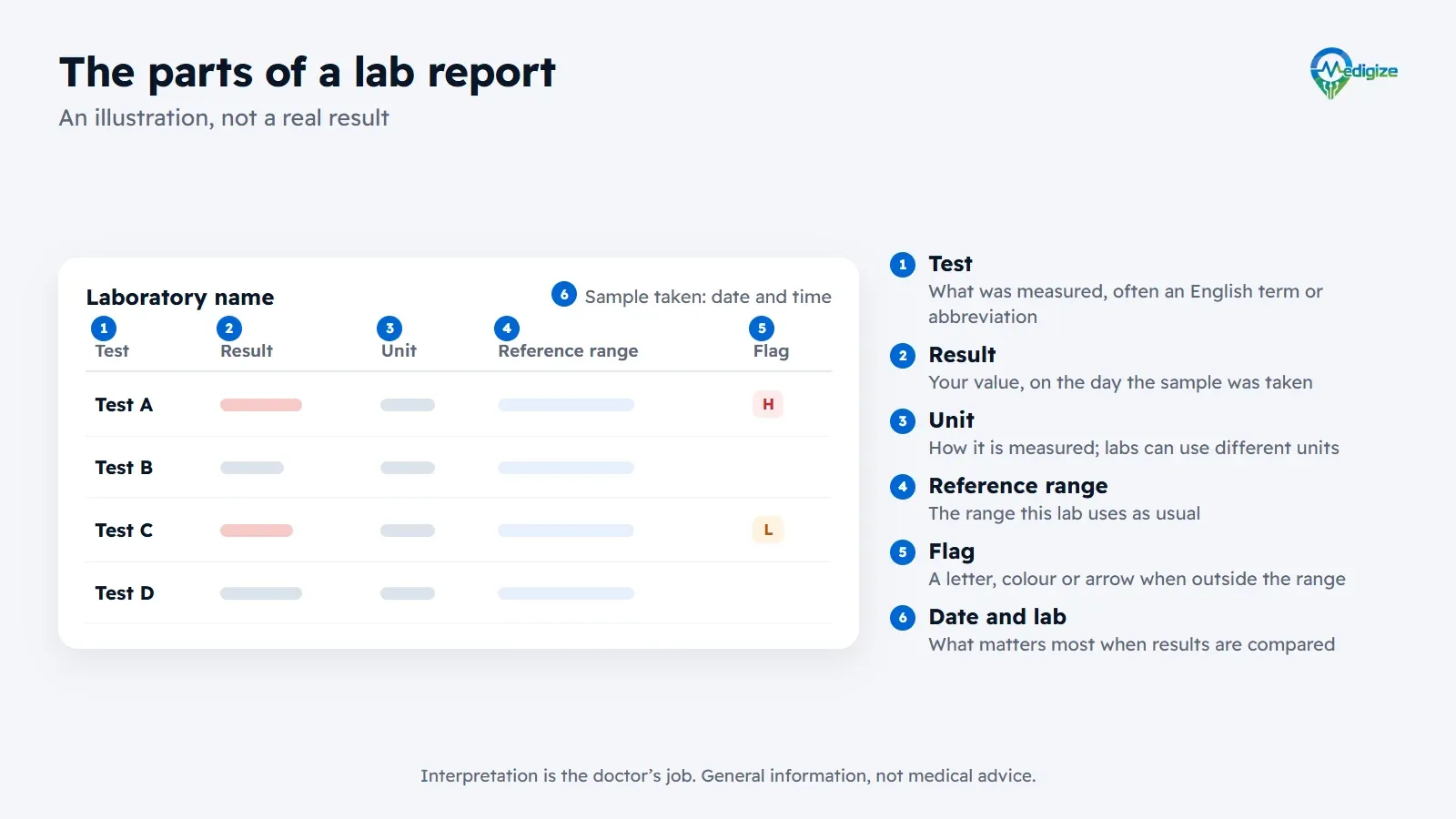
The parts of a lab report. An illustration, not a real result.
How a lab report is laid out
Reports look different from lab to lab, but most share the same columns:
| Part of the report | What it shows |
|---|---|
| Test | What was measured, often as an English term or an abbreviation |
| Result | Your value for that test, on the day the sample was taken |
| Unit | How the value is measured. The same test can be reported in different units by different labs |
| Reference range | The range this lab uses as its usual range for that test |
| Flag | A letter, colour or arrow when a result falls outside the reference range |
Two details are easy to miss and matter most when results are compared: the date the sample was taken, and the name of the lab. Units and reference ranges can differ between labs, which is one reason comparisons are best left to your doctor.
Why red and green are not the whole story
A flagged result is not a diagnosis, and an unflagged one is not a guarantee. A reference range describes what is usual across many people; your doctor reads your result alongside your history, your symptoms, your medicines and your earlier results. That is why the same number can mean different things for two different people, and why a single result is often followed up rather than acted on alone.
So instead of reading the colours, use the report to prepare your questions.
Questions to ask your doctor about your results
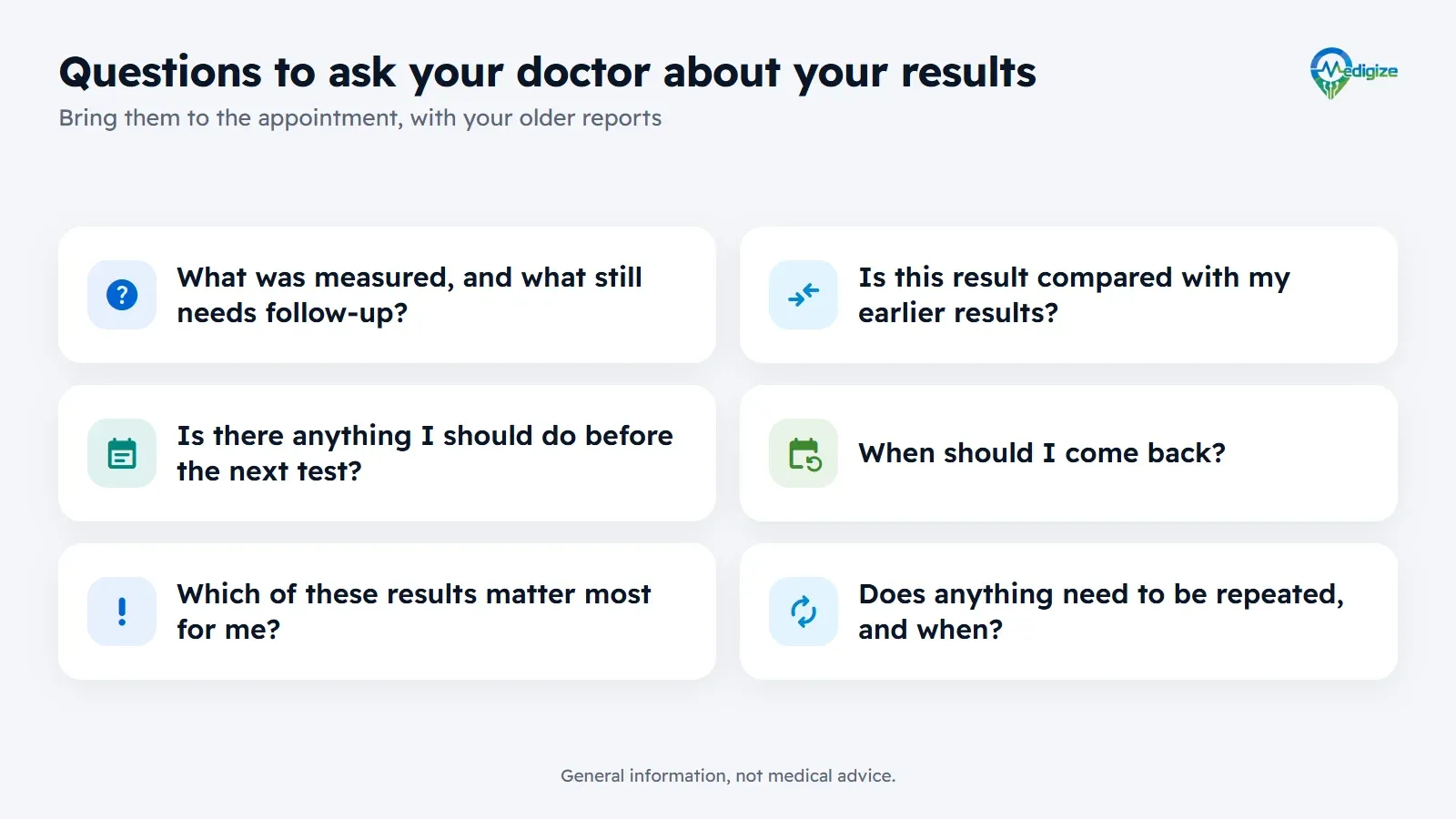
Questions to bring to the appointment.
- What was measured, and what still needs follow-up?
- Is this result compared with my earlier results? Bring the old reports, with their dates.
- Is there anything I should do before the next test? Some tests have preparation steps; the doctor or the lab will tell you which.
- When should I come back?
- Which of these results matter most for me?
- Does anything need to be repeated, and when?
Pick the questions that matter to you, add your own, and take the list with you:
Try it
Your questions for the doctor
Tick the questions you want to ask, add your own, then copy, print or send the list to yourself.
4 questions on your list.
What you type stays on this page. Nothing is saved or sent unless you copy, print or send it yourself.
Keep a copy, with its date
Photograph the report and keep it in one place with its date. When you see a new doctor, comparing with older results saves a lot of time.
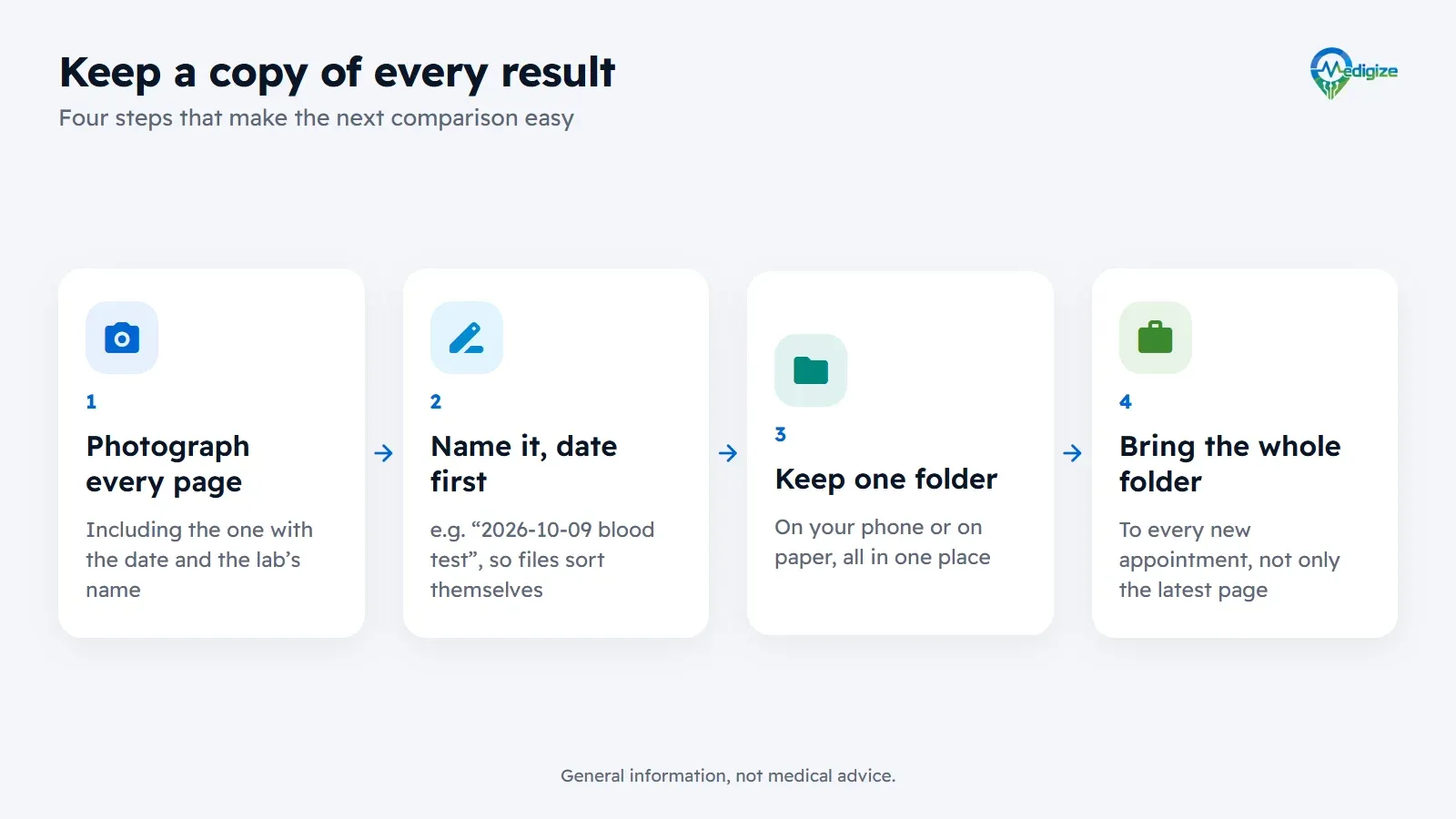
Four steps that make the next comparison easy.
- Photograph every page, including the one with the date and the lab’s name.
- Name each file with the date first, for example “2026-10-09 blood test”, so the files sort themselves.
- Keep them in one folder, on your phone or on paper.
- Bring the whole folder to new appointments, not only the latest page.
If you did not receive a copy, ask the lab or the clinic for one. A guide from the US Office of the National Coordinator for Health IT puts the habit in three steps: get your records, check them, and use them. Paper results lost between visits are one of the places a journey breaks, as we described in Seven stops, and every one worked.
When not to wait for an appointment
A lab report is not the place to decide whether something is urgent. If you feel severely unwell, or you have chest pain, trouble breathing, fainting or signs of a stroke, call an ambulance or go to the nearest emergency department. If the lab or your doctor contacts you about a result, follow their instructions.
Frequently asked questions
What does it mean if my result is outside the reference range?
It means the lab has flagged it as outside the range it usually uses. It is not a diagnosis by itself: your doctor reads it with your history and earlier results, and may want to repeat it or follow it up.
Why are some results marked H or L?
H usually means higher than the reference range and L lower. Labs mark results differently, so check the key printed on your report and ask the doctor what it means for you.
Can I compare results from two different labs?
Sometimes, but units and reference ranges can differ between labs. Bring both reports, with their dates, and let your doctor compare them.
Should I look up my results online?
General information can help you prepare questions, but it cannot interpret your result for you. Take your questions to the doctor who ordered the test.
What should I bring to the follow-up appointment?
The new report, older reports with their dates, your list of medicines, and your questions.
Medigize is a non-diagnostic navigation tool. This is general information, not medical advice. In an emergency, call an ambulance or go to the nearest emergency department.
References
Last updated:
Explore Medigize
Medigize is in development. Explore our current scope and express your interest.