
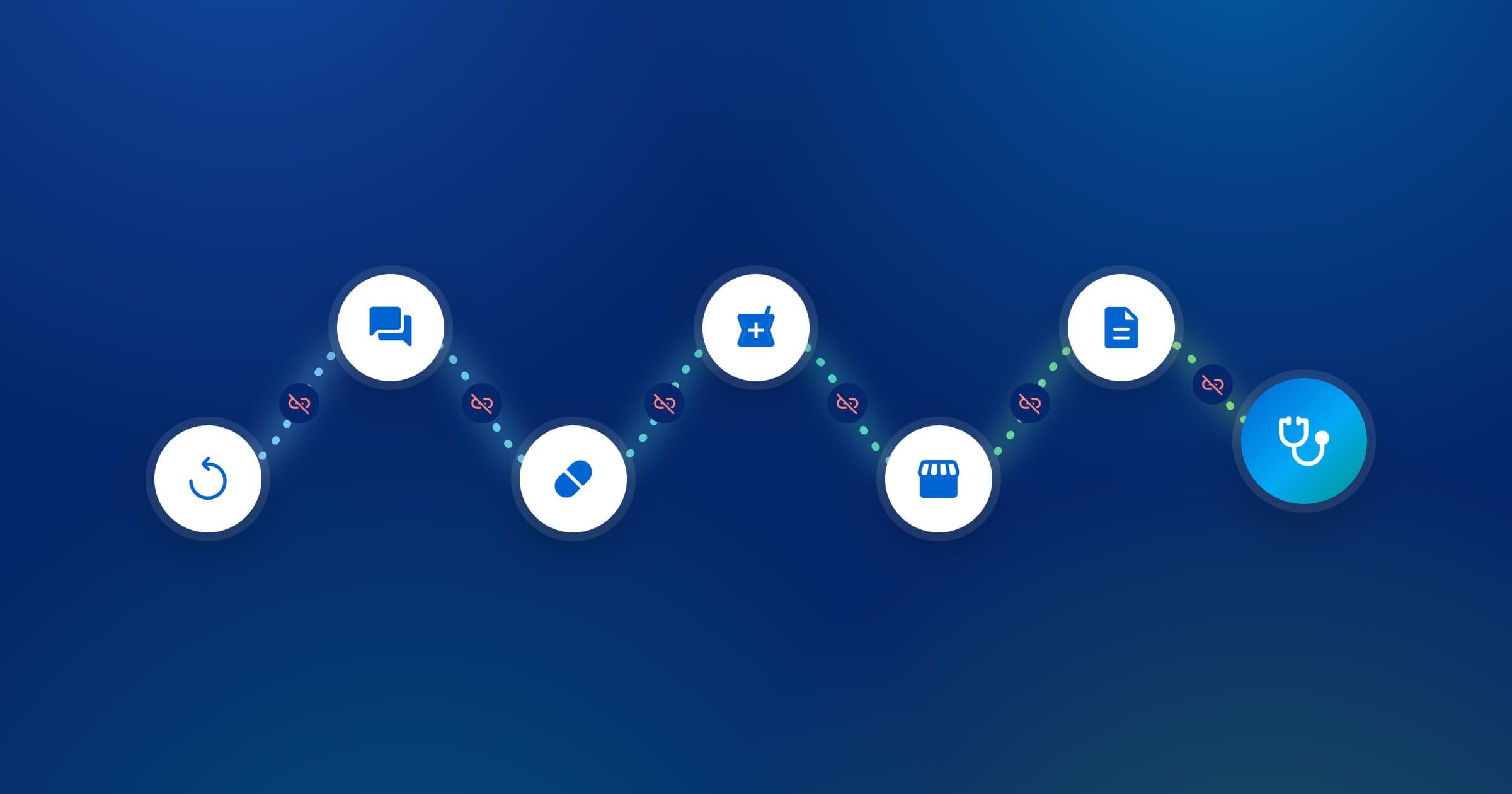
A recurring complaint, a family group, a painkiller, a pharmacy, the wrong clinic, paper results, and finally the right specialist. Every stop did its job. What broke was the connection between them.
Take a journey composed from many cases, with every identifying detail removed: a recurring complaint, a question in the family group, a painkiller, a pharmacy, a clinic in a nearby specialty, paper test results, and finally the right specialist.
Every stop worked correctly on its own. What broke was the connection: every stop started from zero, and every paper travelled in a bag.
In short:
- A fragmented patient journey is rarely one person’s mistake. Each stop can be right and the journey still slow.
- What gets lost lives between the stops: the story, the results, and who owns the next step.
- The answer is not fewer stops. It is something that connects them, with the patient’s consent.
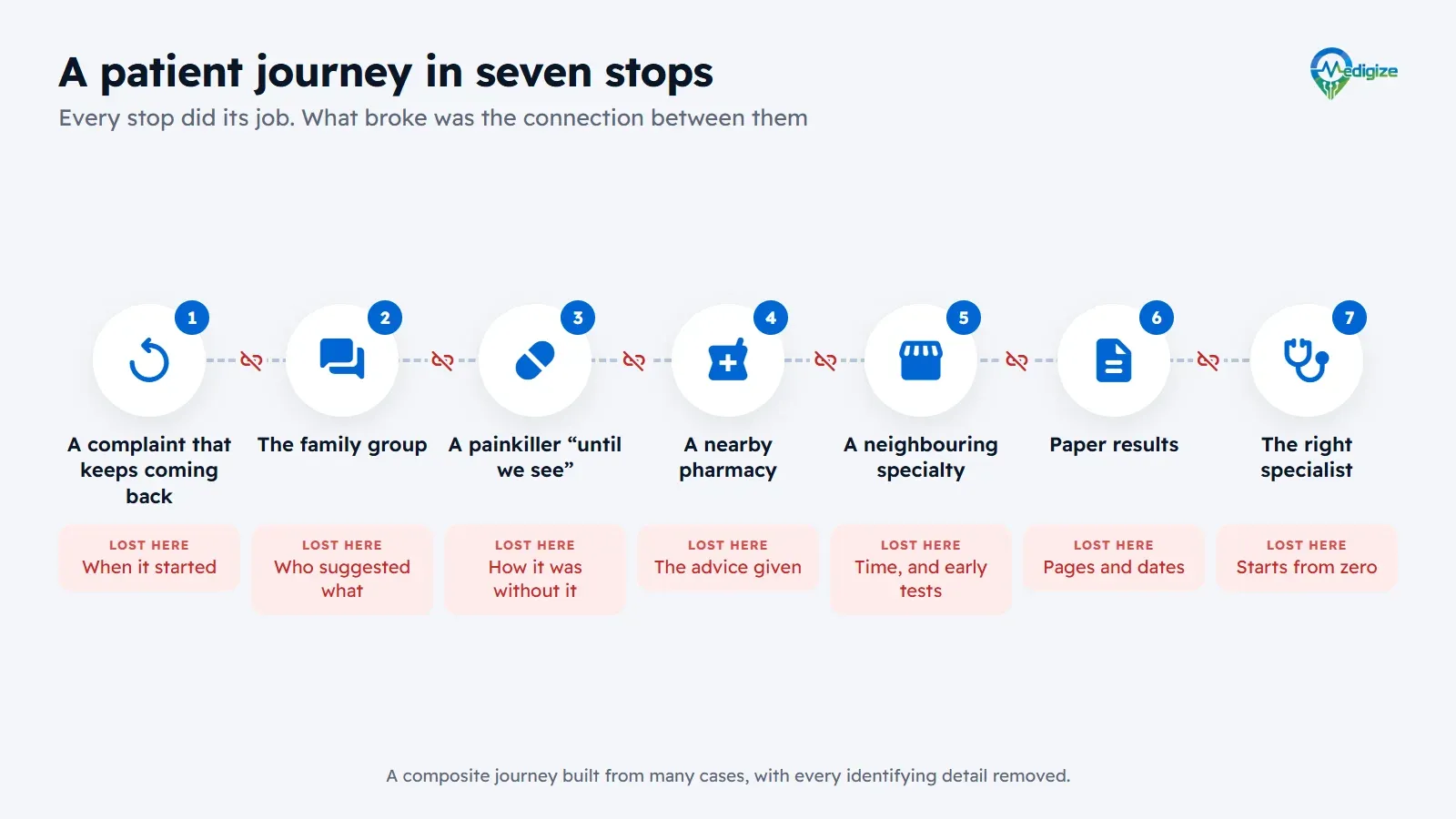
Seven stops. Each one did its job, and the journey still took the long way round.
The seven stops, one by one
- A complaint that keeps coming back. It is mild at first, so it waits. Nobody writes down when it started or how it changes.
- A question in the family group. Someone recognises it from their own experience and suggests a name, or a medicine.
- A painkiller “until we see”. It helps for a while, which makes it harder to say later how the complaint behaved without it.
- A nearby pharmacy. A trusted pharmacist listens, advises, and suggests seeing a doctor if it continues.
- A clinic in a neighbouring specialty. Close to home and available, but not the specialty the complaint needs. Tests are ordered.
- Paper results. The report goes home in a bag. By the next visit, one page is missing and the dates are unclear.
- The right specialist. Finally the right door. The doctor asks everything from the beginning, because nothing arrived with the patient.
Every stop worked. The connections did not.
Read the list again and look for the mistake. There is no single one. The pharmacist did their job, the first doctor did theirs, the lab did theirs. What broke lives in the gaps between them:
- The story restarts at every stop. Each new person hears it for the first time, in a shorter and less precise version.
- Results travel on paper. They get lost, arrive without dates, or stay at home.
- Nobody owns the next step. Each stop ends with advice, not with a handover.
This is not only a feeling. The World Health Organization’s patient safety fact sheet lists breakdowns in communication between providers, and between providers and patients and families, among the factors that contribute to harm. Its 2019 report on medication safety in transitions of care makes the same point about medicines: discrepancies are common whenever a patient moves between care settings, such as admission to or discharge from hospital. The risk sits at the handover, not inside each visit.
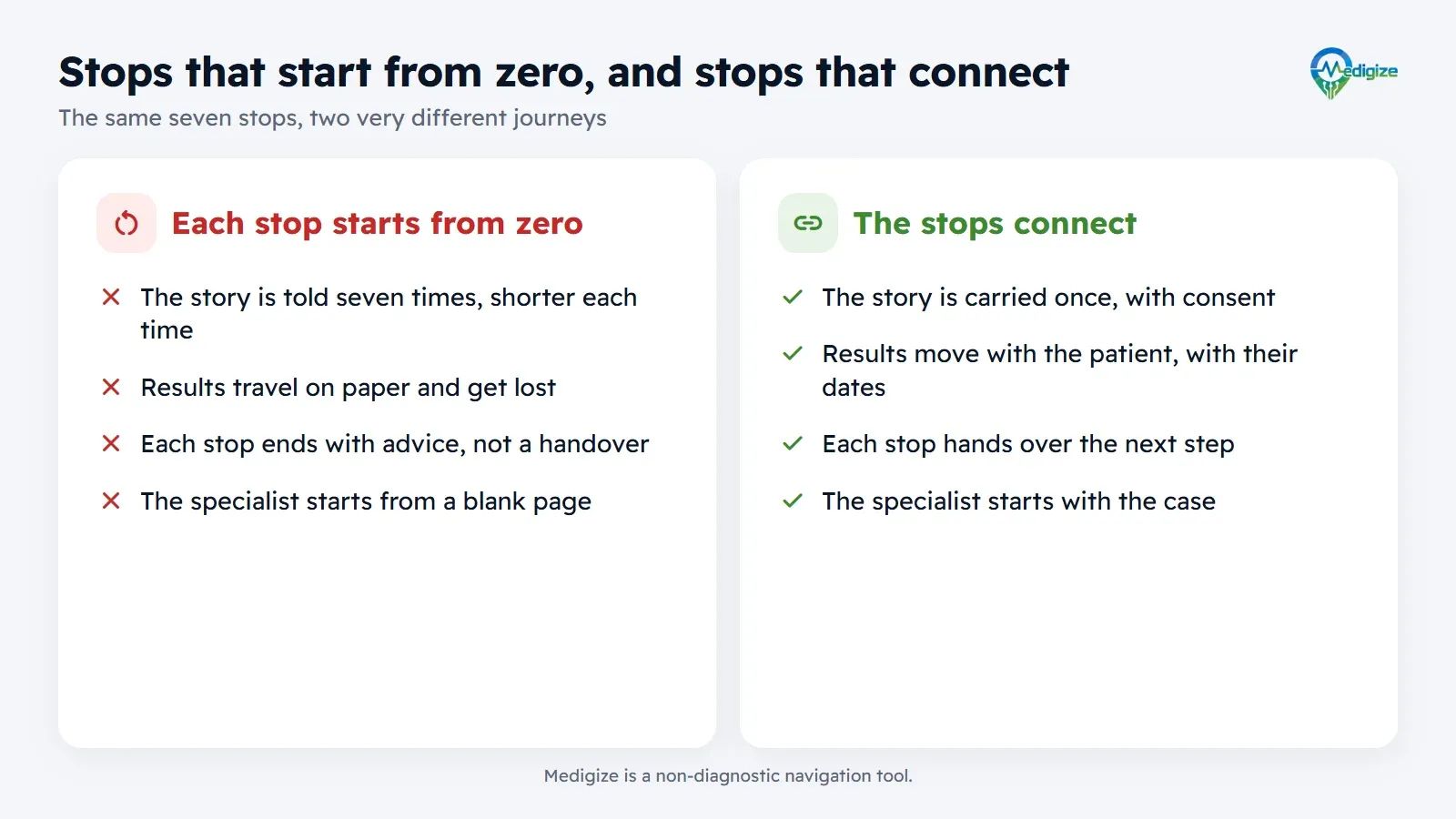
Stops that start from zero, and stops that connect.
Why patients tell their story seven times
Telling the story again is not a formality. Each retelling is a chance to leave something out: when the complaint started, what was already tried, which medicine helped and which did not. By the seventh time, the version the specialist hears is usually the shortest one.
If you are in the middle of a journey like this, two habits help today:
- Keep one written description of the complaint and update it, rather than retelling it from memory. The one-minute template from the first article in this series is a good start.
- Keep every result in one place with its date, and take the whole set to each new doctor.
Which stop cost you the most time?
Every journey is different. Tap the stops below to see what tends to get lost at each one, then pick the one that cost you the most time, and ask the people around you the same question. If you tell us on LinkedIn, it helps us understand what patients prioritise.
Try it
The seven stops
Tap a stop to see what tends to get lost there.
What gets lost: When it started and how it changed, because nobody wrote it down.
Which stop cost you the most time?
Your pick stays on this page unless you share it.
What could change
You do not have to remove stops. Many of them are useful: the pharmacist close to home, the doctor who is available today. What matters is a party that connects them:
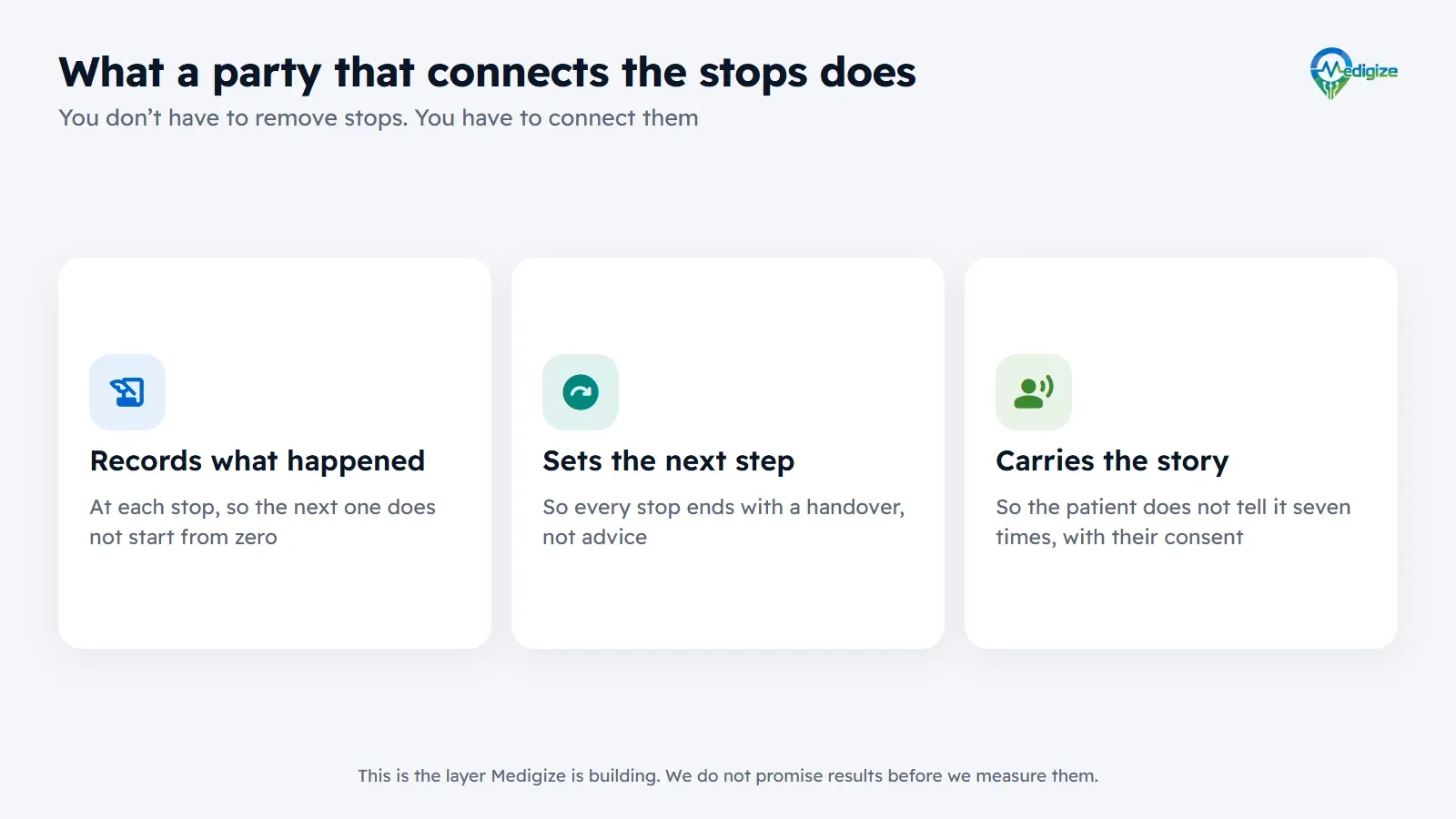
What a party that connects the stops does.
- It records what happened at each stop, so the next one does not start from zero.
- It sets the next step, so every stop ends with a handover rather than advice.
- It spares the patient from telling the story seven times, by carrying it for them, with their consent.
That is the layer Medigize is building: navigation for the patient and care operations for the provider, with a record that moves only when the patient agrees. See Medigize for patients. We are still building, and we do not promise results before we measure them.
Frequently asked questions
What is a fragmented patient journey?
A journey where each stop works on its own but information does not move between them, so the patient repeats their story, tests may be done again, and the next step depends on the patient remembering it.
Why do I have to tell my medical history to every new doctor?
Usually because each facility keeps its own records and there is no safe, consent-based way for them to move with you. Bringing a written summary and your results with their dates reduces how much you have to repeat.
Is it wrong to ask a pharmacist or my family first?
No. They are often the closest and most trusted first stop. The problem is not asking them; it is when nothing they learned or suggested travels with you to the next stop.
How can I keep my own journey connected today?
Keep one written description of your complaint, one folder of results sorted by date, and a list of your medicines and allergies, and take all three to every new appointment.
Does Medigize replace doctors or pharmacists?
No. Medigize is a non-diagnostic navigation and coordination tool. It connects the stops; every medical decision stays with a licensed clinician.
Medigize is a non-diagnostic navigation tool. This is general information, not medical advice. In an emergency, call an ambulance or go to the nearest emergency department.
References
Last updated:
Explore Medigize
Medigize is in development. Explore our current scope and express your interest.