Every new facility asks for the same details: name, age, allergies, medications. Sometimes even the same facility, between two visits. Why, what it costs, and what helps.
Every new facility asks for the same details: name, age, allergies, medications. Sometimes even the same facility, between two visits.
The repeated form is nobody’s stupidity. It results from every place running its own system, with no safe way to move patient data with consent.
In short:
- Forms repeat because each facility keeps its own records, and there is rarely a safe, consent-based way to bring yours along.
- Patients pay in time and transfer errors; clinics pay in longer intake and incomplete data.
- Until records move with you, a one-page summary you fill in once saves the most retyping.
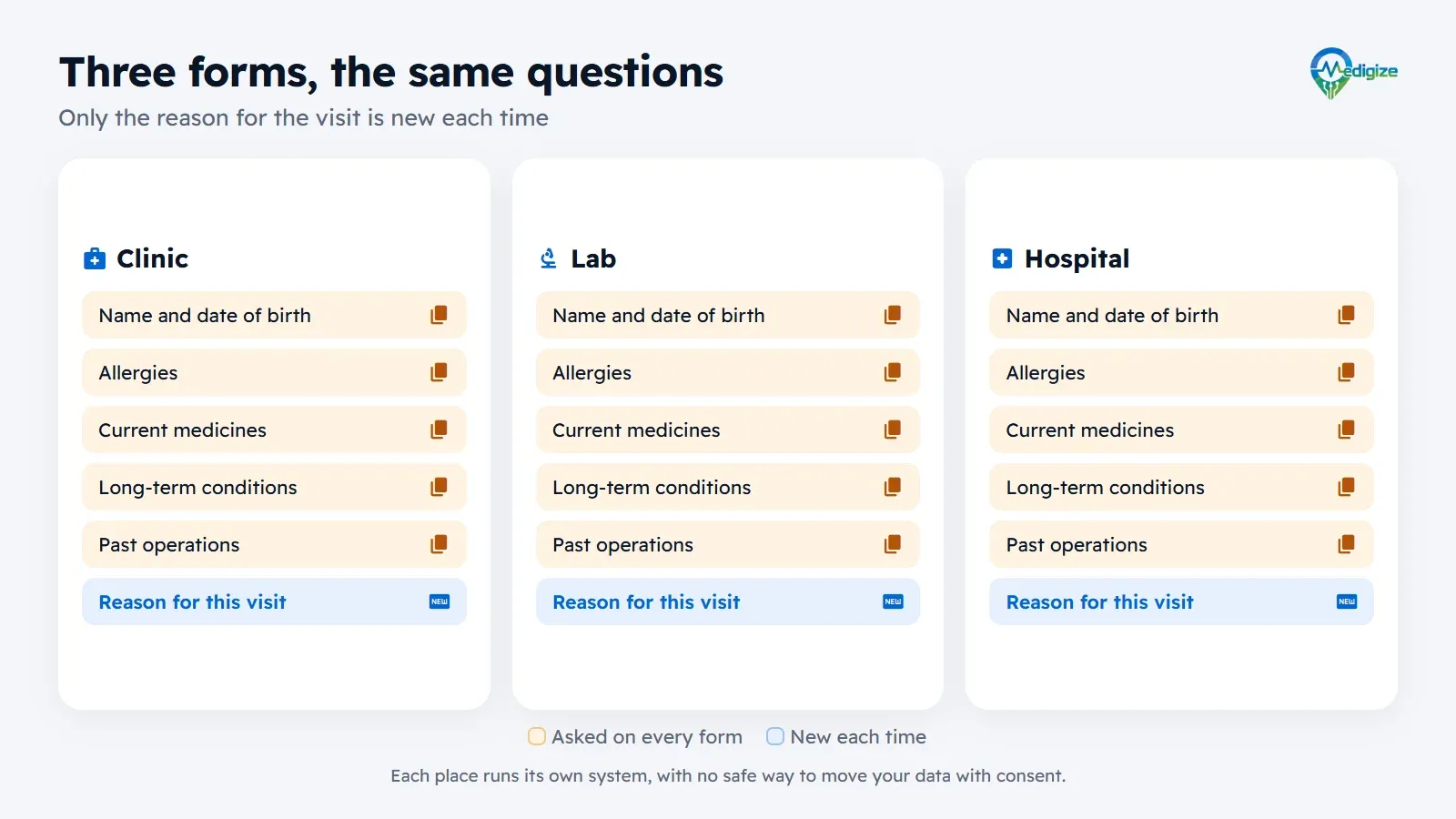
Three forms, the same questions. Only the reason for the visit is new.
The questions every form asks
Put any two intake forms side by side and the overlap is striking:
- Name, date of birth and contact details
- Allergies
- Current medicines and their doses
- Long-term conditions
- Past operations and hospital stays
- The reason for this visit
Most of these change rarely. The reason for the visit is the one part that is new every time, and it is often the part with the least space on the form.
Why it happens
- Each place runs its own system. A clinic, a lab and a hospital rarely share one record.
- There is no safe road between them. Moving health data needs the patient’s consent and a secure way to send only what is needed.
- Re-asking feels safer than trusting an old copy. Staff ask again because they cannot know whether what they hold is still current, and for medicines and allergies, checking is the right instinct.
The World Health Organization’s 2019 report on medication safety in transitions of care describes the same gap from the medicines side: discrepancies are common whenever a patient moves between care settings.
The cost
Patient time, manual transfer errors, and the feeling that the system does not see you. Providers pay too: longer intake and incomplete data.
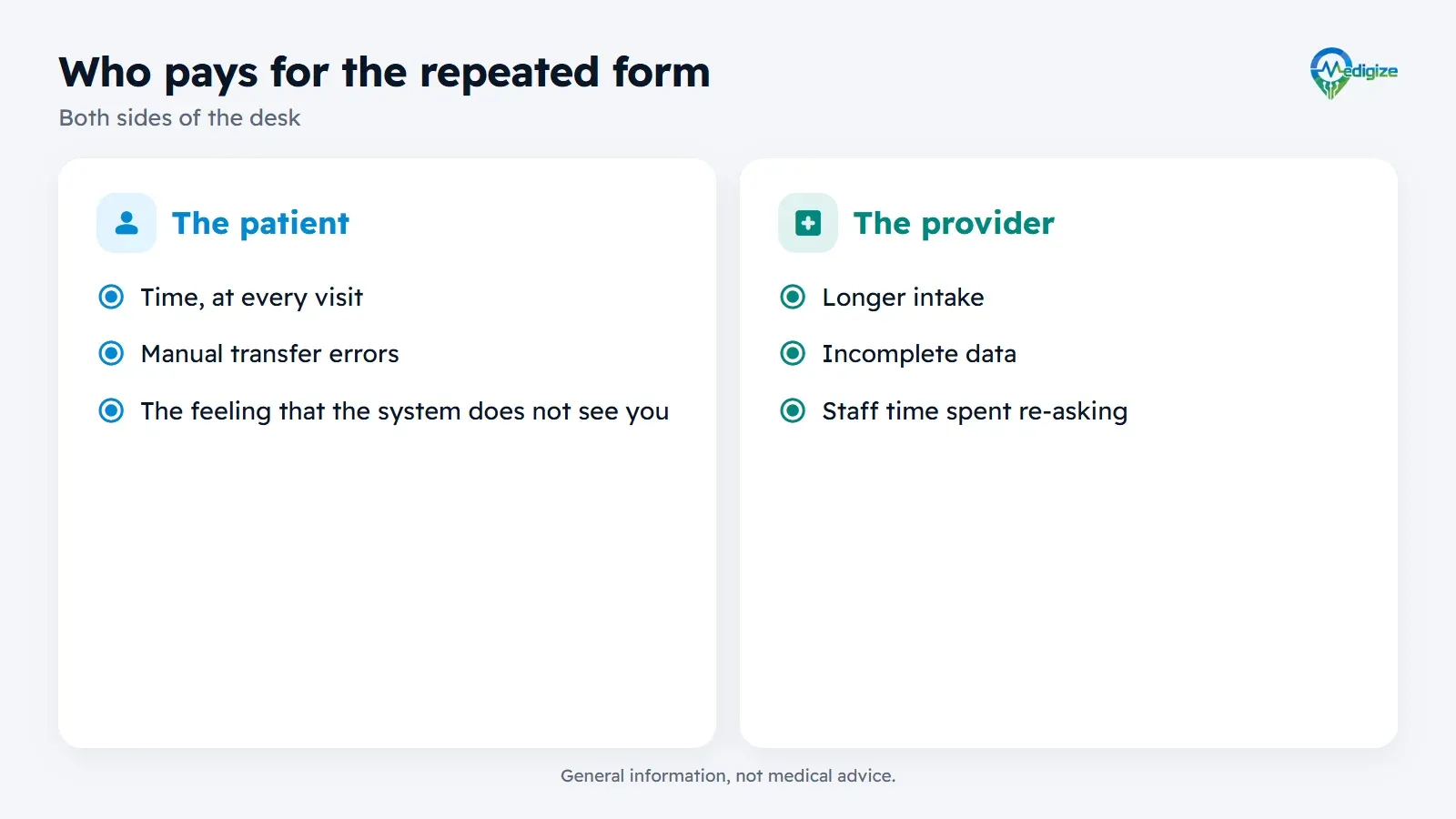
Both sides of the desk pay for the same form.
Fill it once: your one-page health summary
You cannot change how every facility works. You can make every form faster and more accurate by keeping one page with the details forms always ask for, and bringing it with you. Fill in what applies to you, then print it or copy it:
Try it
My health summary
The details forms ask for every time, on one page. Fill in what applies to you, then print it or keep a copy.
Your page
Your summary appears here as you fill it in.
Nothing you type is saved, not even in this browser, and nothing is sent unless you do it yourself. Update the page whenever a medicine or a condition changes.
Update it whenever a medicine or a condition changes, and keep your results with their dates, as described in questions to ask your doctor about your lab results. The fewer times you retell your story, the fewer chances for something to fall out of it, which is the point of Seven stops, and every one worked.
The right direction
Structured intake before the visit, and information that moves with the patient’s consent and with only the data that is needed. That is what Medigize works on in MIHOS and MIPORT, without claiming a connection to any specific system today.
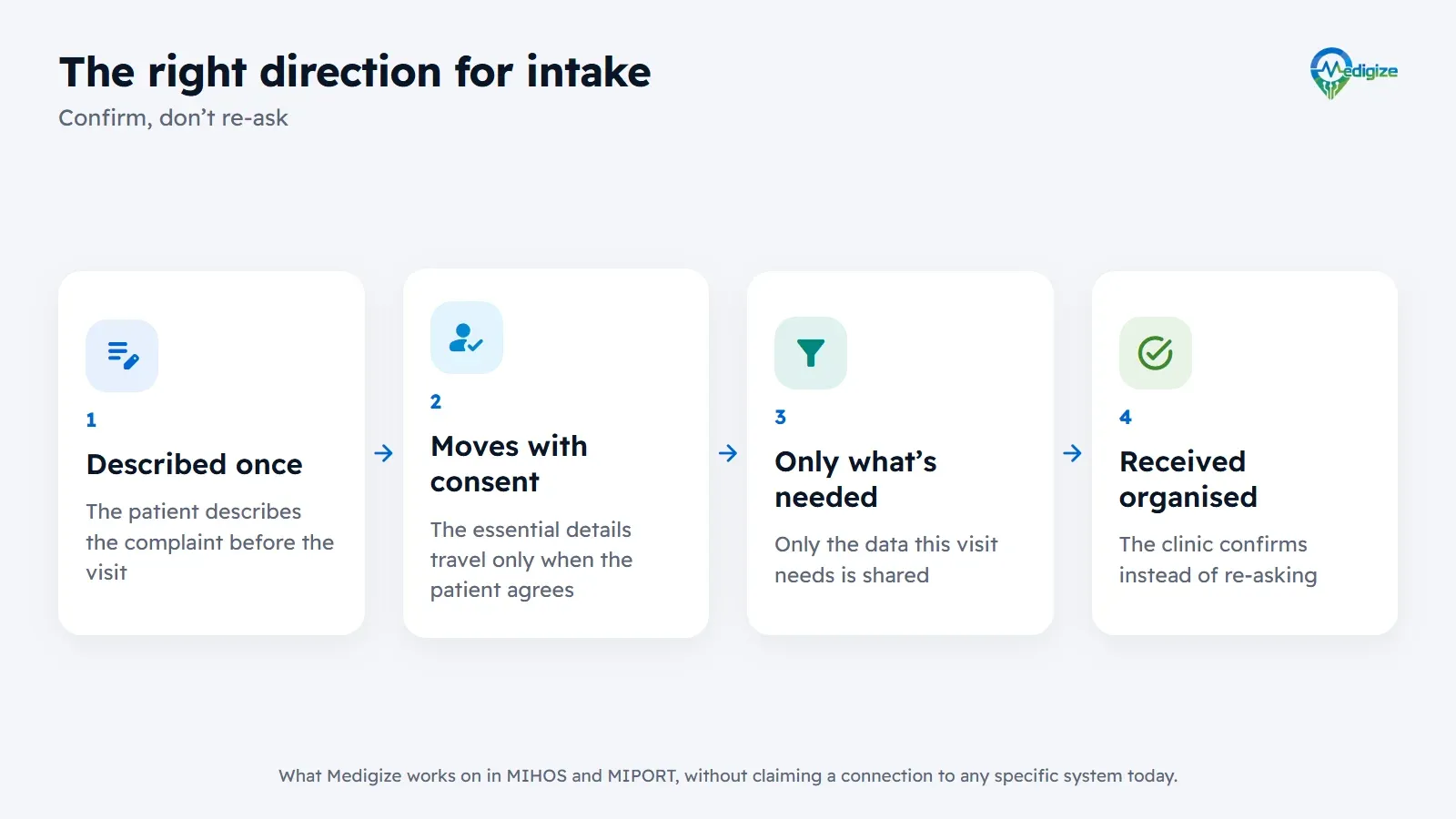
Confirm, don’t re-ask.
- The patient describes the complaint once, before the visit.
- The essential details travel with it, only with the patient’s consent.
- Only the data needed for this visit is shared.
- The clinic receives the case already organised, and confirms rather than re-asks.
Read how we approach consent and data on our governance and privacy page.
Frequently asked questions
Why do doctors ask the same questions again?
Partly because their system does not hold your earlier answers, and partly because details like medicines and allergies change. Confirming them is safer than assuming they have not.
What should a personal health summary include?
Your allergies, current medicines with their doses, long-term conditions, past operations and hospital stays, the doctors you see, and where your results are kept.
Is it safe to carry a written health summary?
It is your information: keep it somewhere private, share it only with the people treating you, and update it when something changes.
Can my records move between clinics automatically?
In some health systems they can, with the patient’s consent. In many places they do not yet, which is why a written summary still helps.
Does Medigize connect to my clinic’s system?
We work on top of existing systems and do not claim a connection to any specific system today. Information moves only with the patient’s consent.
Medigize is a non-diagnostic navigation tool. This is general information, not medical advice. In an emergency, call an ambulance or go to the nearest emergency department.
References
Last updated:
Explore Medigize
Medigize is in development. Explore our current scope and express your interest.