“Is my case an emergency?” No responsible navigation tool can answer that the way a physician would. What it can do, what it cannot, and the rule we hold ourselves to.
A recurring question: “Is my case an emergency?” No responsible navigation tool can answer that as a physician would.
What it can do: ask structured questions, flag signs that call for an ambulance, and point to the nearest suitable level of care. What it cannot do: diagnose, or reassure a patient about something that needs examination.
In short:
- Severe chest pain, trouble breathing, loss of consciousness or signs of a stroke: call an ambulance now. Do not wait for an app.
- A navigation tool can organise your complaint and flag warning signs. It cannot examine you, diagnose you, or tell you it is safe to wait.
- At Medigize, when in doubt, urgency goes up, never down.
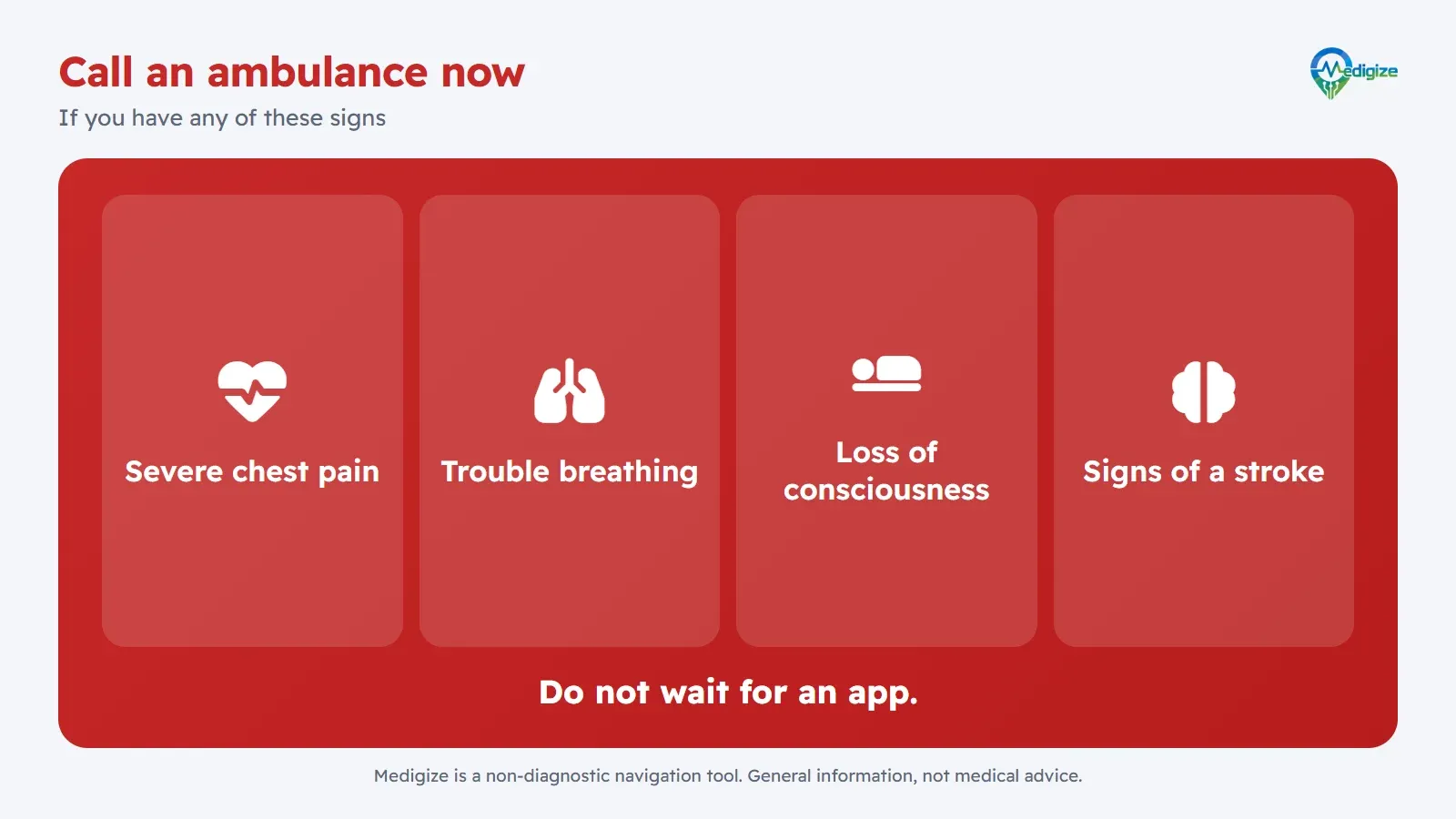
These signs need an ambulance, not a search and not an app.
What a navigation tool can do
- Ask structured questions about the complaint, so that nothing important is skipped.
- Flag warning signs that call for an ambulance, and say so plainly.
- Point to a suitable level of care, from an emergency department to a clinic visit.
- Prepare the case, so the clinician who sees you starts with the information instead of a blank page.
What it cannot do
- Diagnose. Naming a condition needs a clinician who can examine you.
- Reassure you about something that needs examination. “It is probably nothing” is not a navigation tool’s to say.
- Lower your urgency because you seem fine.
- Stand in for an emergency call. When a warning sign is there, the call comes first.
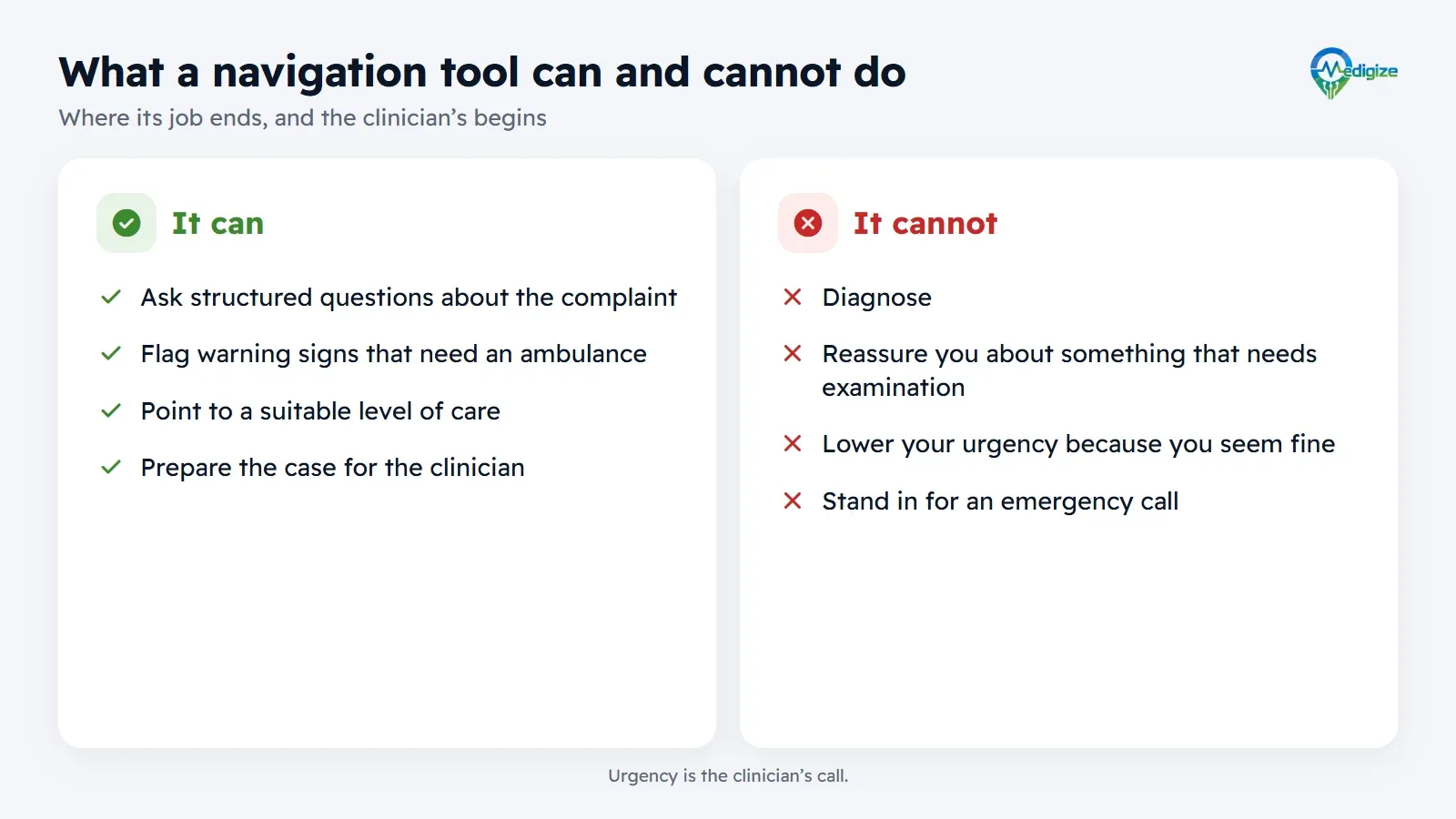
Where a navigation tool’s job ends, and the clinician’s begins.
Test yourself: can a navigation tool do this?
Six things people often expect from a health app. For each one, decide whether a responsible navigation tool can do it.
Try it
Can a navigation tool do this?
Six things people expect from a health app. Decide for each one.
0 of 6 answered
Your answers stay on this page.
The Medigize rule: when in doubt, urgency goes up
When in doubt, urgency goes up, never down. Every output passes a mandatory validation gate before release, and every stage leaves an audit trail.
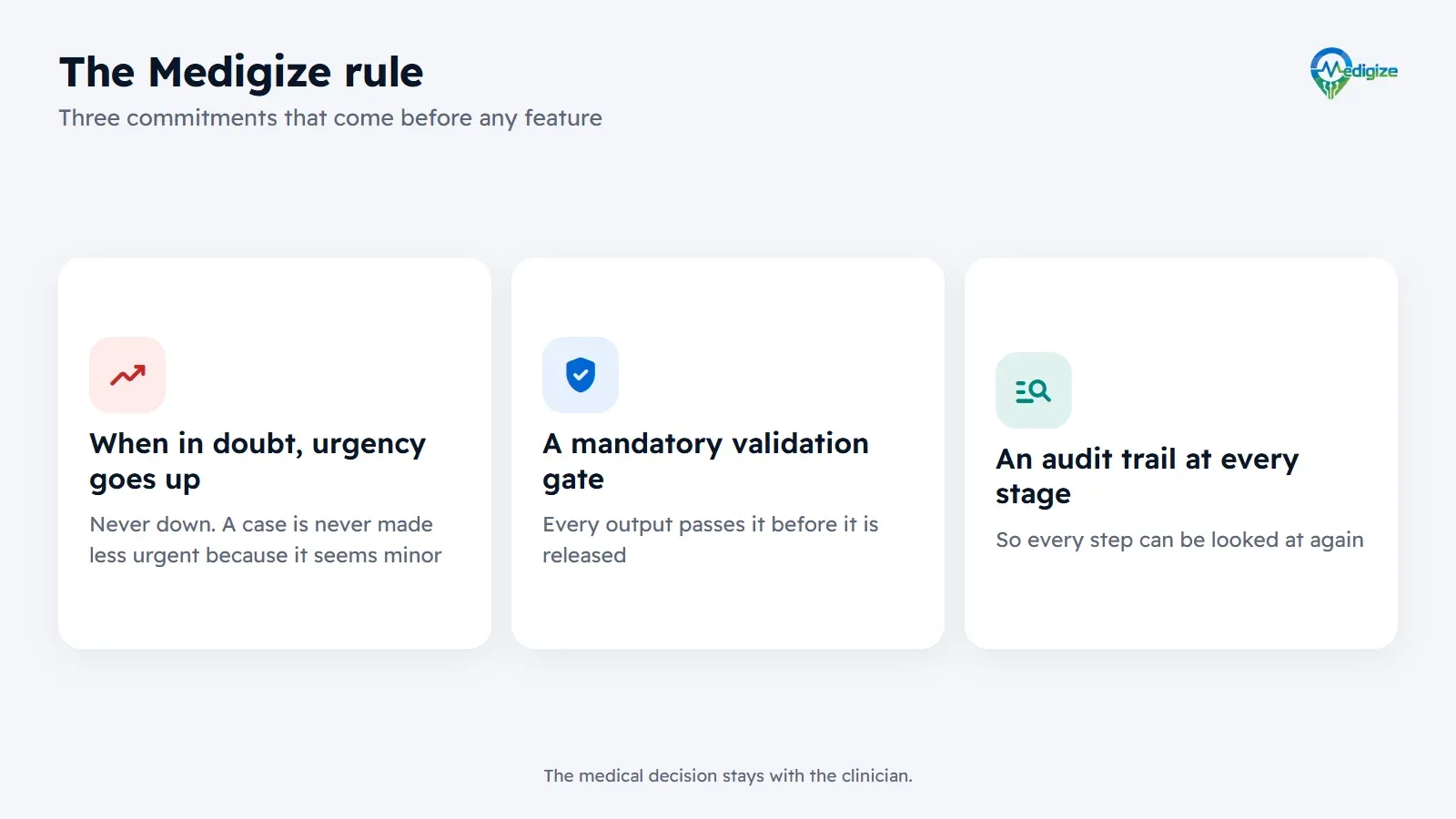
Three commitments that come before any feature.
That rule has a cost, and we accept it. A tool that errs towards caution will sometimes point someone to more care than they turned out to need. The opposite error, telling someone it can wait when it cannot, is the one we will not risk.
The decision itself stays with the clinician. A navigation tool can prepare that decision; it never takes it. It is the same line we draw in what care operations means: the operations around treatment are ours to organise, the treatment is not.
For patients
If you have severe chest pain, trouble breathing, loss of consciousness or signs of a stroke, call the ambulance immediately. Do not wait for an app.
If none of these signs is present and you are still unsure, contact a doctor and describe exactly what you feel and since when. The one-minute description in the first article of this series helps you say it clearly.
Frequently asked questions
Can a symptom checker tell me if I need the emergency room?
It can flag warning signs and suggest a level of care, but it cannot examine you. If you have severe chest pain, trouble breathing, loss of consciousness or signs of a stroke, call an ambulance instead of using any app.
Does Medigize diagnose?
No. Medigize is a non-diagnostic navigation tool. It organises the complaint and points to a level of care; the diagnosis stays with a licensed clinician.
What does “urgency goes up, never down” mean?
When the answers leave room for doubt, the tool points to the more urgent level of care, not the less urgent one. It never lowers a case’s urgency because it is probably minor.
What is a validation gate?
A mandatory check that every output passes before it is released. Together with an audit trail at every stage, it means nothing reaches a patient unchecked, and every step can be looked at again.
What should I do if I am not sure it is an emergency?
If any warning sign is present, call an ambulance. If not, contact a doctor and describe exactly what you feel and since when.
Medigize is a non-diagnostic navigation tool. This is general information, not medical advice. In an emergency, call an ambulance or go to the nearest emergency department.
References
Last updated:
Explore Medigize
Medigize is in development. Explore our current scope and express your interest.