


In every treatment journey abroad, someone does the coordinator’s work without the title: a relative, a travel office or the patient. What the role involves, and how to make it clear and accountable.
In every treatment journey abroad, someone does the coordinator’s work without the title: a relative, a travel office or the patient.
This article is about that role: what it involves, why it is fragile while it lives in one person’s phone, and what would make it clear and accountable.
What does a cross-border care coordinator do? They keep a treatment journey abroad connected: they collect the reports the receiving facility needs, turn its requirements into steps the patient can follow, book what has to be booked, and make sure the doctor at home receives what happened and the plan after return. They do not diagnose or choose treatment, which stays with clinicians, and the patient decides what is shared.
In short:
- In every treatment journey abroad, someone coordinates: a relative, a travel office or the patient. The work is real; the title is missing.
- The job has four parts: collect reports, translate requirements, book, and follow up after return. It takes knowledge of both systems.
- Today the role is mostly informal, depends on one person and leaves no record. Making it accountable must not take the patient’s data or consent out of the patient’s hands.
The role
Collect reports, translate requirements, book and follow up after return. It takes knowledge of both systems.
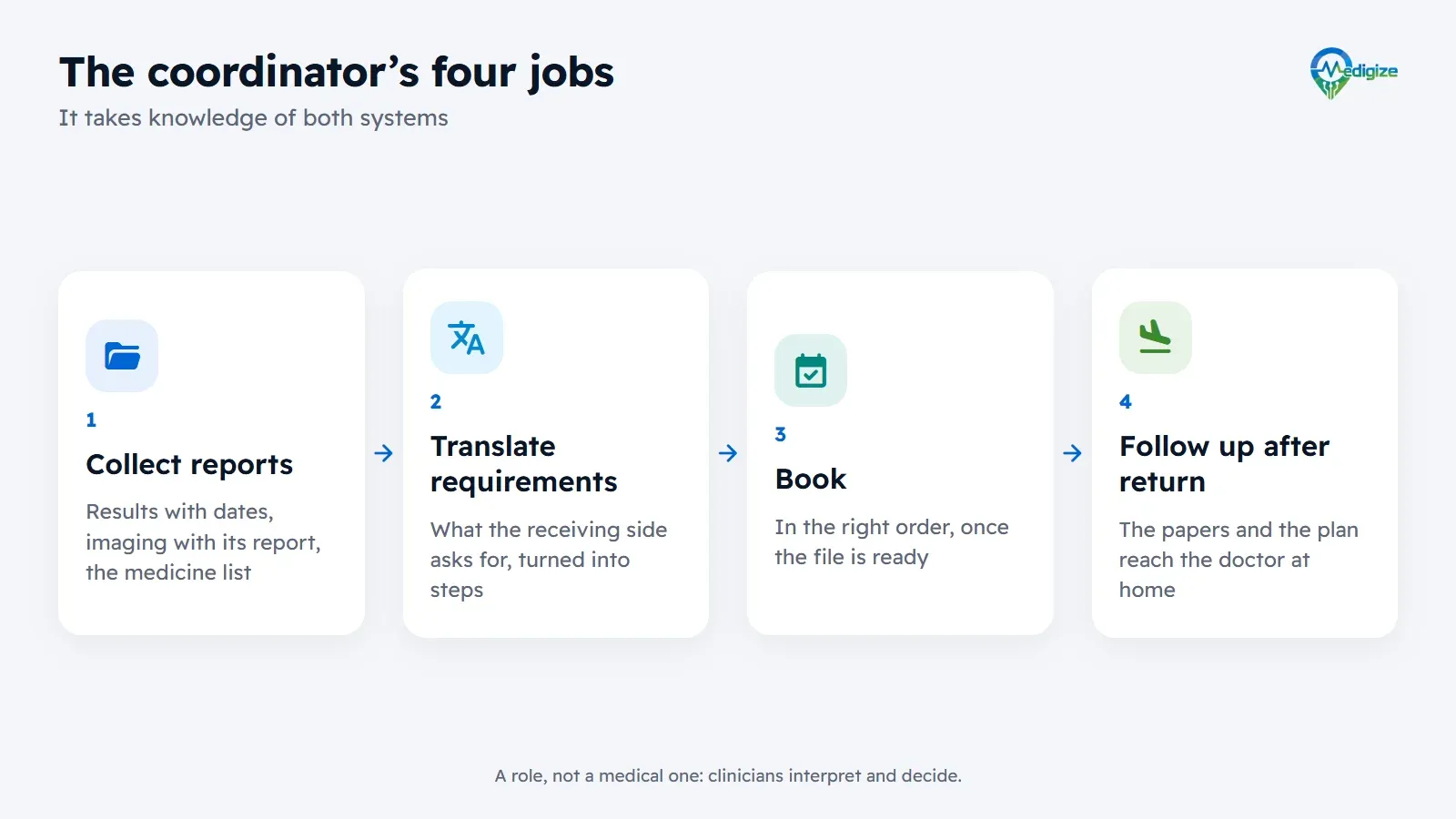
Four jobs, and none of them is a medical decision.
- Collect reports. Recent reports and results with their dates, imaging with its written report, the medicines and any allergies, usually from several places: paper, a lab’s system, a disc. The US Centers for Disease Control and Prevention (CDC), writing for US travellers who go abroad for care, advises bringing copies of medical records, including test results, and a list of every medicine with its brand and generic names and doses.
- Translate requirements. Sometimes this means language. More often it means turning what the receiving side asks for, such as a recent scan or a summary from the treating doctor, into steps the patient can actually take.
- Book. The appointments, in the right order, and the arrangements around them. A booking made before the file is ready can mean a second trip.
- Follow up after return. CDC advises getting copies of all medical records from the facility abroad before returning home, translated if needed, and arranging follow-up care before travelling. Someone has to carry those papers to the doctor at home.
“Knowledge of both systems” is the hidden part: how records, referrals, appointments and follow-up work at home and at the destination, and where the two do not fit.
Who does the coordinator’s work today?
- A relative. Often the one who is good with papers. They bring trust and know the family’s history, but they coordinate on top of a job and a life, like the relative in the real competitor.
- A travel office. It knows the destination and the bookings. What it knows of the patient’s history is whatever the family forwarded.
- The patient. Coordinating their own care while unwell, often in a second language.
Research has started to map the skills the role needs. A 2024 study of medical travel facilitators, people who organise care for patients who travel, calls the role essential but relatively unexamined: a bridge between patients and healthcare providers, with no shared understanding or standard of the skills it needs. Its authors interviewed 30 experienced people at hospitals in Thailand that treat foreign patients. Communication came up in all 30 interviews and healthcare knowledge in 28; language proficiency and medical knowledge were the competencies mentioned most, with document management and translation management among the others.
That is one study, in one country, of professionals rather than families. What it shows is the shape of the work: mostly communication, much of it about documents and language.
The problem
The role is mostly informal, depends on one person and leaves no record.
- Informal means nobody agreed what the coordinator does and does not do, so a relative ends up interpreting a report, or a travel office ends up holding a family’s medical history.
- One person means the journey stalls when they are ill, travelling or busy. The case lives in one phone.
- No record means files are forwarded from chat to chat, and nobody can say what was sent, to whom and when.
These are the points where health care is known to drop things. The World Health Organization counts communication breakdown, among health workers and with patients and their families, and disruptions in care coordination among the factors that can lead to patient harm. Its 2019 report on medication safety says medication discrepancies affect almost every patient who moves across a transition of care, such as admission to or discharge from hospital. A journey abroad adds a border and a second system to every transition.
Language adds its own risk. A systematic review in the Oman Medical Journal found that language barriers lead to miscommunication between clinicians and patients, and lower the quality of care and patient safety. CDC warns that receiving care where you do not speak the language fluently could lead to misunderstandings about your care.
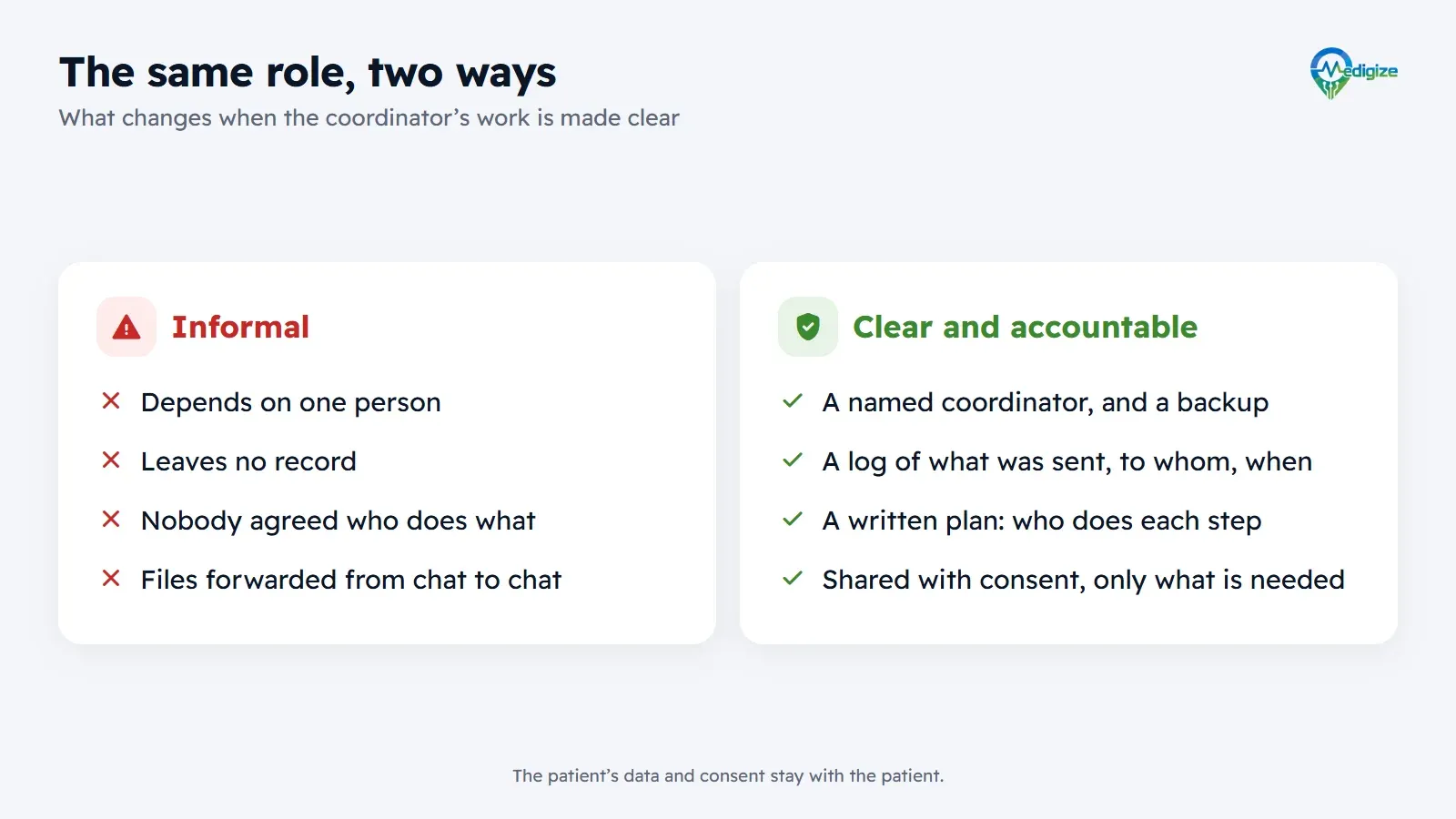
The same work, made visible.
One journey abroad, coordinated two ways: a composite example
A composite example, built from many cases, with no identifying detail. A man in his sixties in Cairo is offered treatment at a hospital abroad. His daughter becomes the coordinator, because she answers the messages.
Informal. She photographs his reports from three places; one result has no date. The hospital asks for a recent scan, and last year’s disc will not open. She forwards everything to the travel office on WhatsApp, and the office forwards it again. When she falls ill the week before the trip, nobody else can answer the hospital’s questions. After he returns, the discharge papers stay in a suitcase, and his doctor at home hears about the treatment from him, in his own words.
Clear and accountable. The family agrees that she coordinates and her brother covers. She keeps one file in date order, with a short summary on top and a note of what was sent, to whom and when. Her father agrees what may be shared. Before he flies home, she asks for the discharge summary, the medicine list and the follow-up plan in writing, and his first appointment at home is booked before the trip.
The hospital, the treatment and the family are the same in both versions. What changed was who owned each step, and what was written down.
The direction
Make the role clearer and accountable, while protecting the patient’s data and consent.
Whoever does the work, that comes down to five things:
- A named coordinator, and a backup. The US Agency for Healthcare Research and Quality (AHRQ) lists establishing accountability and agreeing on responsibility among the activities of care coordination.
- A written plan of who does each step, so that, in AHRQ’s words, the patient’s needs and preferences are known ahead of time and communicated at the right time to the right people.
- One file, in date order, with a log of what was sent, to whom and when.
- Consent for each share, and only what is needed. A treatment abroad rarely needs the whole record.
- A written handover home. The discharge summary, the medicines and the follow-up plan reach the doctor at home before the first visit after return, as in follow-up is where care is won or lost.
What the coordinator is not
A clear role has edges. A coordinator is not the doctor: interpreting a report, choosing a treatment or judging urgency belongs to clinicians. A coordinator does not own the patient’s data, and does not promise outcomes. And if there are signs of an emergency at any point, such as severe chest pain, trouble breathing, fainting or signs of a stroke, the next step is an ambulance or the nearest emergency department, wherever the patient is.
How to coordinate a treatment journey abroad: seven steps
- Agree who coordinates, and who covers. Write both names down, with how to reach them.
- Ask the receiving facility, in writing, what it needs: which reports and results, how recent, which imaging and in what form, and in which language.
- Build one file in date order, with a short summary on top. Keeping a personal health folder shows how, and how to get a copy of your medical records covers the asking.
- Agree how communication will work. CDC advises deciding ahead of time how the patient will communicate with the clinicians caring for them, if they do not speak the language.
- Keep a log of every share: what went, to whom, on what date, with the patient’s agreement.
- Before leaving, ask for the papers: the discharge summary, the medicines and what changed, and the follow-up plan, translated if needed into a language the doctor at home reads.
- Arrange follow-up at home before the trip, as CDC suggests, so that care at home is possible if complications appear after return.
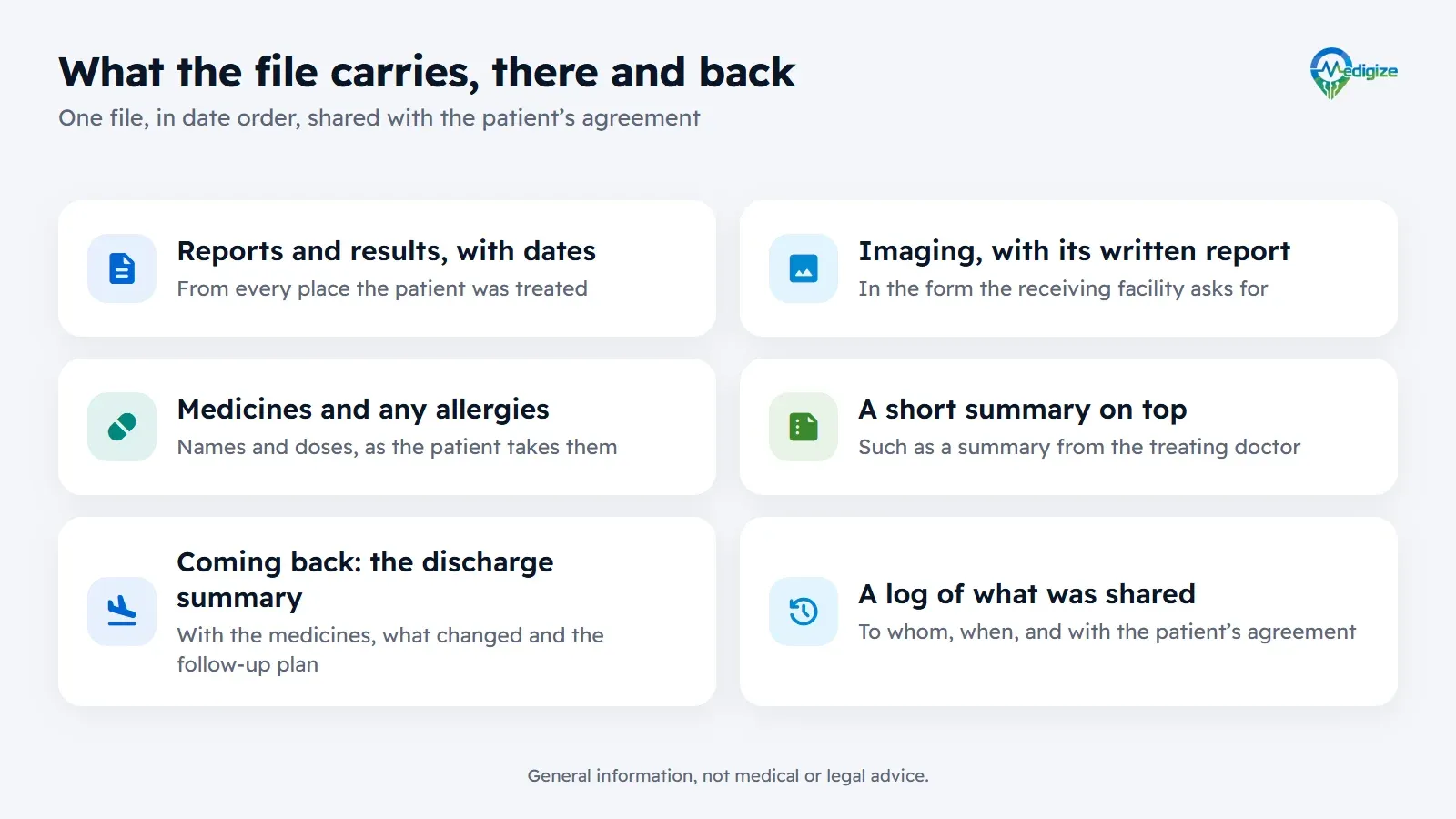
One file, there and back.
Not sure how a journey is organised right now? Five questions, for one journey, yours or a relative’s:
Try it
Is your journey abroad coordinated?
Five questions about one treatment journey abroad, yours or a relative’s. Answer for how it is organised today.
1. Is one person clearly coordinating, with a named backup?
2. Is there one file in date order, with what the receiving facility asked for?
3. Has the patient agreed what may be shared, and with whom?
4. Is there a record of what was sent, to whom and when?
5. Is follow-up at home arranged, and do you know which papers to bring back?
Answered 0 of 5. Your list appears when all of them are in.
A checklist for organising, not medical or legal advice. Your answers stay on this page.
Data and consent when health information crosses borders
A journey abroad moves health data across at least one border. This part is a general explainer, not legal advice.
In Egypt, according to published legal commentary on the executive regulations of the Personal Data Protection Law, issued on 1 November 2025, processing health data needs explicit written consent, and an organisation needs a separate licence or permit from the Personal Data Protection Center before transferring personal data outside Egypt, including to cloud environments. The same commentary expects enforcement from 1 November 2026, a timeline the regulator may clarify. For a travel office or a clinic’s international desk, these are questions for a lawyer, and the data-protection law and your clinic lists where to start.
At the other end, rules differ by place. In Dubai, the health authority’s NABIDH patient-rights policy says patients should be able to see their information in a readable form, including an electronic one, and to upload clinical and laboratory documents from treatment received outside Dubai and the UAE, and it makes the patient responsible for uploading the correct ones. It also lets an authorised agent make certain requests, such as opting out of the exchange, when the patient is unable to: a role that acts for the patient, named in the policy itself.
Where Medigize stands
This article describes a role, not a service we sell. For us, cross-border care is one use case of an organised journey, not a speciality. The principles we build on apply to it as to every journey: a record moves only with the patient’s consent, only what is needed is shared, and every view leaves a trail. See our governance and privacy page.
Frequently asked questions
What is a cross-border care coordinator?
The person who keeps a treatment journey abroad connected: collecting reports, translating requirements, booking, and following up after return. Today it is usually a relative, a travel office or the patient.
What documents should I take for treatment abroad?
Copies of reports and results with their dates, imaging with its written report, a list of your medicines with names and doses, any allergies, and whatever the receiving facility asked for in writing.
What should I bring back after treatment abroad?
Copies of your records from the facility, including the discharge summary, your medicines and the follow-up plan, translated if needed. CDC advises getting them before you return home.
Who should coordinate treatment abroad for a family member?
One named person, agreed with the patient, with a backup. The patient decides what is shared and with whom.
Can a care coordinator give medical advice?
No. Interpreting reports, choosing treatment and judging urgency belong to clinicians.
Can a travel office send my medical reports abroad?
Ask how, and on what basis. For organisations in Egypt, published commentary describes explicit written consent for health data and a separate licence or permit for transfers outside Egypt. A lawyer can say what applies.
What if there is an emergency during the trip?
For severe chest pain, trouble breathing, fainting or signs of a stroke, call the local ambulance or go to the nearest emergency department. Do not wait for the coordinator or an app.
Medigize is a non-diagnostic navigation tool. This is general information, not medical advice. In an emergency, call an ambulance or go to the nearest emergency department.
References
- Agency for Healthcare Research and Quality: Care coordination
- Heliyon (2024): Understanding the multidimensional role of medical travel facilitators, a study on competencies and a proposed model
- Centers for Disease Control and Prevention: Medical tourism, travel to another country for medical care
- World Health Organization: Patient safety (fact sheet)
- World Health Organization: Medication safety in transitions of care (2019)
- Al Shamsi H, et al. Implications of language barriers for healthcare: a systematic review. Oman Medical Journal (2020)
- Dubai Health Authority: NABIDH Policies and Standards, Subject of Care Rights (2020)
- Chambers and Partners: A first look at Egypt’s personal data protection executive regulations
- CMS: Egypt’s PDPL executive regulations issued, one-year compliance countdown begins
Last updated:
Explore Medigize
Medigize is in development. Explore our current scope and express your interest.