
Many of us carry a bag of scans, results and reports from different places, and tell the story again to every new doctor. What a record that moves with you means, and how to ask for yours.
Many of us carry a “bag” of scans, lab results and reports from different places. When we change doctors, we tell the story from the beginning again.
A record that moves with the patient means essential health information is organised in one place and passes to a new clinician only when the patient agrees.
In short:
- A record that moves with you is structured context, not a folder of PDFs: what happened, when, who reviewed it, and what comes next.
- You can ask any facility where you were treated for a copy of your file. Say what you need, check what arrives, keep it in date order, and bring it to new doctors.
- The patient decides who sees it. That is the line Medigize builds on: sharing by consent, only what is needed, and a trail of who looked.
How do you get a copy of your medical records?
Ask each facility that treated you how it handles requests, then say which records you need, from which dates, and in what form. You may be asked for identification. Ask too about any fee, and how long it will take. When the copy arrives, check it, keep it in date order, and bring it to your next doctor.
“Your records” is several things, and each place holds its own part. The lab holds your results, the imaging centre your scans, the hospital its discharge papers. Things worth asking for:
- Lab results, with the date and the lab’s name.
- Imaging reports, and the images themselves, on a disc or as a digital copy.
- Discharge summaries from any hospital stay.
- Consultation notes and reports.
- Prescriptions and your medication list.
- Your vaccination record.
You rarely need everything. The US Office of the National Coordinator for Health IT (ONC) notes that a record can run to hundreds of pages, and that a full record suits a change of main doctor or your own files. Match the request to the reason:
- Changing your main doctor: the full record.
- Seeing a specialist about one complaint: the results and reports related to it, and your medication list.
- Leaving hospital: the discharge summary, before you go home.
- After imaging: the written report and the images.
Not a PDF vault
A real record is not just uploaded images. It is structured context: what happened, when, who reviewed it, and what is needed next. Most importantly, the patient decides who sees it.
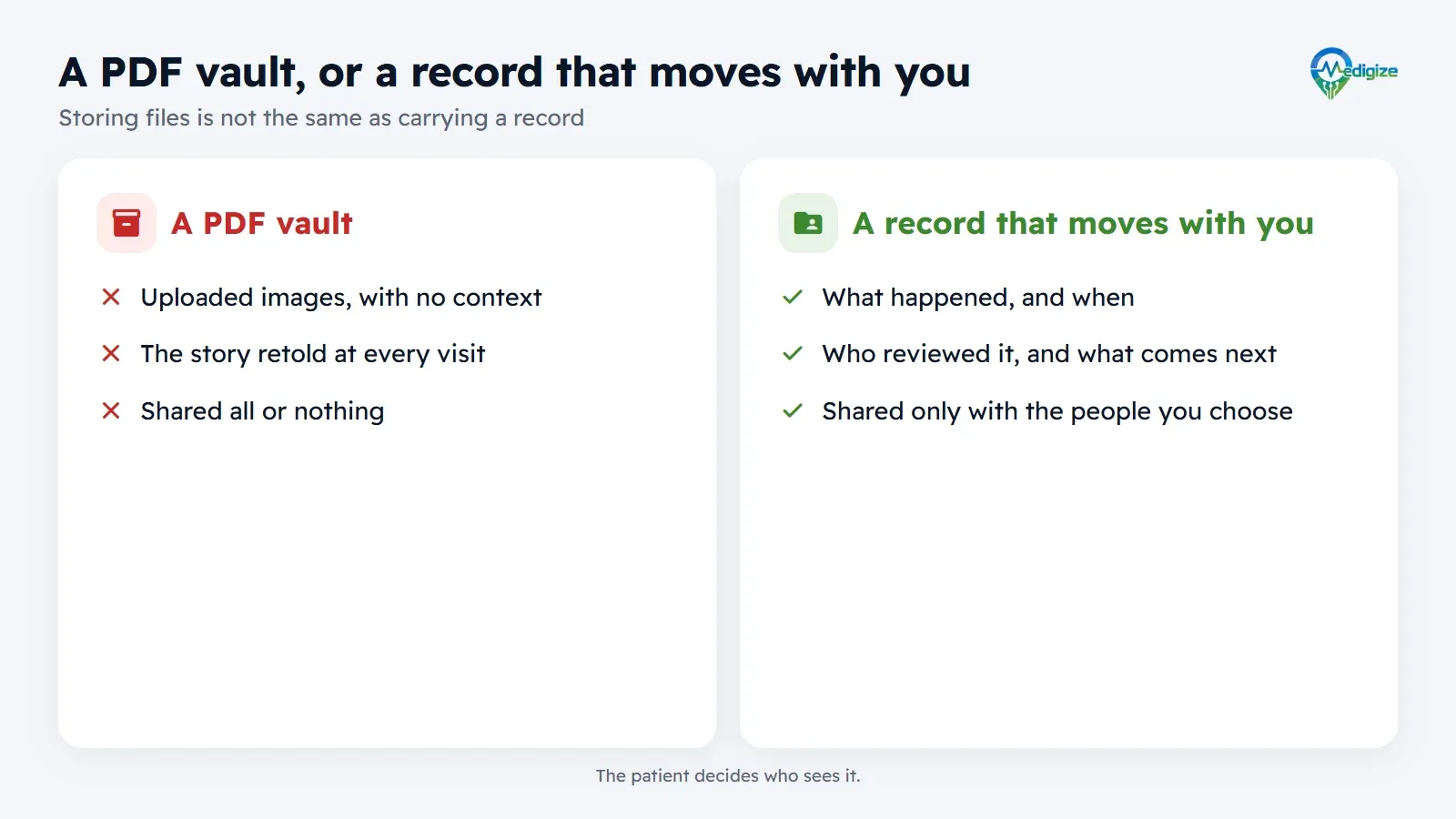
Storing files is not the same as carrying a record.
A folder of photos on a phone is a good start, and far better than nothing. But a new doctor still has to read every page to find what matters, and still cannot tell which result is the latest or what was already done about it. The difference between a pile of files and a record is the order and the context. What a journey costs when that order is missing is in Where do I go? The hidden cost of a fragmented patient journey.
How to ask for your own records: five steps
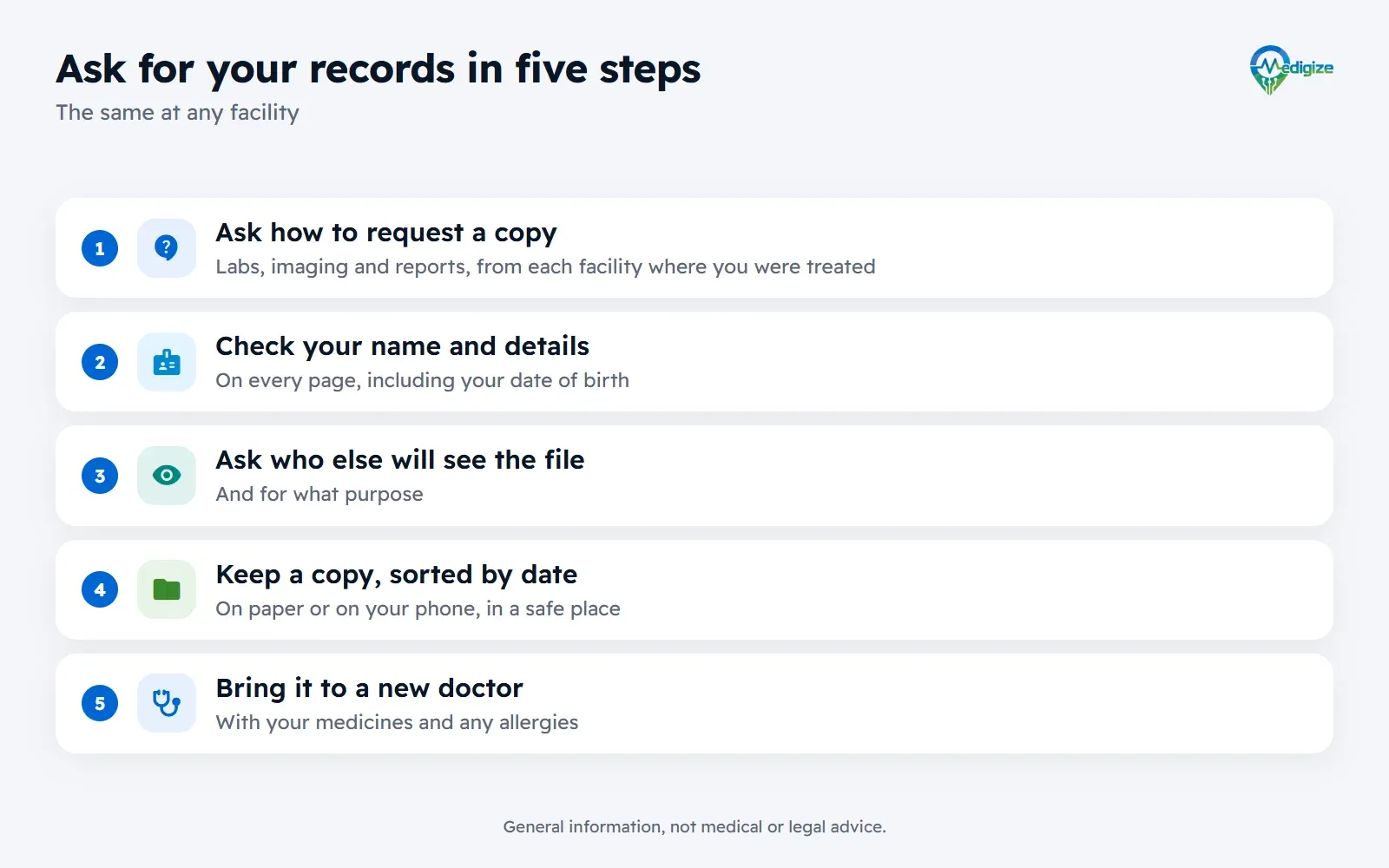
Five steps, the same at any facility.
- Ask the facility where you were treated how to request a copy of your file: labs, imaging, reports. Some have a form or a front desk for it; some may charge a fee. If the facility has a patient portal, look there first. Otherwise ask for the medical records desk, or whoever releases records, and ask how long it takes.
- Check that your name and details are correct on every document. A record with the wrong date of birth is a record someone else might be handed.
- Ask who else will see the file, and for what purpose. If the copy is going straight to another doctor, ask how it will be sent.
- Keep an organised copy, sorted by date, in a safe place, on paper or on your phone. Older X-rays and scans may not exist in digital form, so keep the disc or film with its report. If you need several paper copies, ONC notes it is often cheaper to request one and copy it yourself.
- With a new doctor, share your medications and any allergies, and hand over the file. Ask the clinic which format it prefers.
A short written request saves a second trip. Put in your full name and date of birth, the records you need, the dates they cover, whether you want paper or an electronic copy, and how to reach you. Then ask whether there is a form to fill in, an identity document to bring, or a fee.
Not sure how to phrase the request? Write it here, then copy it, print it or send it:
Try it
Ask for your records
Fill in what applies. You get a short request to copy, print or send to the facility.
How you want them
Your request
Your request appears here as you fill it in.
Nothing you type is saved, not even in this browser, and nothing is sent unless you send it yourself.
When you get it: get it, check it, use it
ONC’s guide sums up the habit in three steps: get your records, check them, and use them. Checking matters as much as getting. Look for:
- Your name, date of birth and contact details, on every page.
- Medicines and allergies that are missing, or listed when you no longer take them.
- Dates that look wrong, and results without a date.
- Something you said that was misunderstood or left out, such as part of your history.
- Charges for a test you never had.
A composite example, built from many cases: a man collects his file before seeing a new specialist. The lab results are there, but one has no date, and his medication list still shows a medicine he stopped last year. He asks the lab to reprint the result with its date, asks the clinic to update the list, and takes both corrected pages to the appointment, with the old ones behind them.
The guide’s advice is practical: let a typo go, but fix a mistake that could affect your care or your bill. If something is wrong, ask the facility how to correct it. ONC suggests attaching a copy of the page with the mistake and keeping a copy of everything you send, and notes that messages through a patient portal are secure while personal email is not. And keep the corrected version, not only the old one. We covered keeping results in order in questions to ask your doctor about your lab results.
Do you have a right to your records? Dubai, Saudi Arabia and Egypt
In Dubai, the health authority runs NABIDH, an exchange that links healthcare facilities. Its published patient-rights policy says a patient’s information is shared with participating facilities unless the patient opts out, either of the exchange as a whole or of specific facilities, and that they can opt back in at any time. It says patients should be able to see their own record in a readable, electronic form, and to upload documents from care received outside Dubai and the UAE. Patients can ask for a report of electronic disclosures, showing the date and who shared and received their information, and should be told of any “break-glass” access, an override of the usual permissions typically used in emergencies.
The idea that matters to us: information travels with the patient instead of the patient travelling with paper. This is a regional example to learn from, not a comparison. Every country has its own rules and systems.
The right to see your own data also appears in data protection law. In Saudi Arabia, the Personal Data Protection Law, in the English translation published by the Saudi Data and AI Authority (SDAIA), counts health data as sensitive data. Among a person’s rights it lists access to their personal data held by a controller, a copy in a readable and clear format, and correction, completion or updating, under rules set in its Implementing Regulations.
In Egypt, according to published legal commentary on the executive regulations of the Personal Data Protection Law, issued in November 2025, controllers must put in place a mechanism, approved by the Personal Data Protection Center, that lets people access and correct their data and object to its processing.
This is general information, not legal advice. For your own case, ask the facility first, and a lawyer if you need one.
What does this mean for clinics?
For a clinic, a records request is a small test of how organised the practice is, and a chance to make the next doctor’s job easier. A few habits help:
- Name one desk, or one person, for records requests, and tell patients how long a request takes.
- Hand over every result with its date and the facility’s name on it, so it still makes sense in someone else’s folder.
- Give imaging together with its written report.
- Ask patients which format they want, and send copies through a secure channel.
The same order is what makes consent-based sharing workable later: a record can only move well if it is in order to begin with.
Where Medigize stands
MIHOS, the Medigize app, is building a longitudinal health record shared with the patient’s consent, with data minimization, removal of unnecessary identifiers, and an audit trail. The patient chooses the next clinician.
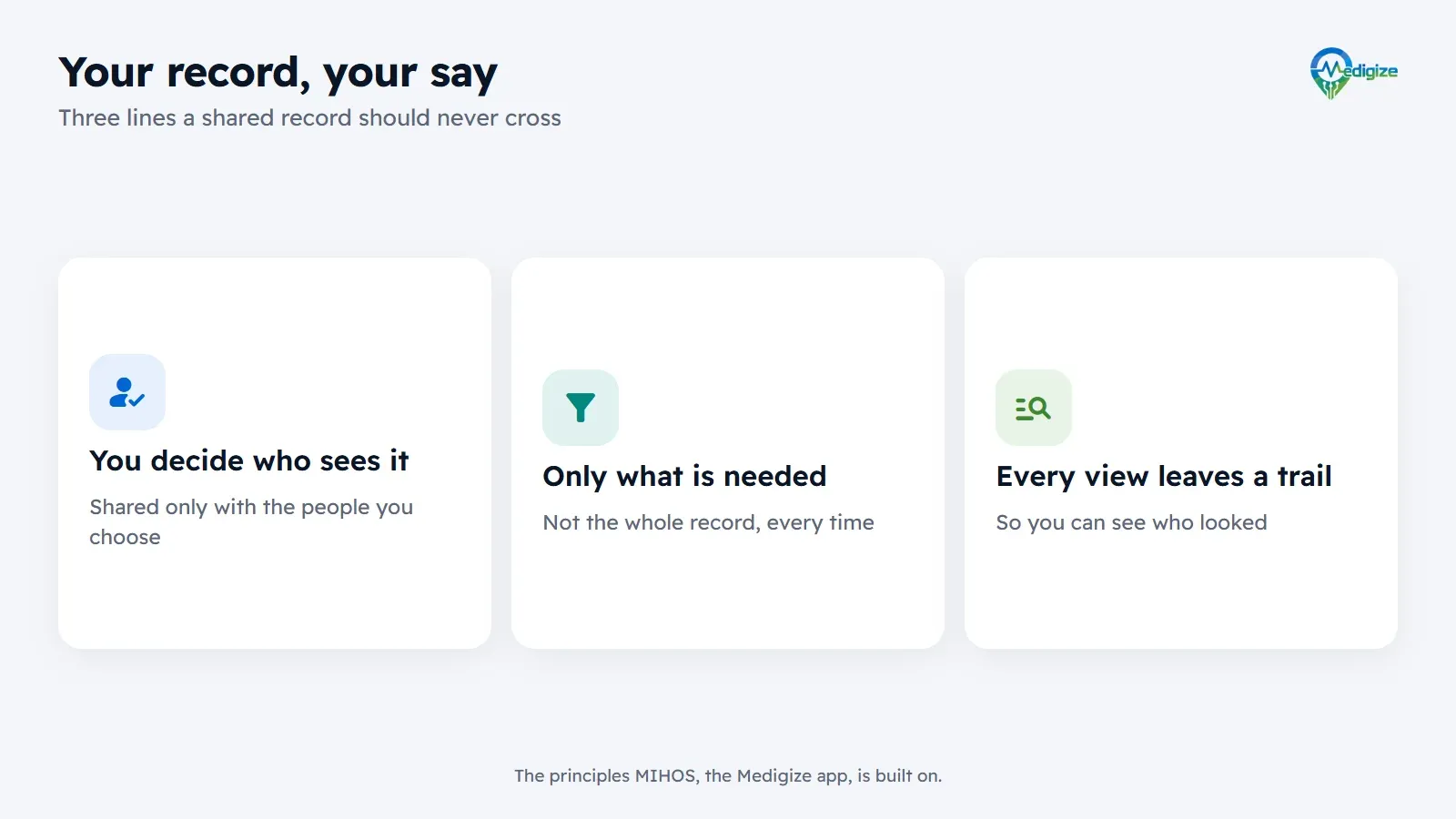
The three lines a shared record should never cross.
Before you trust any app with your records, ours included, ONC’s checklist is a fair test. The app should:
- Have a privacy policy you can read.
- Say how it protects your information, and where it is stored.
- Let you control your information and share it securely with a provider or caregiver.
- Say plainly that it will not use, sell or share your health information without your permission.
For how we approach consent and data, see governance and privacy. For why forms keep asking for what your record should already hold, see why every form asks the same questions.
Frequently asked questions
How do I get a copy of my medical records?
Ask the facility where you were treated how to request one: many have a form or a desk that handles it. Say which records you need, from which dates, and how you want to receive them.
Do I have a right to my medical records?
Data protection laws in many countries give people a right to access personal data held about them, and health data is usually covered. The process and any fee differ by country and facility, so ask the facility for its own.
What should I check in my medical records?
Your name and details on every page, your medicines and allergies, and the dates. If something is wrong, ask how to correct it, and keep the corrected copy.
How long does it take to get my medical records?
It depends on the facility and the country. Ask when you make the request, and note the date you asked, so you can follow up if it takes longer than you were told.
Can I get my X-rays and scans, not just the reports?
Usually you can ask for both: the written report and the images, on a disc or as a digital copy. Older images may exist only on film or disc, so keep the original safe.
Can I ask for a family member’s records?
Expect to be asked for proof that you may act for them, and ask the facility what it needs. Dubai’s NABIDH policy, for example, lets an authorised agent make certain requests when the patient cannot.
What is a longitudinal health record?
A record that follows one person over time, across different doctors and facilities, so each new clinician can see what came before.
Who can see my record in Medigize?
Only the people you choose. MIHOS shares a record with a clinician only with your consent, shares only what is needed, and keeps a trail of who looked.
Medigize is a non-diagnostic navigation tool. This article is general information, not medical or legal advice. In an emergency, call an ambulance or go to the nearest emergency department.
References
- Office of the National Coordinator for Health IT: The guide to getting and using your health records
- Office of the National Coordinator for Health IT: Benefits of health IT
- Dubai Health Authority: NABIDH Policies and Standards, Subject of Care Rights (2020)
- Office of the National Coordinator for Health IT: Get it
- Office of the National Coordinator for Health IT: Check it
- Office of the National Coordinator for Health IT: Use it
- Saudi Data and AI Authority (SDAIA): Personal Data Protection Law, English translation
- Chambers and Partners: A first look at Egypt’s personal data protection executive regulations
Last updated:
Explore Medigize
Medigize is in development. Explore our current scope and express your interest.