

You do not need to wait for a national system. You can start with a folder: what goes in it, how to keep it current, and what to ask before you hand it over.
You do not need to wait for a national system. You can start with a folder.
Your health information is spread across the places that treated you: the lab keeps your results, the hospital its discharge papers, each clinic its own notes. MedlinePlus, the health site of the US National Library of Medicine, notes that you may have charts at several doctors’ offices and at a hospital, and suggests keeping your own personal health record to keep track of them.
How do you keep a personal health record? Put four things in one folder, on paper or on your phone: your current medicines with their start dates, any allergy, your tests, imaging and reports in date order, and your doctors’ names, specialties and last visit. Add to it after every visit, name every file by its date, review it every three months, and keep a second copy somewhere safe.
In short:
- A personal health folder is your own copy of the essentials: medicines with start dates, allergies, results and reports in date order, and the doctors you see.
- One habit keeps it useful: photograph after each visit, name files by date, review every three months, and keep a copy somewhere safe.
- The file is yours. When someone asks for it, ask why it is needed, who will see it and how it will be stored.
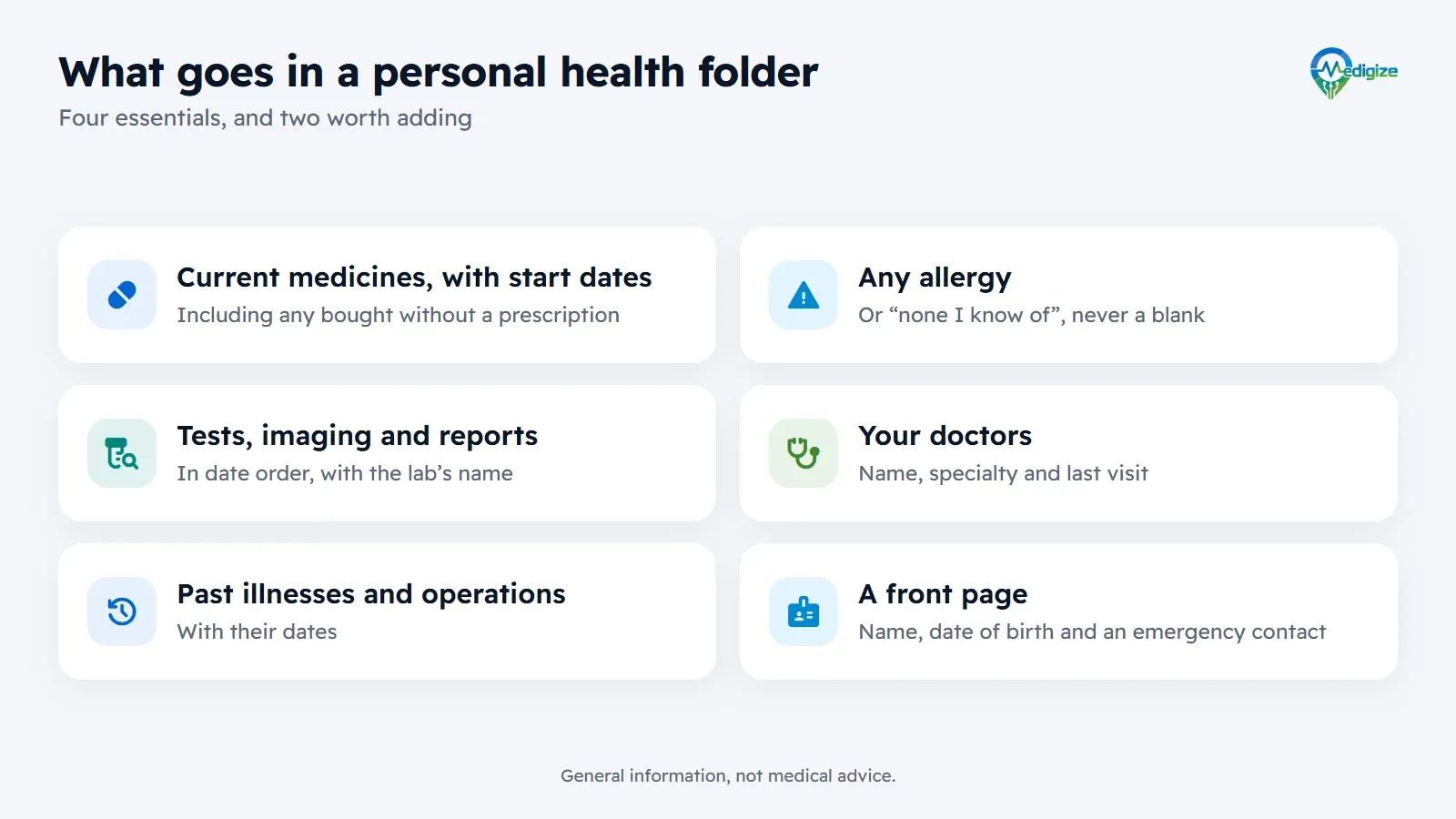
Four essentials, and two worth adding.
What is a personal health folder?
It is your own copy of the information about your health that otherwise sits in many places. It does not replace the records your doctors keep. It is the part of your story you can carry: what you take, what you react to, what was tested and when, and who is looking after you.
Three terms, in plain language:
- Medical record: the file a clinic, lab or hospital keeps about you. Each place holds its own part, so no single place has the whole picture.
- Personal health record: the record you keep yourself. In this article, the folder.
- Front page: a one-page summary at the top of the folder, the page a new doctor or a relative reads first.
The US Office of the National Coordinator for Health IT (ONC) says your health record can help you understand, advocate for and manage your own care. Getting it is covered in how to get a copy of your medical records; this article is about keeping it.
What goes in a personal health folder?
Start with four things:
- Current medications with start dates. The US National Institute on Aging (NIA) suggests writing down every medicine you take, including those bought without a prescription, and any vitamins or supplements: the name, the amount and the times you take it, and for a prescription, who prescribed it and why. Add the date you started each one. A start date is easy to forget and hard to rebuild later.
- Any allergy. To a medicine, a food or anything else, with what happened, in your own words. NIA advises keeping your doctor and pharmacist up to date on your allergies. If you know of none, write “none I know of” rather than leaving a blank.
- Tests, imaging and reports in date order. Lab results with the lab’s name, imaging reports kept with the images, discharge summaries and consultation reports. Why dates matter is in questions to ask your doctor about your lab results.
- Doctors’ names, specialties and last visit. One line per doctor: name, specialty, where they work, how to reach the clinic, and when you last saw them.
Then add what you can. MedlinePlus’s starting list also includes your name, birth date and emergency contact, major illnesses and surgeries with their dates, long-term conditions, and illnesses in your family. ONC counts staying on top of immunisations among the uses of your record, so the vaccination card belongs here too.
Put the essentials on a front page: your name, date of birth, emergency contact, medicines and allergies. The summary tool in why every form asks the same questions builds the medical part of that page; add your name, date of birth and emergency contact at the top.
One limit: a folder is for planning, not for emergencies. With severe chest pain, trouble breathing, fainting or signs of a stroke, call an ambulance or go to the nearest emergency department. Do not stop to look for papers or open an app.
How to set up your folder in one evening: six steps
- Choose one place. A ring binder with plastic sleeves, or one folder on your phone. What matters is that there is only one. ONC notes that an electronic copy is easier to share and manage.
- Gather what you already have. The drawer, the plastic bag that comes to every visit, the photos on your phone, the files in your messages. If a lab sent a PDF, save the file itself.
- Sort it into four sections. Medicines, allergies, results and reports, doctors.
- Name every file with the date first. Year, month and day, then what it is: “2026-10-30 blood test”. Files named this way sort themselves into date order.
- Write the front page. Copy medicine names and doses from the box or the prescription, not from memory.
- Make a second copy. Keep it somewhere safe, separate from the first. NIA suggests keeping one copy of your medicine list in a safe place at home and one in your wallet or purse.
Looking after a parent or a child? Give each person a folder.
How to keep it current
Photograph after each visit, name files by date and review every three months. Keep a copy somewhere safe.
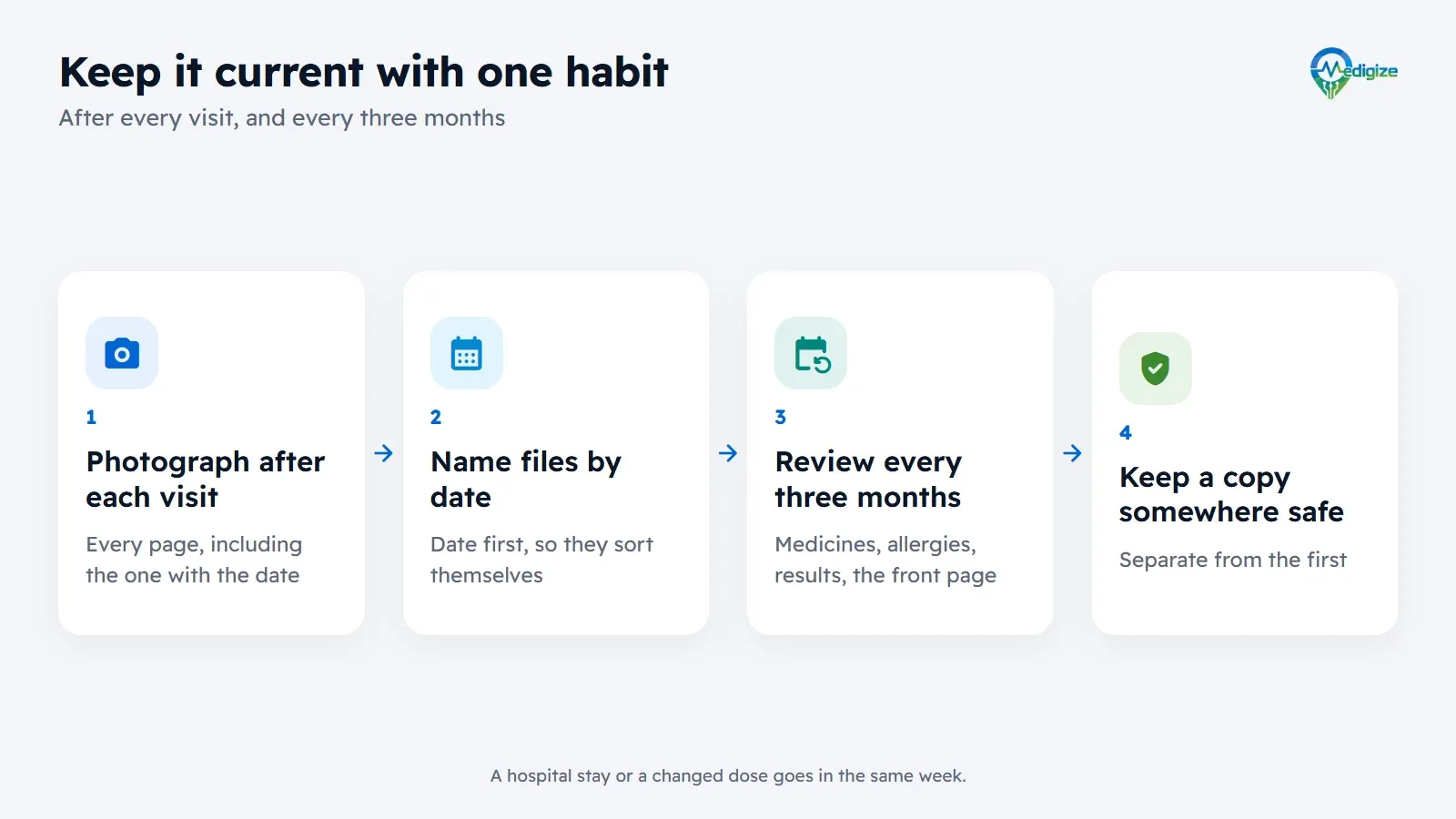
One habit, four steps.
After each visit, five minutes is enough: photograph every page you were given, including the one with the date; add any new medicine with its start date, and move one your doctor stopped to a short “stopped” list, with the date; update that doctor’s line; and write down the next step and the follow-up date, as described in why follow-up matters.
Every three months, a ten-minute review:
- Is every medicine on the list still current, and is everything you take on it? NIA suggests telling your health care providers about any new medicines at every visit, and asking whether you still need all of them.
- Is the allergy line still right, and are the latest results in?
- Does the front page match the folder, and is the second copy as current as the first?
A hospital stay, a new diagnosis or a changed dose should not wait for the review: it goes in the same week.
Check your own folder now. Answer five questions and you get a short list of what to add. Your answers stay on this page:
Try it
Is your health folder ready?
Five questions about your folder as it is today. You get a short list of what to add.
1. Is every medicine you take on one list, with the date you started it?
2. Is any allergy written down, or “none I know of”?
3. Are your tests, imaging and reports in one place, in date order?
4. Do you have each doctor’s name, specialty and your last visit written down?
5. Is there a second copy somewhere safe, checked in the last three months?
Answered 0 of 5. Your list appears when all of them are in.
A checklist for organising your papers, not medical advice. Your answers stay on this page.
Paper or phone: which is safer?
Both can be safe, and both can leak. ONC’s advice holds for either: however you store your health record, make sure no one else can see your health information without your permission.
- Paper: one binder, kept away from shared space. Keep imaging discs in a sleeve beside their reports.
- Phone: lock it, and keep the folder in one place, not scattered across chats. A family group chat is a good place to ask for help and a poor place to keep a report.
- An app: ONC’s checklist asks for a privacy policy you can read, a clear statement of how your information is protected and where it is stored, and a promise not to use, sell or share your health information without your permission.
- The second copy: if one is lost, the other saves the folder.
A composite example: one evening, three folders
A composite example, built from many cases, with no identifying detail. A woman in her forties looks after her father, in his seventies, and her ten-year-old son. Her father’s papers live in a plastic bag, hers in her phone’s photos, and her son’s vaccination card somewhere in a drawer.
One evening she sets up three folders. Copying her father’s medicines onto one list, she finds two boxes from two pharmacies with different brand names, and writes a question for his doctor: “Are these the same medicine?” Sorting his reports by date, she sees the latest is missing its first page, and asks the lab for it.
At his next appointment, the doctor asks when he started one of his medicines. The answer is on the list. Three months later, her review finds what she had missed: her son’s vaccination card was never photographed. Now it is, named with the date, in his folder.
Nothing in the folder made a medical decision. It made each decision easier for the person whose job it was.
Common mistakes, and how to avoid them
- Keeping only the latest result. Keep the older ones; the comparison is often the point.
- Photos with no date. Photograph the page with the date, and name the file date first.
- Files that live only in chats. Messages get deleted and phones get changed. Save each file into the folder.
- One folder for the whole family. One person, one folder.
- No second copy. A lost phone or bag should not mean a lost history.
We wrote about the plastic bag of papers in the real competitor is WhatsApp and paper.
This file is yours: what to ask before you hand it over
This file is yours. When someone asks for it, ask why and how it will be stored.
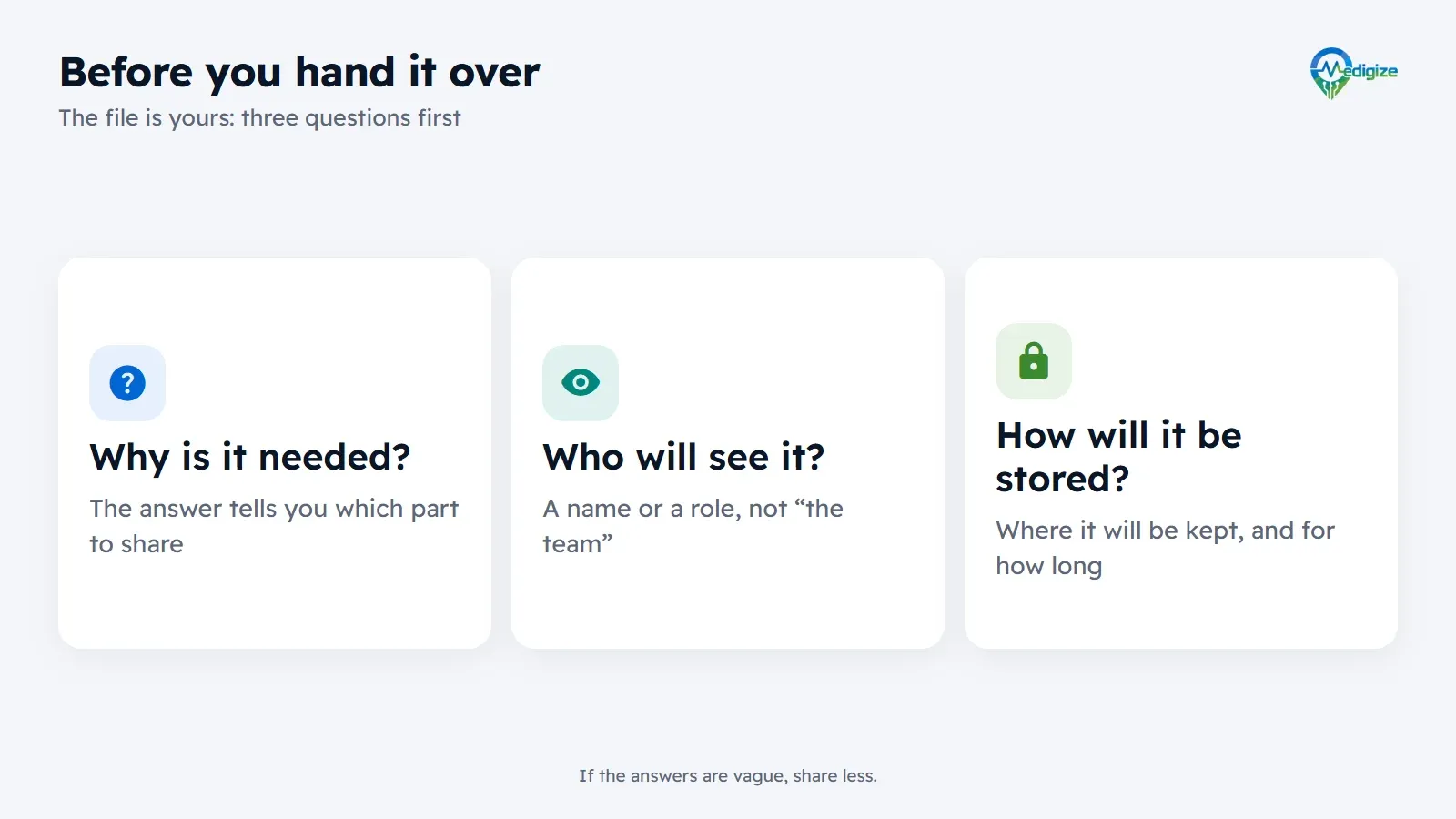
Three questions before the folder leaves your hands.
Showing your folder to the doctor treating you is the point of keeping it. The questions matter most when a request comes from elsewhere:
- Why is it needed? The answer tells you which part to share.
- Who will see it? A name or a role, not “the team”.
- How will it be stored? Where it will be kept, and for how long.
If the answers are vague, share less: the front page, or only the report that matters. In Egypt, published legal commentary on the executive regulations of the Personal Data Protection Law describes health data as sensitive data, with explicit written consent required to process it, and a mechanism, approved by the Personal Data Protection Center, that lets people access and correct their data and object to its processing. More is in the data-protection law and your clinic. This is general information, not legal advice.
What clinics can do to help
A clinic decides, without meaning to, how easy a patient’s folder is to keep:
- Hand over every result with its date and the facility’s name on it.
- Give imaging together with its written report.
- Write the start date on a new prescription, and say clearly when a medicine stops.
- Ask patients to bring their folder, and read the front page first.
- When you ask for a copy of a patient’s folder, say why, who will see it and how it will be stored.
More on preparing a visit is in one page for a specialist visit.
Where Medigize stands
A folder is a habit that works today, anywhere, with no system behind it. MIHOS, the Medigize app, is building a record that moves with the patient, shared only with their consent, with only what is needed and a trail of who looked. Medical decisions stay with the clinician. See Medigize for patients, and our governance and privacy page.
Frequently asked questions
What is a personal health record?
Your own copy of the essentials about your health: medicines, allergies, results and reports, and your doctors, in one place on paper or on your phone.
What should I keep in my personal health folder?
Current medicines with start dates, any allergy, tests, imaging and reports in date order, and your doctors’ names, specialties and last visit.
How do I organise my medical records at home?
One folder per person, four sections, and every file named with the date first, so it sorts itself.
How often should I update my health folder?
After every visit, with a ten-minute review every three months. A hospital stay or a changed medicine goes in the same week.
Is it safe to keep my medical records on my phone?
It can be, if the phone is locked and the files sit in one folder rather than in chats. Keep a second copy.
Should I keep a health folder for my children or parents?
Yes, one for each person, so a report never ends up in the wrong file.
Do I have to give my health folder to anyone who asks?
It is yours. Ask why it is needed, who will see it and how it will be stored, and share only what the purpose needs.
Does a health folder replace the records my doctors keep?
No. Each facility keeps its own record. Your folder is your copy of the essentials.
Medigize is a non-diagnostic navigation tool. This is general information, not medical advice. In an emergency, call an ambulance or go to the nearest emergency department.
References
- MedlinePlus: Personal health records
- National Institute on Aging: Taking medicines safely as you age
- Office of the National Coordinator for Health IT: The guide to getting and using your health records
- Office of the National Coordinator for Health IT: Use it
- Chambers and Partners: A first look at Egypt’s personal data protection executive regulations
Last updated:
Explore Medigize
Medigize is in development. Explore our current scope and express your interest.