

The visit ends when you leave the door. Care does not. Many problems happen in the gap between one visit and the next, and what gets documented decides it.
The visit ends when you leave the door. Care does not.
Follow-up decides whether the patient understood the plan, took the medicine correctly and returned on time. Many problems occur in the gap between one visit and the next.
Why does follow-up matter? Because a plan is carried out between visits, not during them. Follow-up is how a patient and a clinic check that the plan was understood, that medicines are taken as intended and that the next step happens. Without it, a problem that starts after the visit stays invisible until the next one.
In short:
- The gap between visits is where a plan is understood or misunderstood, a medicine taken or not, a return kept or missed.
- Four things make follow-up real: what was said, the next step, the follow-up date, and who is responsible for what. Written down, before you leave.
- Without documentation, follow-up relies on memory: the patient’s, the doctor’s, or nobody’s.
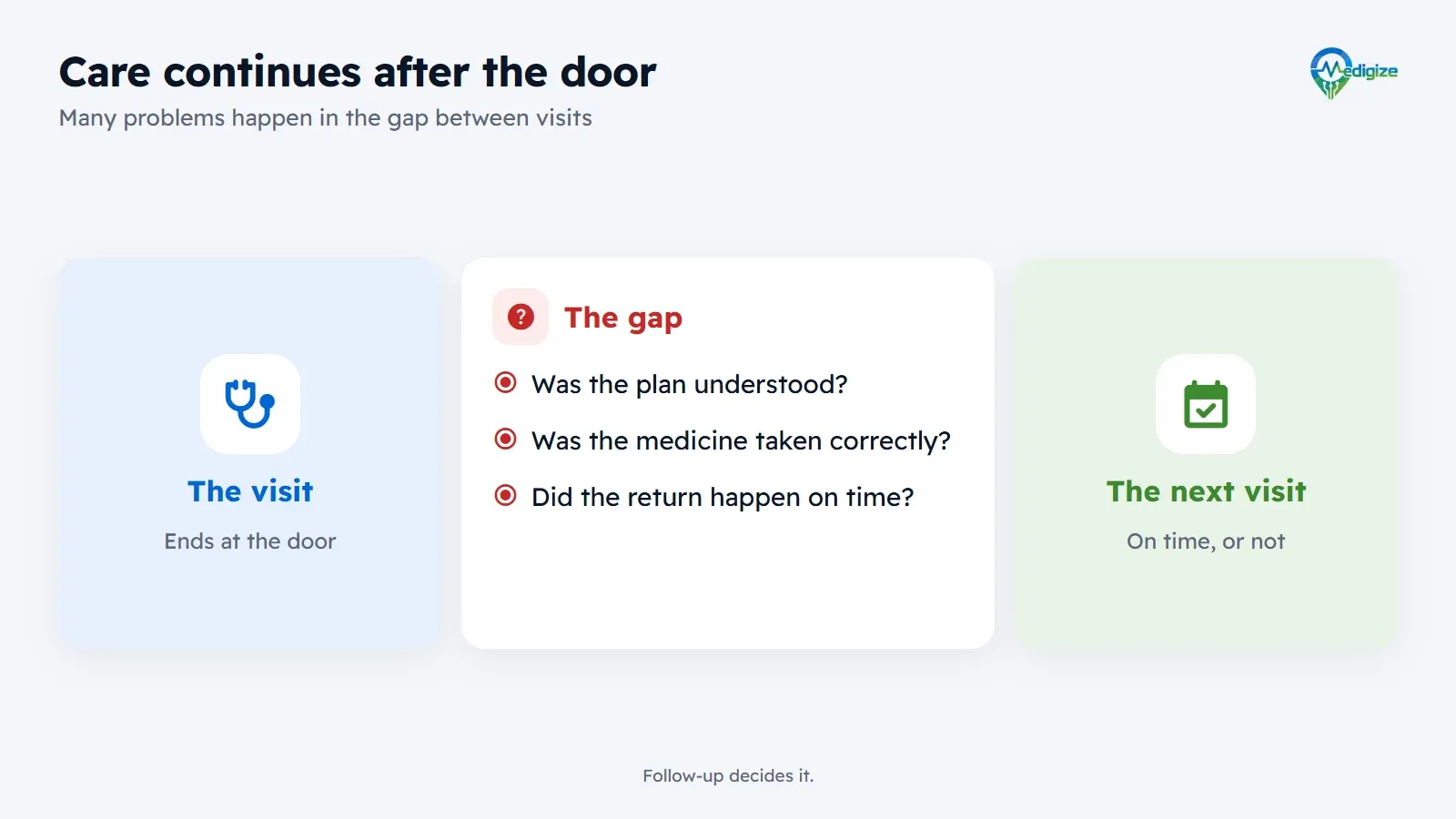
The visit is the short part. The gap is where care is won or lost.
What does follow-up mean? Four terms in plain language
Words you will meet on leaflets, discharge papers and clinic messages:
- Follow-up: as the US Agency for Healthcare Research and Quality (AHRQ) puts it, contact with a patient or caregiver at a later, specified date to check on their progress since the last appointment.
- Transition of care: any move from one setting or clinician to the next, such as admission to hospital, discharge from it, or a referral.
- Continuity of care: in the World Health Organization’s definition, how far separate health care events are experienced as coherent and connected over time, and consistent with the person’s needs and preferences. In plain terms: whether your care feels like one story or several.
- Teach-back: checking understanding by asking the patient to say, in their own words, what they need to know or do. AHRQ stresses that it tests the explanation, not the patient.
The gap between visits: where care is won or lost
A consultation can go perfectly and the care can still fail afterwards. The patient goes home with a plan they half remember, a prescription they are not sure how to take, and a return date nobody wrote down. Nothing went wrong in the room. It went wrong after.
These moments have a name in patient safety: transitions of care. The World Health Organization has a technical report on medication safety at exactly these points, when a patient moves from one setting or one clinician to the next. Its summary says medication discrepancies affect almost every patient who moves across a transition of care, such as admission to or discharge from hospital.
WHO’s practice brief on continuity and coordination of care names the risks when care is fragmented: failed communication, information not shared, medicines not reconciled, repeated tests and avoidable hospital admissions.
For one patient, it comes down to three questions:
- Was the plan understood? The US National Institute on Aging (NIA) notes that it is easy, at any age, to forget a lot of what a doctor says.
- Was the medicine taken as intended? New, changed or stopped: unless someone writes down which is which, the old list and the new one blur.
- Did the return happen on time? “Come back in a couple of weeks” is not an appointment, and a result nobody asks about can sit in a drawer.
One visit, followed up two ways: a composite example
A composite example, built from many cases, with no identifying detail: a woman in her fifties sees a doctor about a complaint that keeps coming back. The doctor asks for a blood test, prescribes a new medicine and asks her to come back with the result in about two weeks.
On memory. At home, her son asks what the doctor said, and she gives him the short version. She is not sure whether the new medicine replaces one she already takes. The lab hands her the result on paper, and she waits for a call that nobody arranged. “About two weeks” passes with no date in anyone’s calendar. Months later, at another clinic, she starts the story again.
Documented. Before she leaves, four lines are written: what was said, in words she understood; the next step, including how the new medicine fits with what she already takes; a follow-up date; and who does what. She books the test, the clinic calls with the result, and if no call comes by the agreed day, she calls the number on the page. She says the plan back, and the doctor corrects one detail. Her son gets a copy.
The doctor, the test and the medicine are the same in both versions. Only what was written down, and who owned each step, changed.
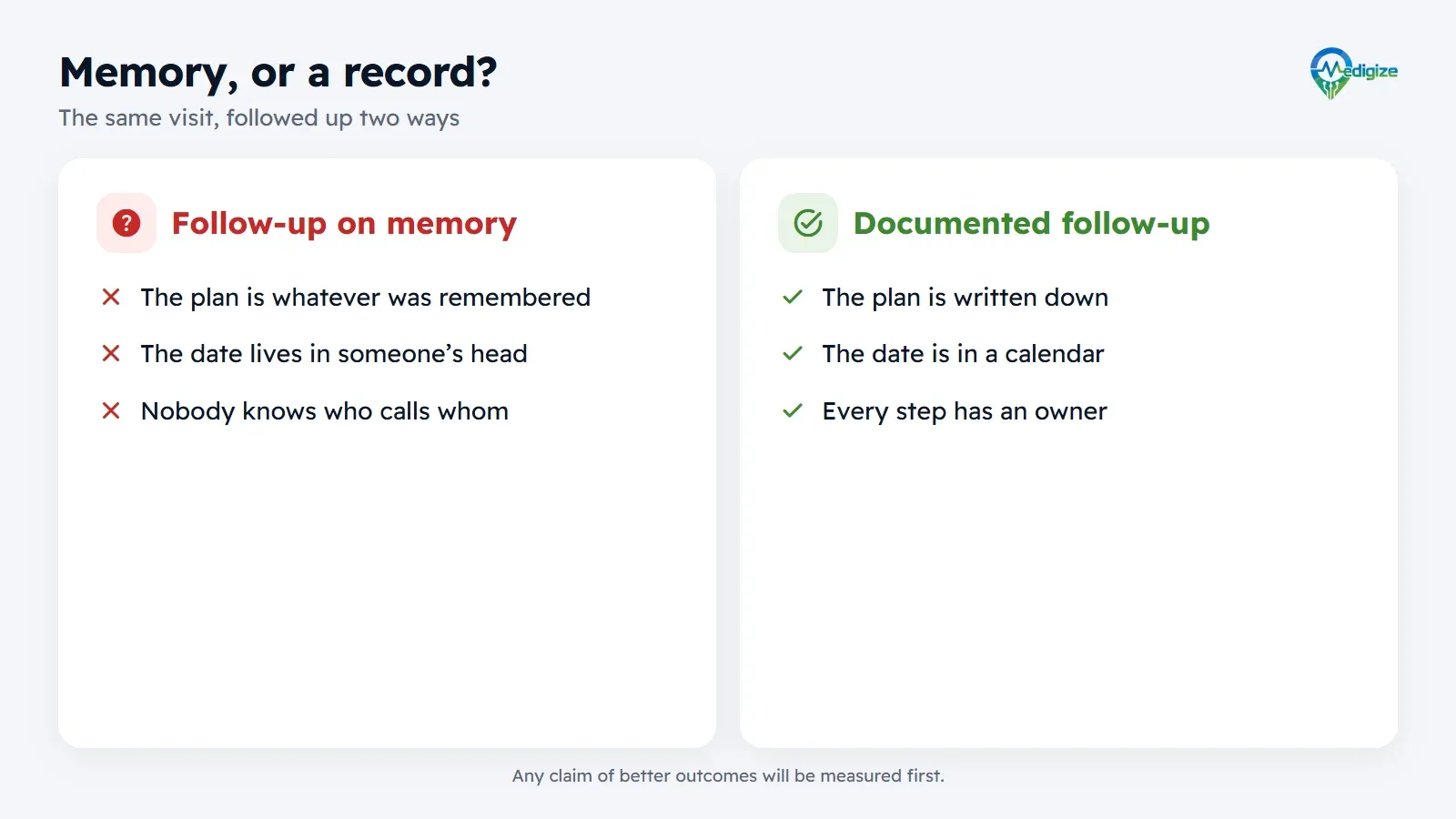
The same visit, followed up two ways.
What gets documented after a visit: four lines
What was said, the next step, the follow-up date, and who is responsible for what. Without documentation, follow-up relies on memory.
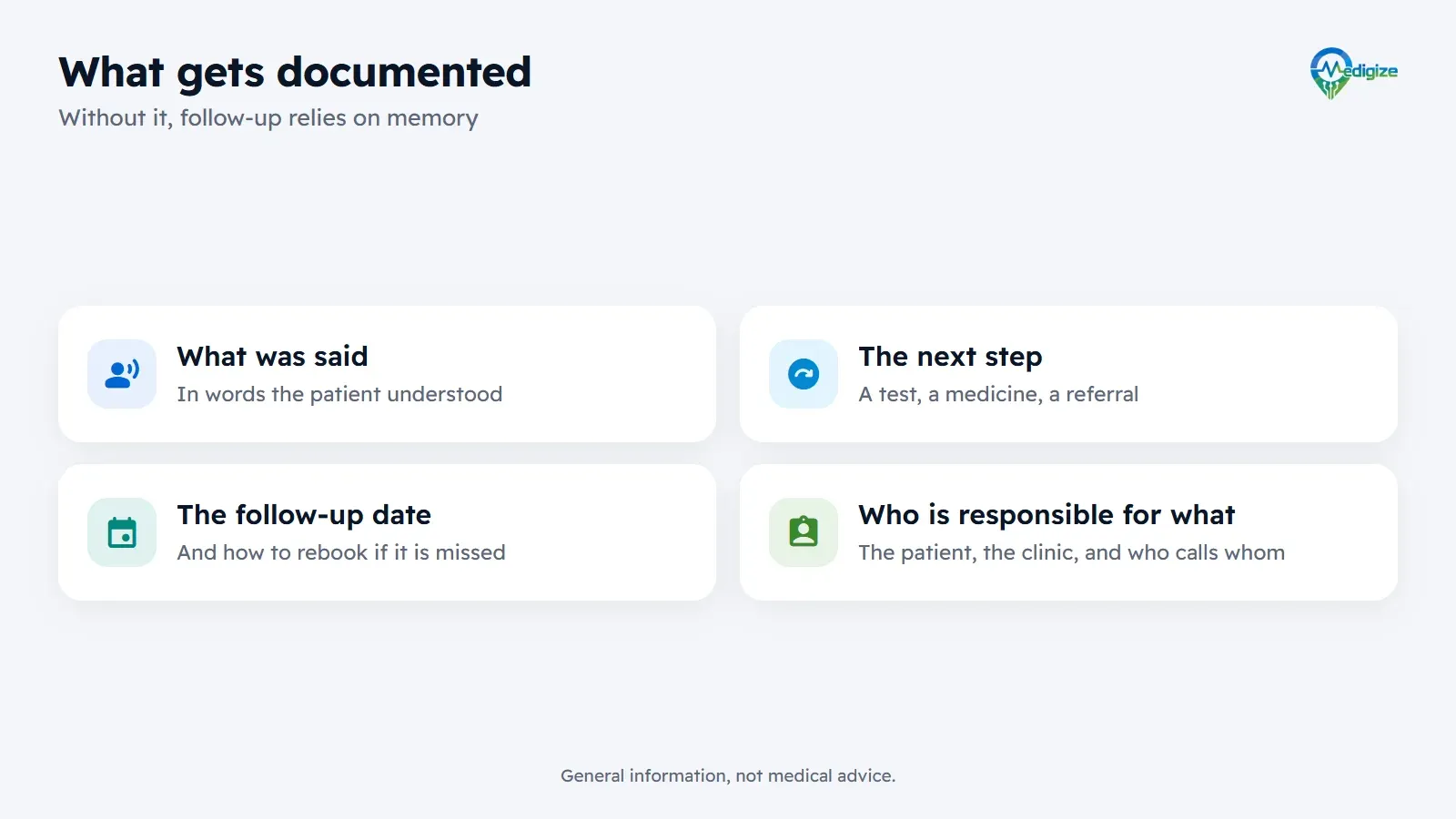
Four lines that turn a visit into a plan.
A quick test for each line before you leave:
- What was said: in words you understood, not only the words you heard.
- The next step: a test, a medicine or a referral. For a test, ask how to get ready and how the result will reach you. For a medicine, ask whether it changes anything you already take.
- The follow-up date: a day, not “in a few weeks”, and how to rebook if it is missed.
- Who is responsible for what: what you do, what the clinic does, who calls whom, and who to contact with a question.
Write yours here. Nothing you type is saved or sent. You can copy it, print it, send it to yourself, or add the follow-up date to your calendar with a reminder the day before:
Try it
Your follow-up plan
Write it before you leave, or as soon as you get home. Then keep it, send it to someone who helps you, or put the date in your calendar.
Your plan
Your plan appears here as you write it.
Saves a calendar file with a reminder the day before. Open it to add the date to your calendar.
Nothing you type is saved or sent. The calendar file is made on this page and saved to your own device.
How do you leave a visit with a follow-up plan? Six steps
- Choose your top questions before you go. NIA suggests the three or four that matter most, raised at the start. Make one of them about what happens after the visit, as in our five questions to ask before your appointment.
- Take notes, or bring someone who can. If you cannot write while the doctor talks, write in the waiting room straight after.
- Say the plan back in your own words. “So I do the test this week, start the new medicine and come back on the 3rd. Is that right?” NIA suggests exactly this check. AHRQ warns clinicians that “Do you understand?” is not one, because people tend to say yes either way.
- Ask for it in writing. MedlinePlus, the US National Library of Medicine’s health site, says to ask for written instructions if you need them, and to keep asking until you understand.
- Ask how results will reach you. Will the clinic call, or should you, and by when? AHRQ’s tips for patients include this question.
- Agree a date and a contact before you leave. Put the date in a calendar there and then, and note the best way to reach the clinic.
Seeing a specialist? The same habits fit on one page for a specialist visit.
After the visit: what to do if something changes
Most of a plan is carried out at home, with nobody to ask. AHRQ’s and NIA’s tips for patients fit in one table:
| If this happens | Do this |
|---|---|
| You get home and the instructions are unclear | Call the clinic. A nurse or staff member can check with the doctor and call you back. |
| You want to stop a prescribed medicine, or cannot follow the plan | Talk to your doctor or pharmacist first, and say what is getting in the way. |
| A result was due and nobody has called | Call the clinic, ask for the result, and ask what you should do about it. |
| You missed the follow-up appointment | Rebook as soon as you can, and take your written plan. |
| You see another doctor in the meantime | Take the plan and your list of medicines with you. |
| Your symptoms get worse | Call your doctor. Do not wait for the follow-up date. |
| Severe chest pain, trouble breathing, fainting or signs of a stroke | Call an ambulance or go to the nearest emergency department. Do not wait for an appointment or an app. |
For results, see questions to ask your doctor about your lab results, and how to get a copy of your medical records.
Leaving hospital: the transition that needs the most care
MedlinePlus says a discharge plan should include, among other things, all your medicines, with new ones highlighted and any that should stop or change; your appointments, with names and phone numbers; and who to call with questions. A caregiver should read it too. WHO’s practice brief describes good transitional care from the patient’s side: someone reviews the medicines, checks that the changes are understood, and the person knows how to get urgent advice.
For clinics: decide who follows up, and track it
AHRQ’s advice to practices starts with two decisions: why you are following up, and who is responsible for it. It also suggests asking patients how they would like to be contacted. In practice:
- Give every task an owner. AHRQ matches tasks to roles: complex or sensitive issues to the clinician, checking medicines to a pharmacist or nurse, scheduling and referrals to office staff.
- Ask how each patient wants to be contacted. AHRQ warns that owning a mobile phone does not mean someone wants to be texted, that electronic messages alone are not enough, and that sensitive information should not travel by unsecured email. Where WhatsApp is an everyday habit, ask first and decide what may be sent that way (see the data-protection law and your clinic).
- Know who needs it most. AHRQ’s examples: patients on high-risk medicines, with action plans for long-term conditions, with missed appointments, or recently discharged from hospital.
- Track it outside anyone’s memory. In the electronic health record or a computer calendar, with named staff who keep it up to date.
- Check understanding before the patient leaves. AHRQ suggests that even staff booking appointments use teach-back, so patients know what the next visit requires.
- Measure it. Take a sample of patients due for follow-up after a recent visit, and count how many got it within the intended time.
That count is how often follow-up disappears, one of the four measures in what care operations means. A missing handover is also where the seven stops of a fragmented journey come apart.
Where Medigize stands
We treat follow-up as part of the journey, not an add-on. Any claim of improved outcomes will be measured first and stated after.
On the patient’s side, MIHOS, the Medigize app, is building a record that moves with the patient, shared only with their consent. On the provider’s side, Medigize Dock runs each case from intake to follow-up, on top of the systems already in use. How often follow-up disappears is among the first things a pilot measures. See Medigize for patients and Medigize for providers.
Frequently asked questions
Why is follow-up important after a doctor’s visit?
Because the gap between visits decides whether the plan was understood, the medicine taken correctly and the return made on time. Many problems happen there.
What should I write down after a visit?
What was said, the next step, the follow-up date, and who is responsible for what, including who to contact with a question.
Who is responsible for follow-up?
It should be decided and written down at the visit: what the patient does, what the clinic does, and who contacts whom.
What should I do if I don’t hear back about my test results?
Silence is not an answer. Call the clinic, ask for the result, and ask what you should do about it.
How can I make sure I understood my doctor’s instructions?
Say the plan back in your own words and ask whether you have it right. Ask for written instructions, and call the clinic if something is unclear at home.
What if I miss a follow-up appointment?
Contact the clinic to rebook as soon as you can. If your symptoms get worse in the meantime, seek care, and in an emergency call an ambulance.
What should a clinic track to make sure follow-up happens?
Why each patient is followed up, who owns it, how to contact them, and whether it happened on time.
Does Medigize claim to improve outcomes?
No. Any claim of improved outcomes will be measured first and stated after.
Medigize is a non-diagnostic navigation tool. This is general information, not medical advice. In an emergency, call an ambulance or go to the nearest emergency department.
References
- World Health Organization: Medication safety in transitions of care (2019)
- Agency for Healthcare Research and Quality: Follow up with patients (Health Literacy Universal Precautions Toolkit, Tool 6)
- World Health Organization: Continuity and coordination of care, a practice brief (2018)
- Agency for Healthcare Research and Quality: Use the teach-back method (Health Literacy Universal Precautions Toolkit, Tool 5)
- Agency for Healthcare Research and Quality: Be more engaged in your healthcare, tips for patients
- National Institute on Aging: Five ways to get the most out of your doctor’s visit
- MedlinePlus: Talking with your doctor
- MedlinePlus: Leaving the hospital, your discharge plan
Last updated:
Explore Medigize
Medigize is in development. Explore our current scope and express your interest.