

Ask anyone building in digital health who their competitor is, and the answer is usually an app. Ours is WhatsApp, paper and a relative who “knows a good doctor”.
Ask anyone building in digital health, “Who is your competitor?” and the answer is usually an app. Ours at Medigize is different.
Our real competitor is WhatsApp, paper, and a relative who “knows a good doctor”. Many people run their health journey on these tools today.
In short:
- WhatsApp, paper and a trusted relative work because they are free, instant and familiar. That deserves respect.
- What they leave behind: no organized file, no visible pathway, and no one accountable when a message is lost.
- A new solution wins only if it is easier than WhatsApp, safer than paper and more reliable than a referral, on day one.
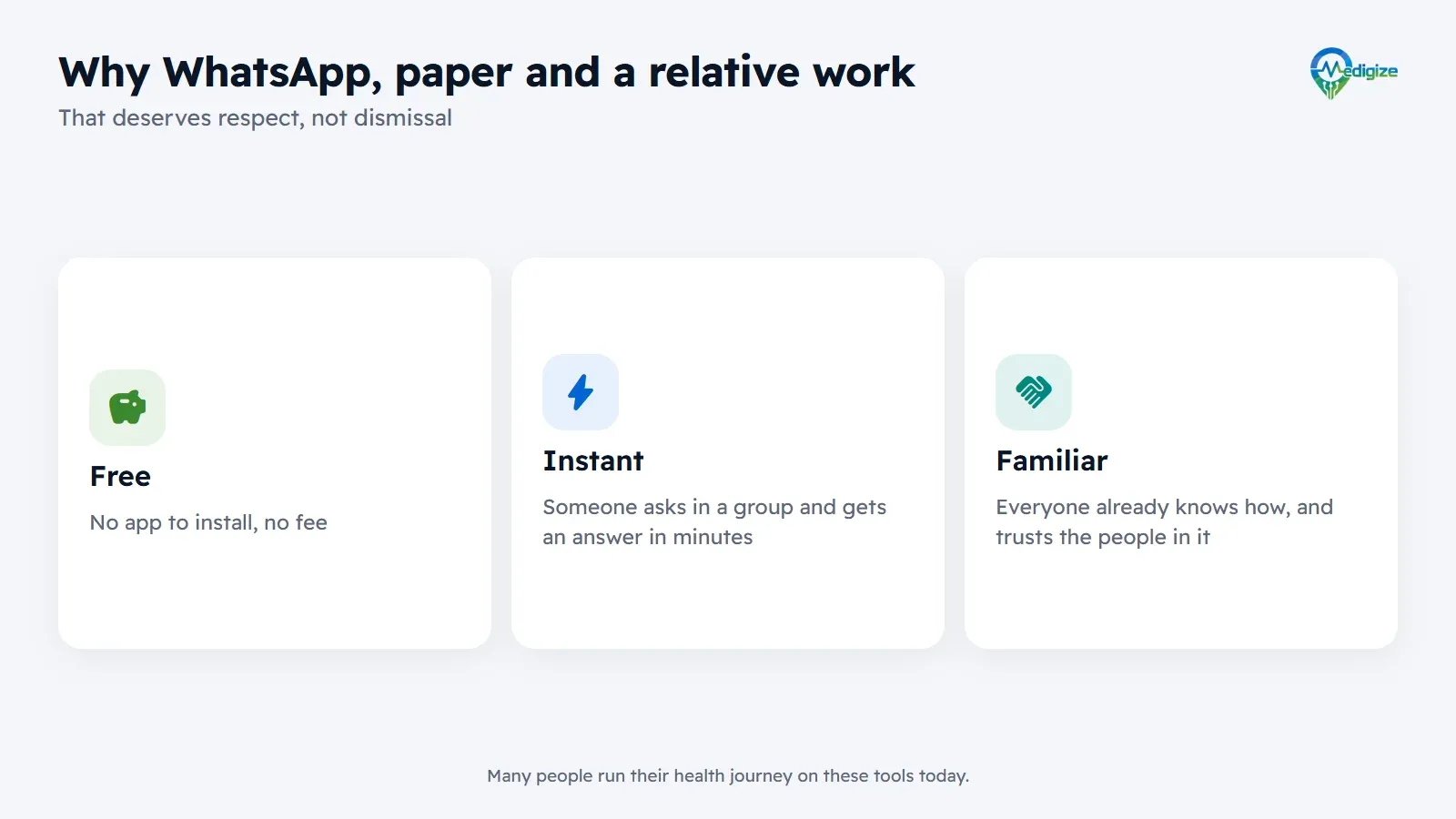
Free, instant, familiar: a high bar.
What is the real competitor in digital health?
For most new health tools, the real competitor is not another app. It is the way people already run their care: a message in a family WhatsApp group, a paper file in a bag, and a relative whose recommendation they trust. A new tool has to beat those habits on ease, safety and reliability, not on cleverness.
The habits run through the whole journey. A patient asks the family group where to go. The clinic confirms the booking by message. A result travels as a photo. The file lives in a plastic bag that comes to every visit. None of it is counted as a product, which is why it is so easy to underestimate.
Why they work
They are free, instant and familiar. Someone asks in a group and gets an answer in minutes. That deserves respect, not dismissal.
There is no app to install, no account to create and nothing to learn. The relative who “knows a good doctor” also brings something no directory has: trust, earned over years. A 2017 review in the Interactive Journal of Medical Research found WhatsApp already in use between health professionals and the public, and called for better research on it. Any tool that dismisses these habits has misunderstood why people chose them.
- WhatsApp carries messages, photos, voice notes and calls over an internet connection, at no cost per message, as the same review describes. It is where the family already is.
- Paper needs no battery, no password and no signal. Every clinic accepts it, and the patient decides who sees it.
- The relative answers at any hour, knows the family’s history and the neighbourhood, and has nothing to sell.
The habits also carry a preference worth respecting. The US Agency for Healthcare Research and Quality (AHRQ) advises clinics to ask patients how they would like to be contacted rather than assume, and not to rely only on electronic messages, because patients may not check their devices regularly.
What they leave behind
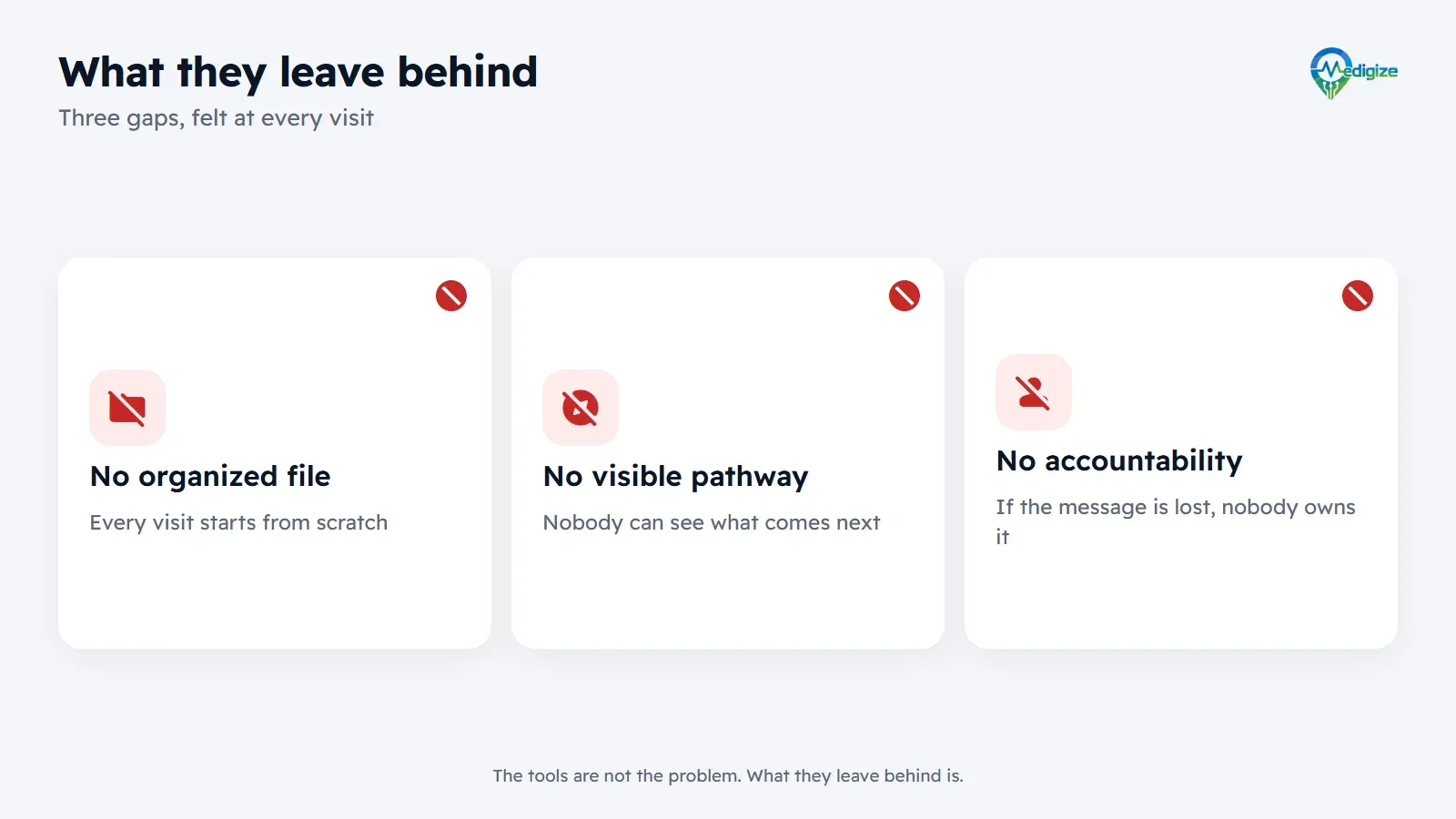
Three gaps, felt at every visit.
- No organized file, so every visit starts from scratch. Results sit in a chat, a bag or a drawer.
- No visible pathway telling you what comes next. The next step lives in someone’s memory.
- No accountability. If the message is lost, nobody owns it.
None of the three is a failure of the people involved. They are what happens when information moves without a structure. The World Health Organization lists communication breakdown, among health workers and with patients and their families, among the factors that lead to harm in health care, alongside disruptions in care coordination. AHRQ, describing the US system, names the same pattern: specialists who do not consistently receive clear reasons for a referral or information on tests already done, and patients unclear about what to do after a specialist visit.
A fourth gap is easy to miss: where the data goes. The 2017 review noted that none of the studies it included discussed ethics or security, and said that new users of WhatsApp for health purposes must consider cyber security. A result in a group chat is a result on every phone in it. For clinics in Egypt, our article on the data-protection law and your clinic lists the questions that follow.
We followed one such journey stop by stop in seven stops, and every one worked, and counted what it costs in the hidden cost of a fragmented patient journey.
A worked example: one result, five forwards
A composite example, built from many cases. A mother’s blood test comes back from the lab as a PDF on her son’s phone.
- He forwards it to the family group, where an aunt says it looks fine and a cousin says it does not.
- His sister sends a screenshot to a friend who works in a pharmacy.
- The clinic asks for it on WhatsApp, and it lands on a phone the whole front desk shares.
- At the follow-up, the doctor asks for the earlier result to compare. It is somewhere in the group, weeks up, with no date in the file name.
- Nobody is sure who was meant to book the next test. Everyone assumed someone else had.
Everyone in that chain acted out of care, and every tool did what it was built to do. What was missing was a file, a visible next step and an owner. The person to read the result is the doctor who ordered it; our questions to ask about lab results help with that conversation. And it shows why a replacement that only adds steps will lose: the family goes back to the group the first time the new tool is slower.
The test we hold ourselves to
A new solution will not win because it is smarter. It wins if it is easier than WhatsApp, safer than paper and more reliable than a referral. On day one.
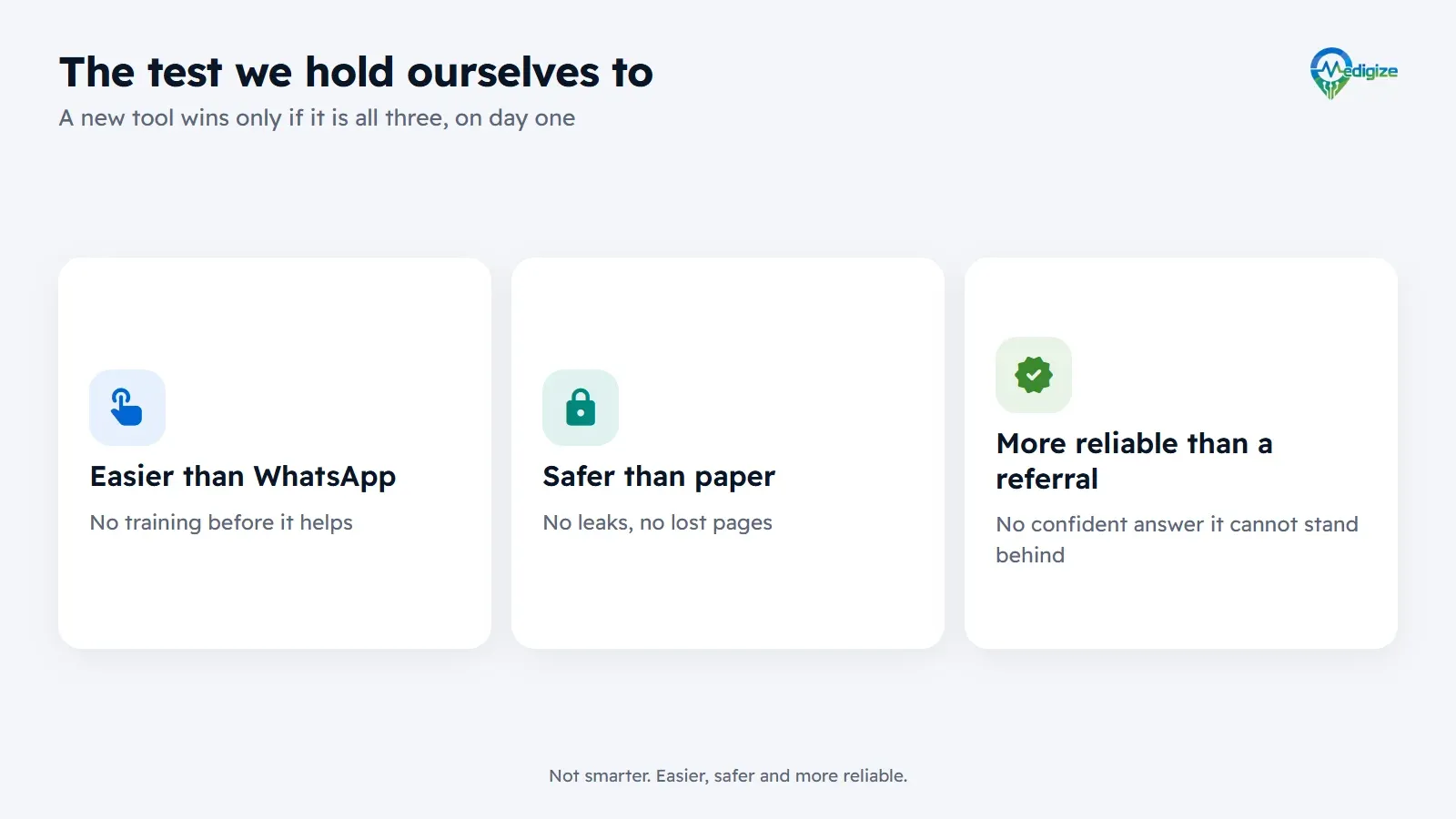
Three comparisons, on day one.
That test rules things out. A tool that needs a week of training is not easier than WhatsApp. A tool that leaks is not safer than paper. And a tool that gives a confident answer it cannot stand behind is not more reliable than a relative who says “I’m not sure, ask a doctor”.
Turned into design rules, the three comparisons look like this:
- Easier than WhatsApp: no training before it helps, and nothing to give up before it has earned it. A first pilot runs in parallel with what a clinic already uses, without data migration.
- Safer than paper: only what is needed, shared with the patient’s consent, with an audit trail, data minimization and removal of unnecessary identifiers.
- More reliable than a referral: never surer than the evidence. Medigize understands the complaint, assesses urgency and routes to the right level of care; the clinician diagnoses and decides. A validation gate stands before any output, and when in doubt, urgency goes up, never down.
Whether we pass is not ours to announce. A pilot will measure it first, and we will state it after. We explained the lines we will not cross in three things we won’t build.
Keep the habits, close the gaps: what you can do today
You do not need a new app to close most of the gaps for your own family. A few habits do it:
- Give every result one home. A folder, on paper or on the phone, in date order. Move results there from the group the day they arrive. A record that moves with you explains how to ask clinics for copies.
- Put the date in the name. “Blood test, March 2026” finds itself; “IMG_4471” does not.
- Keep one page for the next visit: the complaint, the medicines and your questions. One page is enough.
- Leave every visit with a next step and an owner: who books the test, who calls with the result, and when. Five questions to ask before your appointment covers it.
- Share results only with the people who need them. A smaller chat is a safer one.
And if there are signs of an emergency, no chat is the right channel: severe chest pain, trouble breathing, loss of consciousness or signs of a stroke mean calling an ambulance or going to the nearest emergency department. Do not wait for a reply, or for an app.
What this means for providers
If you run on paper and WhatsApp, Medigize Dock is designed to become your case operating system from day one. If you already have a system, we work on top of it rather than replacing it.
- If your clinic runs on paper and one WhatsApp number, write down where results arrive, who answers the number and who owns each message. The three gaps can be seen before anything changes.
- If you already have a clinic system, look at what happens around it: the messages, photos and follow-ups that never reach it.
- If a colleague cannot pick up a case without calling you, the case lives in one phone. AHRQ lists establishing accountability and agreeing on responsibility among the specific activities of care coordination.
Dock is not an electronic medical record, a billing system or an inventory system. It runs the case, from intake to follow-up.
What does your clinic’s week leave behind? Five questions, answered for a typical week:
Try it
What does your week leave behind?
Five questions about your clinic. Answer for a typical week.
1. When a patient comes back, is their whole file in one place?
2. Does every patient leave knowing the next step?
3. If a message is lost, is it clear who owns it?
4. Do results and photos sent on chat reach the patient’s file?
5. Could a colleague pick up a case without calling you?
Answered 0 of 5. Your list appears when all of them are in.
A conversation starter, not an assessment. Your answers stay on this page.
More on the providers page.
Common mistakes when replacing WhatsApp and paper
- Banning WhatsApp overnight. Patients will keep writing there. Decide what happens to each message instead: where it is filed, and who answers it.
- Asking for a week of training. That fails the first comparison before the tool has helped anyone.
- Migrating everything first. A parallel run lets a clinic compare before it commits.
- Believing the smarter tool wins. People do not leave a habit for cleverness. They leave it for something easier that keeps their trust.
- Leaving out the family. WHO counts engaging patients and families among the measures of a safe health system. A tool that ignores the relative will be routed around.
- Claiming results before measuring them. Ask any vendor, us included, what was measured and how. We explain why in why we build in public.
Frequently asked questions
Who is Medigize’s real competitor?
The status quo: WhatsApp, paper, and a relative who “knows a good doctor”. Many people run their health journey on these tools today.
Why do people use WhatsApp for health questions?
Because it is free, instant and familiar. Someone asks in a group and gets an answer in minutes.
What is wrong with running a clinic on WhatsApp and paper?
Nothing is wrong with the tools themselves. The problem is what they leave behind: no organized file, no visible next step, and nobody accountable when a message is lost.
Is it safe to send medical results on WhatsApp?
It is widely done, but a 2017 review noted that the studies it included did not discuss security, and said users must consider it. Send results only to the people who need them, and keep your own copy in one place.
Is a relative’s recommendation a good way to choose a doctor?
It brings trust and local knowledge, but not the whole picture: your history, earlier results and the level of care the complaint needs. Our first-stop checklist helps fill the gap.
How can a clinic move away from paper without disrupting patients?
Start by writing down where results arrive and who owns each message. Then try any new tool in parallel with what you use today; a first Medigize pilot runs that way, without data migration.
Does Medigize replace a clinic’s existing system?
No. If a clinic already has a system, Medigize works on top of it. If it runs on paper and WhatsApp, Medigize Dock is designed to be its case operating system from day one.
What is Medigize Dock?
The provider side of Medigize: running each case from intake to follow-up, with a structured file and a documented pathway.
Medigize is a non-diagnostic navigation tool. This article is general information, not medical advice. In an emergency, call an ambulance or go to the nearest emergency department.
References
- Interactive Journal of Medical Research (2017): WhatsApp Messenger as an adjunctive tool for telemedicine, an overview
- World Health Organization: Patient safety (fact sheet)
- Agency for Healthcare Research and Quality: Care coordination
- Agency for Healthcare Research and Quality: Follow up with patients (Tool 6)
Last updated:
Explore Medigize
Medigize is in development. Explore our current scope and express your interest.