

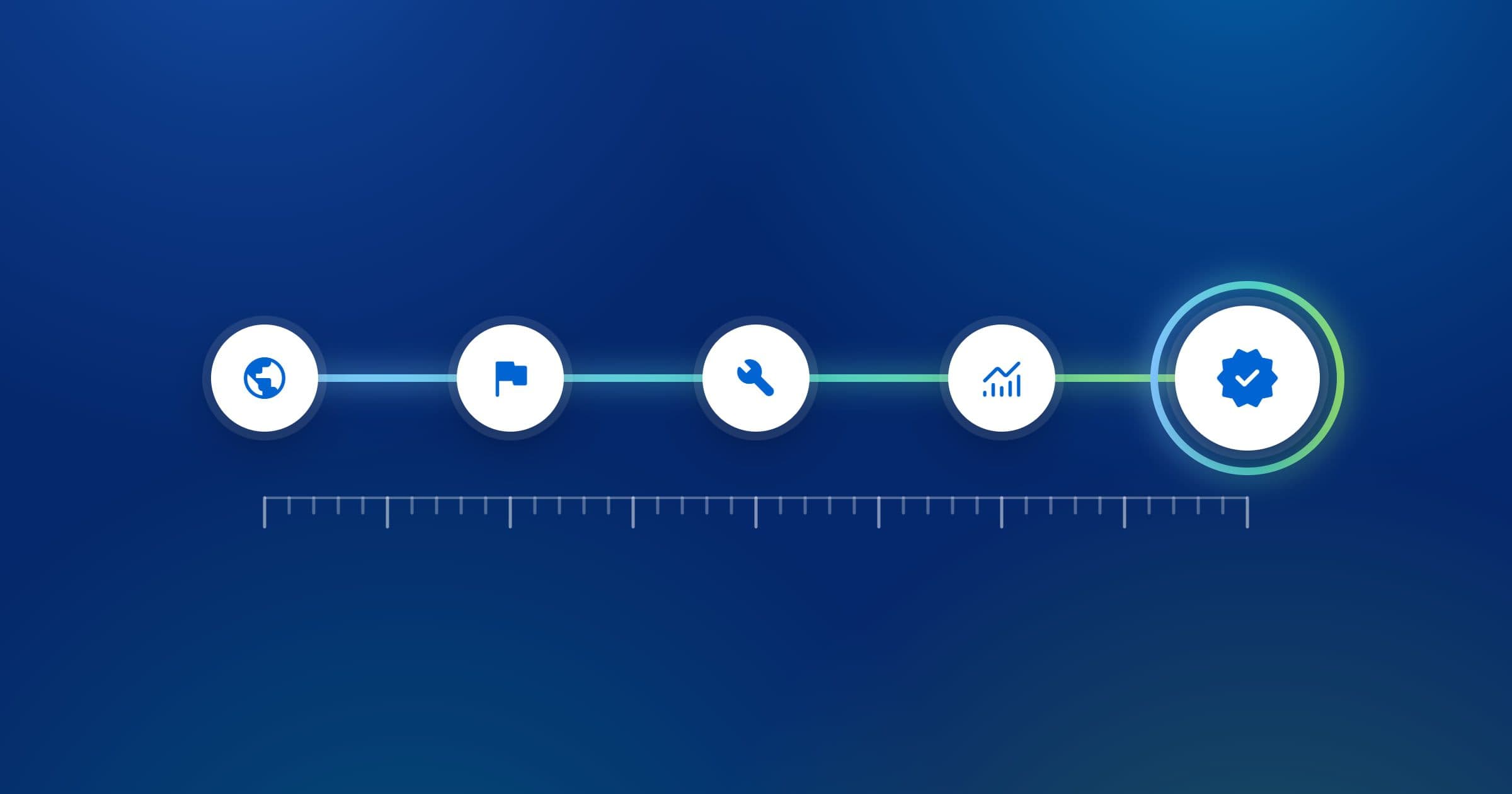
In healthcare, the easiest sentence in any pitch is “we will save time”. The hardest is “we measured, and here is what happened”. The chain we follow, and what a first pilot measures.
In healthcare, the easiest sentence in any pitch is “we will save time” or “we will cut errors”. The hardest is: “we measured, and here is what happened”.
What does “measure before we claim” mean? It means a claim about what a product does for patients or teams is made only after it has been measured at a real facility, against a starting point measured the same way beforehand. Until then, the honest sentence is what will be measured, how, and against what. An outside study can show that a problem matters. It cannot show that one product solved it.
In short:
- The chain: external benchmark, baseline, intervention, measured change, claim. In that order, with no link skipped.
- We do not say “we save time” yet: the time teams spend today has not been measured, and an outside figure is not our result.
- A first pilot is for learning, not proving. A result that differs from what we expected is still a useful result.
The chain we follow
External benchmark → baseline → intervention → measured change → claim. In that order.
- An external benchmark proves a problem matters.
- A baseline says where one specific facility stands today.
- The intervention is what we try.
- The measured change is the real difference.
- Only then do we have a claim.
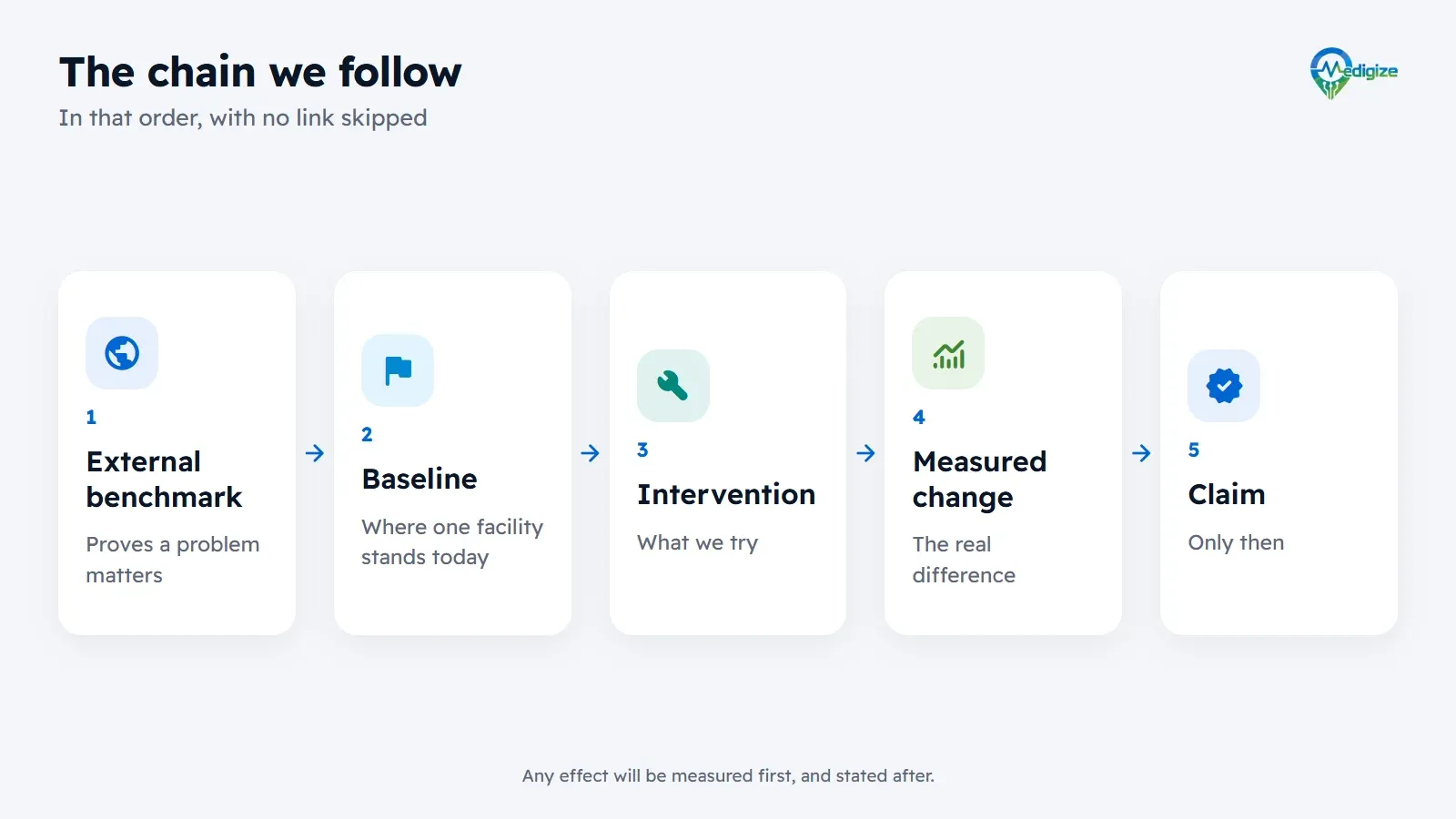
Five links, in this order. Skip one, and a result becomes a guess.
Each link answers its own question, and each leaves a sign when it is skipped:
| Link | The question it answers | A sign it was skipped |
|---|---|---|
| External benchmark | Is this problem worth working on? | A product looking for a problem |
| Baseline | Where does this facility stand today, by its own count? | “Before” numbers borrowed from somewhere else |
| Intervention | What exactly is changing, and for which cases? | Several things changed at once |
| Measured change | What is different, counted the same way as before? | New definitions for the second count |
| Claim | What can now be said, about where and over how long? | One clinic’s result stated as true everywhere |
Why is a benchmark not a claim?
Take a real benchmark. The World Health Organization’s report on medication safety in transitions of care says that medication discrepancies affect almost every patient who moves across a transition of care, such as admission to or discharge from hospital. That sentence is a good reason to look closely at handovers. It does not tell any one hospital what its own rate is, and it says nothing about whether a particular product changes it.
The same goes for every outside figure in a pitch, however solid the study behind it. It describes other places, other patients and another period. Used honestly, it earns a problem a place on the list. Used as a result, it borrows trust the product has not earned.
There is a second difference worth knowing. The Institute for Healthcare Improvement (IHI) separates measurement for research, which aims to discover new knowledge through one large blind test, from measurement for improvement, which brings new knowledge into daily practice through many sequential, observable tests and “just enough” data. A first pilot is the second kind. It can tell a facility what changed there. It is not a clinical trial, and it should never be described as one.
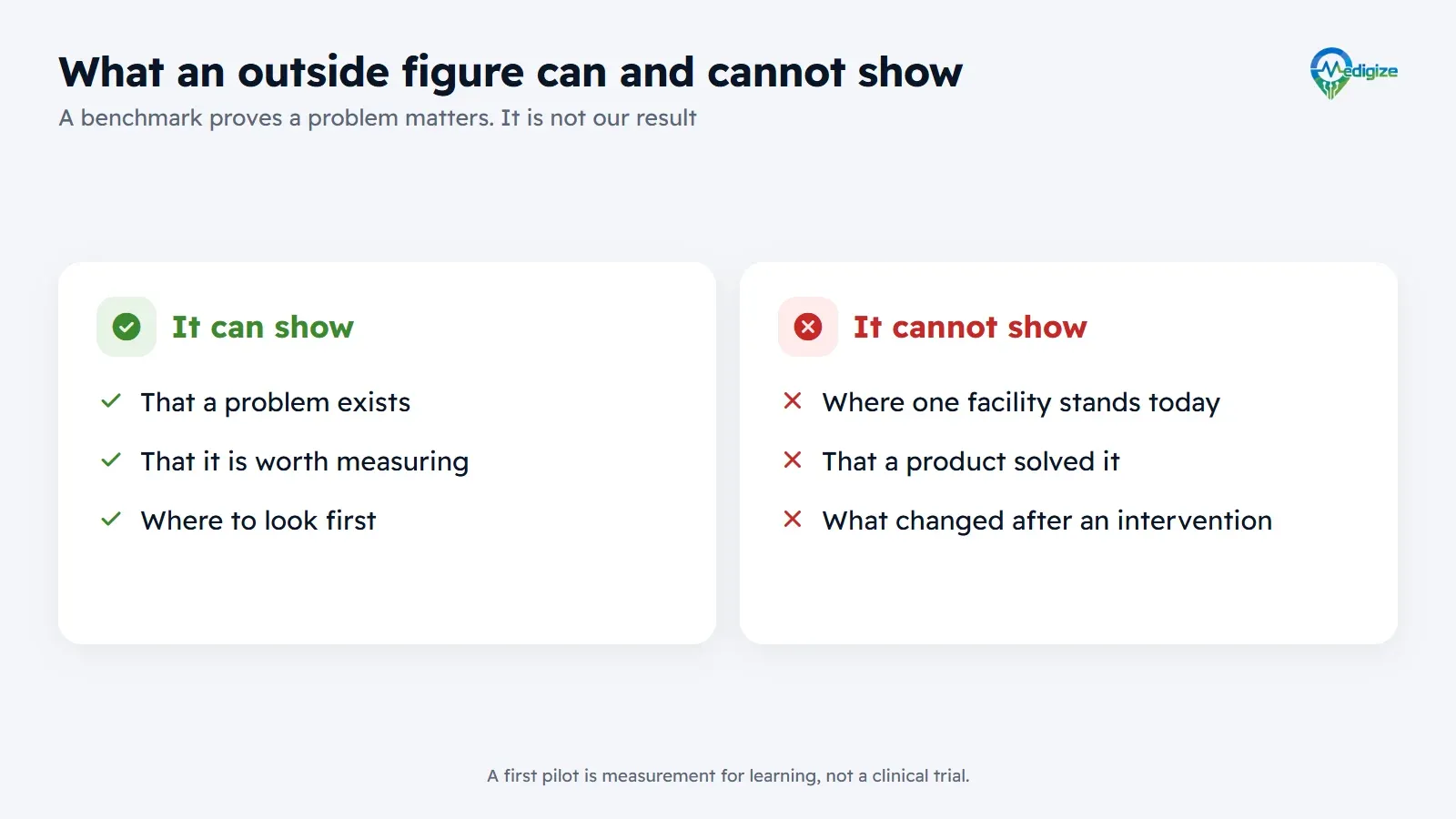
An outside figure earns a problem a place on the list. It is not a result.
Why we do not say “we save time” yet
Because we have not measured the time teams spend today. And because a figure from an outside study shows the problem exists; it does not show that our product solved it.
“Save time” also hides three questions that need answers before it means anything: whose time, at which step, and compared with what. Time saved at the front desk can reappear as time spent by a coordinator. IHI calls the check for this a balancing measure: are changes designed to improve one part of the system causing new problems in other parts? One of its examples is making sure readmissions do not rise when hospital stays get shorter. A claim that reports only the measure that improved has left out the one that might not have.
Four things we measure in any pilot
- Case completeness at first review.
- Manual handoffs per case.
- Time to the next step.
- How often follow-up disappears.
None of the four needs new software to count, and each has a common trap:
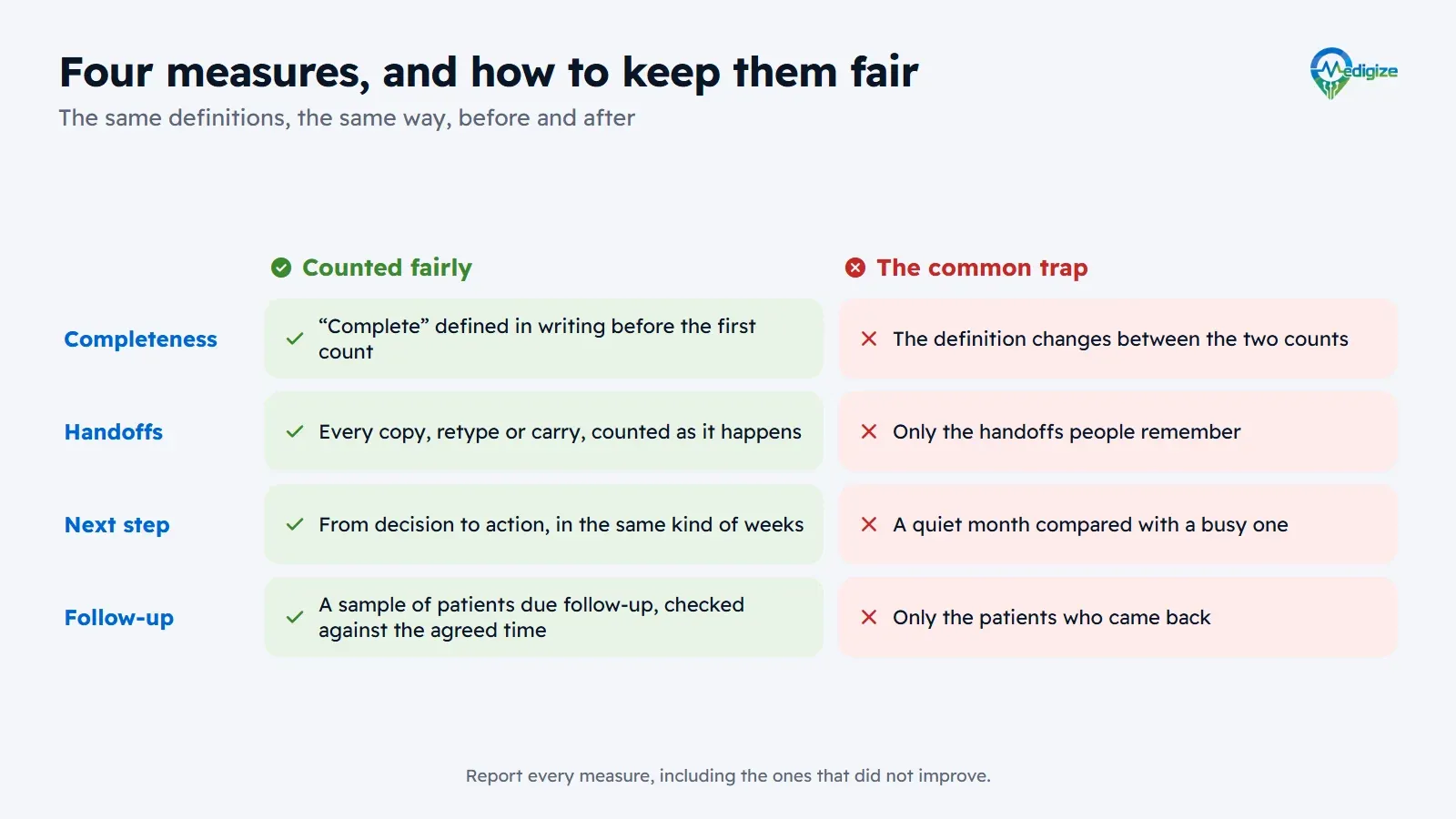
The same definitions, the same way, before and after.
- Case completeness at first review: of the cases a clinician opens, how many have what they need at first look. Write down what “complete” means before counting; what makes a case qualified is a starting definition.
- Manual handoffs per case: how many times a case is copied, retyped or carried between people by hand. Count as it happens, not from memory at the end of the week.
- Time to the next step: from a decision, such as “book the scan”, to the action actually happening. Compare like with like: a quiet month against a busy one proves nothing.
- How often follow-up disappears: the US Agency for Healthcare Research and Quality (AHRQ) describes the count: take the records of a sample of patients who should have been followed up after a recent visit, count how many were, and count the follow-up actions done within the desired time frame. Counting only the patients who came back hides the ones who did not.
Why these four, and how they fit the work around a visit, is in how to measure care operations and why follow-up matters.
How to measure a starting point: seven steps
- Agree the definitions first, in writing, with the people who will count. IHI says the people whose lives an improvement will affect should have a voice in deciding which measures matter.
- Choose the scope and the period: which cases, which team, and a stretch of ordinary weeks. Note anything unusual, such as a holiday or a staff change.
- Count on paper if you need to. IHI notes that useful data are often easy to get without information systems, and suggests a simple data collection form that is part of someone’s job.
- Use a sample when counting everything is too much. IHI calls sampling a simple, efficient way to understand how a system is performing.
- Add what people say to what you count. IHI advises using qualitative as well as quantitative data. A front desk’s explanation of a delay is data too.
- Write down what you expect before you change anything. AHRQ’s Plan-Do-Study-Act worksheet asks for the measurement or outcome you hope a change will produce, before the test begins.
- Plot it over time, and mark the changes. IHI describes tracking a few key measures over time as the single most powerful tool a team can use, on a run chart annotated with the changes made.
In our parallel run, the starting point is two ordinary weeks, counted before anything changes. The aim is not a perfect number. IHI’s phrase is “seek usefulness, not perfection”: just enough data to know whether a change is leading to improvement.
Common ways to fool yourself, and how to avoid them
- Borrowing a benchmark as a baseline. An outside rate is not your starting point. Count your own.
- Changing the definition halfway. If “complete” means something new at the second count, the change you see may be in the words.
- Comparing different kinds of weeks. A holiday week against a normal one, or a new team against an experienced one, shows a difference the intervention did not make.
- Counting what people remember. Memory keeps the dramatic cases and loses the ordinary ones.
- Reporting only the measure that improved. Report the balancing measures too, and say what got worse.
- Counting only while everyone is watching. People often work differently in the weeks they know are being counted, so keep counting after the novelty has worn off.
- Turning the best case into the headline. “Up to” describes one good day, not the usual one.
What we want to learn from a first pilot
The question is not “what do we want to prove?” but “what do we want to learn?” If the result differs from what we expected, that is still a useful result.
A worked example in AHRQ’s toolkit shows why. A practice tested ways of collecting patient feedback surveys, hoping for at least 25 completed surveys a week. Offering them at the checkout desk brought back 8 in a week. Sending them home with a stamped envelope brought back 3 in two weeks. Leaving them in the exam room, with nurses pointing them out after vital signs, brought back 24 in a week. The first two fell far short and the third came close, and each try told the team what to change next. That is what a useful result looks like.
So a first pilot starts with questions rather than a target to hit:
- Where do cases arrive incomplete most often, and what is usually missing?
- Which handoff is hardest to remove, and why does it exist?
- Does follow-up disappear more for some kinds of cases than for others?
- What does the parallel run cost the team, in time and attention?
And it ends with a decision taken together: continue, change something, or stop. Stopping is a result too.
How to read a “we save time” claim, including ours
One of WHO’s six guiding principles for AI in health says that measures of quality control in practice, and of quality improvement in the use of AI, must be available. For any product, that comes down to a few plain questions. Think of one claim you have been given, by anyone, and answer five questions about it:
Try it
Before you rely on a “we save time” claim
Think of one claim you have been given about a health product, by any supplier, including us. Answer five questions about it, and you get the questions to send back.
1. Was the starting point measured at a real facility before anything changed?
2. Were the same definitions used before and after?
3. Do the numbers come from that facility, not from an outside study?
4. Do you know what got worse, or did not change?
5. Do you know who counted, over how long, and whether the period was a typical one?
Answered 0 of 5. Your list appears when all of them are in.
A list of questions, not an assessment of any product. Your answers stay on this page.
Our own answers today are short. Medigize is in development and is not a live clinical service, and we have measured nothing we would quote. Effects will be measured in a controlled pilot that runs in parallel with a provider’s existing systems, without data migration, against a starting point measured first, and stated after, with how they were measured. If you run a clinic or a hospital and want to know your own starting point, talk to us, or see Medigize for providers.
Regional funding context
According to published reports, regional startup funding in the first half of 2026 was more selective. Wamda reports that startups in the Middle East and North Africa raised $1.7 billion across 242 funding rounds in that half, with deal volume down 28% year on year, reflecting greater investor selectivity and fewer transactions, and with capital increasingly concentrated around larger ecosystems, established sectors and companies with clearer paths to scale. In Saudi Arabia, it reports, healthtech came third by capital raised, with five companies raising a combined $14 million. The takeaway: investors fund discipline and evidence. This is general context, not a reference to any Medigize funding round.
Frequently asked questions
What is a baseline in healthcare?
The measured starting point of one facility, team or process, counted before anything changes, so that a later count can be compared with it fairly.
What is the difference between a benchmark and a baseline?
A benchmark comes from outside, often from a study of other places, and shows that a problem matters. A baseline is your own count, at your own facility, today.
How long should a baseline be measured?
Long enough to see an ordinary pattern, in the same kind of period you will compare it with later. IHI’s advice is just enough data to tell whether a change is an improvement.
What does a healthcare pilot measure?
Ours measures four things: case completeness at first review, manual handoffs per case, time to the next step, and how often follow-up disappears, each against a baseline.
What if a pilot shows no improvement?
Then that is the result, and it is reported. A result that differs from what was expected still shows what to change, or whether to stop.
Why doesn’t Medigize publish time savings?
Because we have not measured the time teams spend today. Any effect will be measured first, against a starting point, and stated after.
Is this article about a Medigize funding round?
No. The funding figures are general regional context from a published report, not a reference to any Medigize funding round.
Medigize is a non-diagnostic navigation tool. This article is general information, not medical advice. In an emergency, call an ambulance or go to the nearest emergency department.
References
- World Health Organization: Medication safety in transitions of care (2019)
- Institute for Healthcare Improvement: Model for Improvement, establishing measures
- Agency for Healthcare Research and Quality: Plan-Do-Study-Act worksheet, directions and examples (Health Literacy Universal Precautions Toolkit)
- Agency for Healthcare Research and Quality: Follow up with patients (Health Literacy Universal Precautions Toolkit, Tool 6)
- World Health Organization: WHO issues first global report on artificial intelligence in health and six guiding principles for its design and use (2021)
- Wamda: MENA startups raise $1.7 billion in H1 2026 despite regional uncertainty (July 2026)
Last updated:
Explore Medigize
Medigize is in development. Explore our current scope and express your interest.