

A provider receives many cases and each takes time. A qualified case arrives with enough information for the team to decide quickly. Its three elements, and why they matter.
A provider receives many cases and each takes time. A qualified case arrives with enough information for the team to decide quickly.
In short:
- A qualified case has three things: a clear complaint with dates, the key medicines and tests, and a patient who knows why they are coming.
- Qualifying a case is not filtering patients out. It is the work done before the visit, so the visit can be about care.
- For a provider it means less intake time, more accurate referrals and a better patient experience, and it can be counted in a typical week.
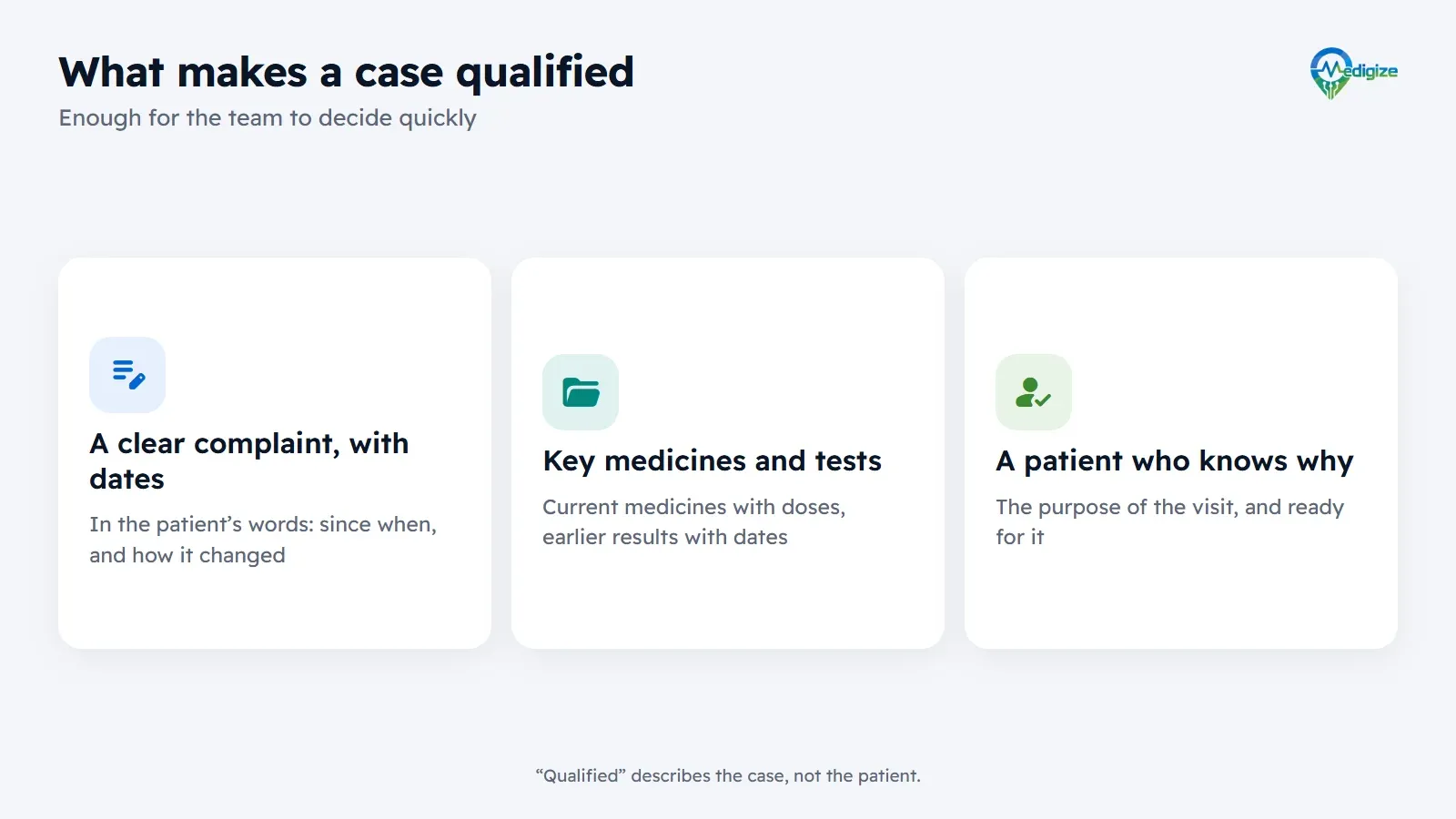
Enough for the team to decide quickly.
What is a qualified case?
A qualified case is one that reaches a provider with what the team needs to act: the complaint in the patient’s words with dates, the current medicines and earlier results, and a patient who knows why they are coming and has prepared. It is ready for a decision at first review, instead of being rebuilt at the desk.
“Qualified” is not a judgement about the patient. Every patient deserves care. It describes the case: whether the information the team needs arrived with it, or has to be collected again at the desk.
The US Agency for Healthcare Research and Quality (AHRQ) describes care coordination in the same spirit: the patient’s needs and preferences known ahead of time, and communicated at the right time to the right people.
AHRQ is also plain about what happens when that fails, writing about the US system. Specialists do not consistently receive clear reasons for a referral, or adequate information on tests already done. Patients are often unclear about why they are being referred. Referral staff deal with many different processes and lost information. A qualified case is the answer to all three, written down before the visit.
Three elements
- A clear complaint with dates. What the patient feels, in their own words, since when, and how it has changed.
- Key medications and tests available. Current medicines with their doses, and earlier results with their dates.
- The patient understands the purpose of the visit and is ready for it. They know why they are coming, and they brought what was asked.
Each one saves the team a specific piece of work:
| Element | What good looks like | What it saves the team |
|---|---|---|
| A clear complaint, with dates | The patient’s own words; when it started; how it has changed; what makes it better or worse | The first minutes of the visit spent rebuilding a timeline from memory |
| Key medicines and tests | Current medicines with doses, allergies, and earlier results with their dates | Calls home about “the white pill”, and results that stay “somewhere at home” |
| A patient who knows why | Knows the purpose of the visit, brought what was asked, has their main questions ready | A visit spent explaining why the patient is there, and a second visit for what was not brought |
None of this needs medical words. “It started three weeks ago, it is worse in the evenings, and the tablets from the pharmacy did not help” is a clear complaint without a single technical term. What makes it useful is the detail around it, which is also what the US National Institute on Aging and MedlinePlus advise patients to bring: their concerns in order of importance, every medicine with its dose, when the problem started, and what makes it better or worse.
Earlier results are easier to bring where records already travel electronically. In Dubai, for example, the health authority’s NABIDH patient-rights policy says patients should be able to see their own record in a readable electronic form, and to add documents from care received elsewhere. We described it in a record that moves with you.
Two cases, the same complaint
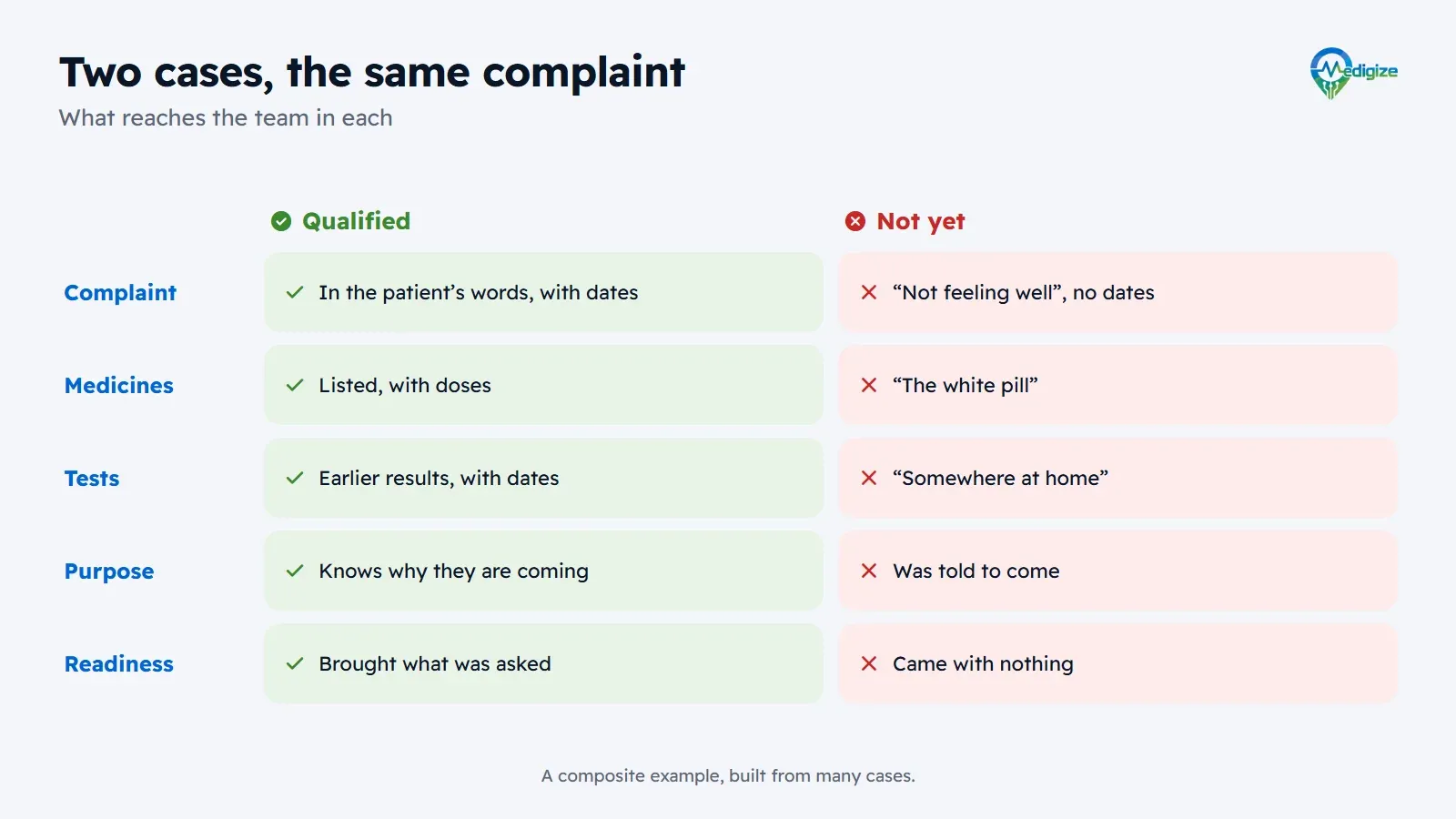
The same complaint, two very different first five minutes.
A composite example, built from many cases. Two patients book the same clinic for the same complaint.
The first arrives with “not feeling well” and no dates. The medicine is “the white pill”. The results are “somewhere at home”. They came because they were told to come. The first minutes go to rebuilding the story: when it started, what was taken, what was found before. Some of it cannot be rebuilt in the room, so the visit ends with a request to come back with the papers.
The second arrives with the complaint in their own words, with dates. Their medicines are listed with doses, and earlier results come with their dates. They know why they are coming, and they brought what was asked. The clinician reads for a minute and starts where the last doctor stopped.
The doctor is the same, and so is the complaint. The difference was made before the visit, by whoever asked the right questions in time. Three questions at booking would have changed the first case: since when, which medicines, and where are the earlier results?
How a clinic can get more qualified cases
A clinic does not need a new system to start. Seven steps that work on paper, by phone, or in whatever system you already use:
- Write down what “complete” means for you. One short list per type of visit: the complaint with dates, current medicines with doses, earlier results with dates, and the reason for the visit. If the team cannot agree on the list, patients cannot meet it.
- Ask when the visit is booked, not at the desk. The days between booking and the visit are when a result can be found and a medicine list written down.
- Ask patients how they want to be contacted. AHRQ’s advice on following up with patients applies here too: having a mobile phone does not mean someone wants to be texted, and sensitive health information should not travel by unsecured email.
- Tell the patient what the visit is for, and what will happen. A patient who knows the purpose can prepare for it. One sentence is often enough.
- Send a short list of what to bring. Medicines or a list with doses, earlier results, and the few questions they most want answered. Suggest bringing someone if that helps them remember.
- Ask referrers for the reason and the question. Not only “please see”, but why, what has already been done, and what the referrer wants answered.
- Measure one typical week. Count how often a case is complete when a clinician first opens it. That number is your starting point, before anything changes.
Do your cases arrive qualified?
Five questions about the cases that reach your team. Answer for a typical week:
Try it
Do your cases arrive qualified?
Five questions about the cases that reach your team. Answer for a typical week.
1. Does the complaint arrive clear, with dates?
2. Are current medicines listed, with doses?
3. Are earlier results available, with dates?
4. Does the patient know why they are coming?
5. Does the patient bring what was asked?
Answered 0 of 5. Your list appears when all of them are in.
A conversation starter, not an assessment. Your answers stay on this page.
Each answer that is not “usually” adds one line to a list you can take to your team.
Common mistakes when qualifying cases
- Using “qualified” to mean “easy”. Qualifying describes the information, never the patient. A complex patient with a complete file is a qualified case.
- Asking for everything. A long form invites skipped answers. Ask for the few things the clinician reads first. We looked at why forms repeat themselves in why every form asks the same questions.
- Asking at the desk. By then the results are at home and the medicine names are forgotten. Ask before.
- Collecting what nobody reads. If the clinician never opens it, stop asking for it, and ask for what they do read.
- Losing it at the next handover. A complete case that is retyped or asked again at the next desk stops being complete. Count manual handoffs as well as missing items.
- Not telling the patient why. A patient who was simply “told to come” cannot prepare for a purpose nobody explained.
Why this matters commercially
A qualified case means less intake time, more accurate referrals and a better patient experience.
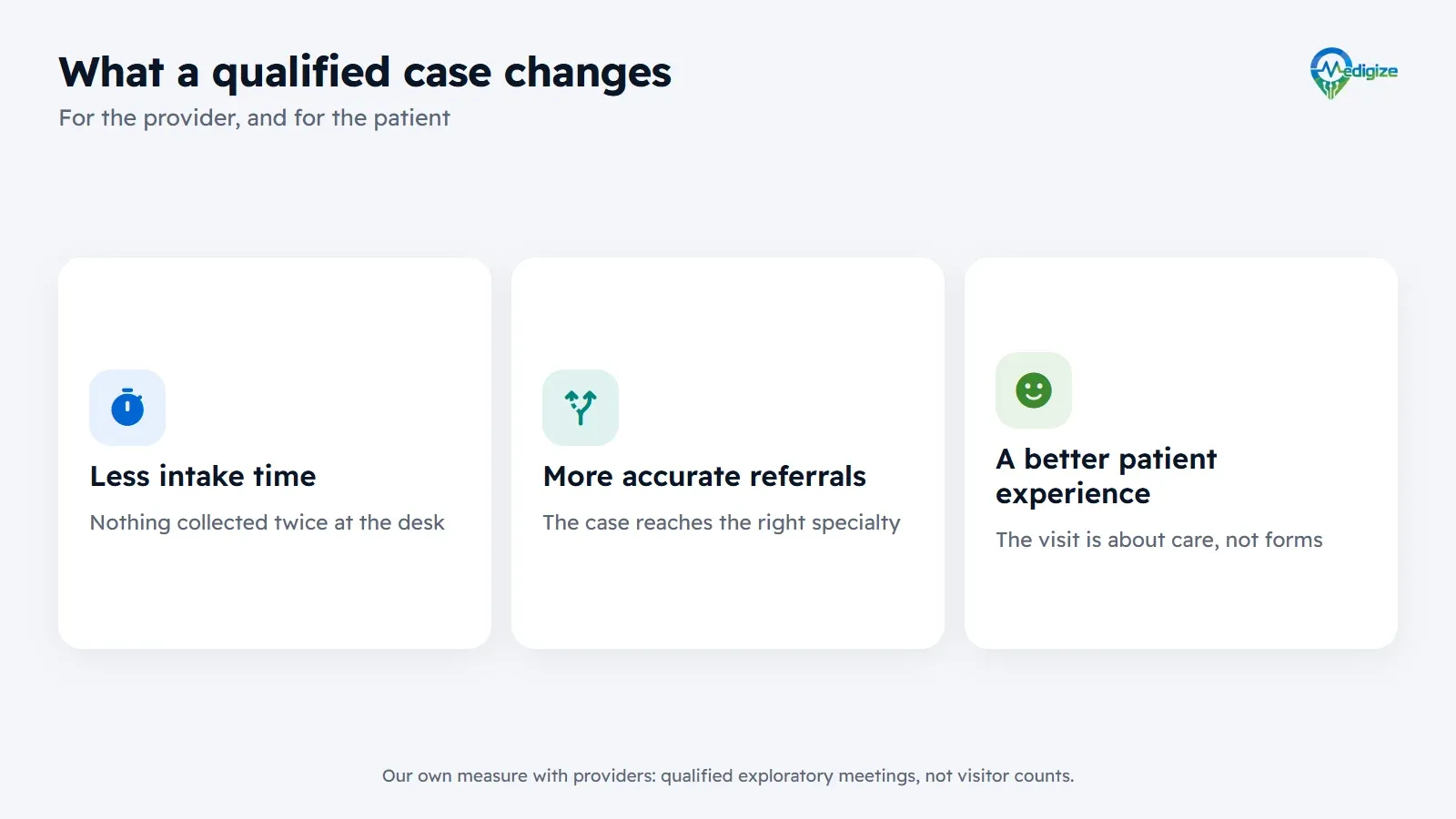
Three gains, before anyone counts visitors.
It is also the measure we hold ourselves to with providers: qualified exploratory meetings, not visitor counts. A hundred visits that each start from zero are worth less to a clinic than ten cases its team can act on. Intake, where all of this happens, is the first of the five stages in what care operations means.
It is also the easiest of these gains to check. Case completeness at first review, the share of cases a clinician can act on when they first open them, is a number any clinic can count by hand this week. Count it before anything changes, and you have a starting point against which any later claim, ours included, can be checked.
What a qualified case means for the patient
For the patient, a qualified case means telling the story once. Without one, the same history is told at every stop, as we followed in seven stops, and every one worked. With one, the minutes in the room go to the question they came with. The National Institute on Aging also suggests telling the doctor about any recent changes, which a page written before the visit makes hard to forget.
Patients can do much of this themselves with a little help. We wrote for them about one page for a specialist, and about five questions to ask before an appointment.
Where Medigize fits
Medigize Dock is designed so that a case reaches the provider with a structured file and a documented pathway, on top of the systems the provider already uses. Most clinics today run on something else entirely, and we wrote about it in the real competitor.
On the patient’s side, MIHOS, the Medigize app, helps a patient organise the complaint before the visit, and shares a record only with their consent and only what is needed. On the provider’s side, Dock is not an electronic medical record, a billing system or an inventory system. It works alongside what a clinic already has, and a first pilot runs in parallel, with no data migration and a starting point measured before anything is claimed. See Medigize for providers.
A qualified case carries information, not conclusions. It does not arrive with a diagnosis attached: organising a complaint is not interpreting it, and the clinician who reads the case decides what it means. We set out why in four rules we do not negotiate.
Frequently asked questions
What is a qualified case in healthcare?
A case that arrives with enough information for the team to decide quickly: a clear complaint with dates, the key medicines and tests, and a patient who knows the purpose of the visit.
Does qualifying a case mean turning patients away?
No. It describes the information that comes with a case, not the patient. Every patient deserves care.
What information should a referral include?
At least the reason for the referral, what has already been done, including tests with their dates, the current medicines, and the question the referrer wants answered.
How can a clinic receive more qualified cases?
Ask for the complaint, current medicines and earlier results before the visit, and tell patients what the visit is for and what to bring.
What should a patient bring to a first visit?
Their medicines or a list with doses, earlier results with dates, a short description of the problem with when it started, and their most important questions. Bringing someone can help.
How do you measure whether cases arrive qualified?
For one typical week, count how often a case is complete when a clinician first opens it. That is case completeness at first review, and it gives you a starting point.
Why do qualified cases matter to a provider?
Less intake time, more accurate referrals and a better patient experience.
How does Medigize help?
Medigize Dock is designed so that a case reaches the provider with a structured file and a documented pathway, on top of the systems already in use.
Medigize is a non-diagnostic navigation tool. This is general information, not medical advice. In an emergency, call an ambulance or go to the nearest emergency department.
References
- Agency for Healthcare Research and Quality: Care coordination
- World Health Organization: Continuity and coordination of care, a practice brief (2018)
- Agency for Healthcare Research and Quality: Follow up with patients, Tool 6
- National Institute on Aging: How to prepare for a doctor’s appointment
- MedlinePlus: Talking with your doctor
- Dubai Health Authority: NABIDH Policies and Standards, Subject of Care Rights (2020)
Last updated:
Explore Medigize
Medigize is in development. Explore our current scope and express your interest.