

“Will we have to replace our system?” It is the first question any hospital asks about a new solution. The answer is no. What a parallel run looks like, and its limits.
“Will we have to replace our system?” It is the first question any hospital asks when it hears about a new solution. The answer is no.
Medigize is an operations layer that sits on top of existing health systems. We work with provider systems; we do not replace them.
What does “on top of your system” mean? Your hospital information system or EMR stays the system of record, unchanged. Medigize works alongside it on the steps around the visit that a record rarely holds: intake, file preparation, handover and follow-up. Nothing is migrated, nothing is switched off, and a first pilot runs in parallel with what you already use.
In short:
- If you run a hospital system or an EMR, it stays your system of record. Medigize coordinates what happens before and after the visit.
- If you run on paper and WhatsApp, Medigize Dock is designed to become your case operating system from day one.
- A first pilot runs in parallel: no data migration, no system shutdown, and a starting point measured before anything is claimed.
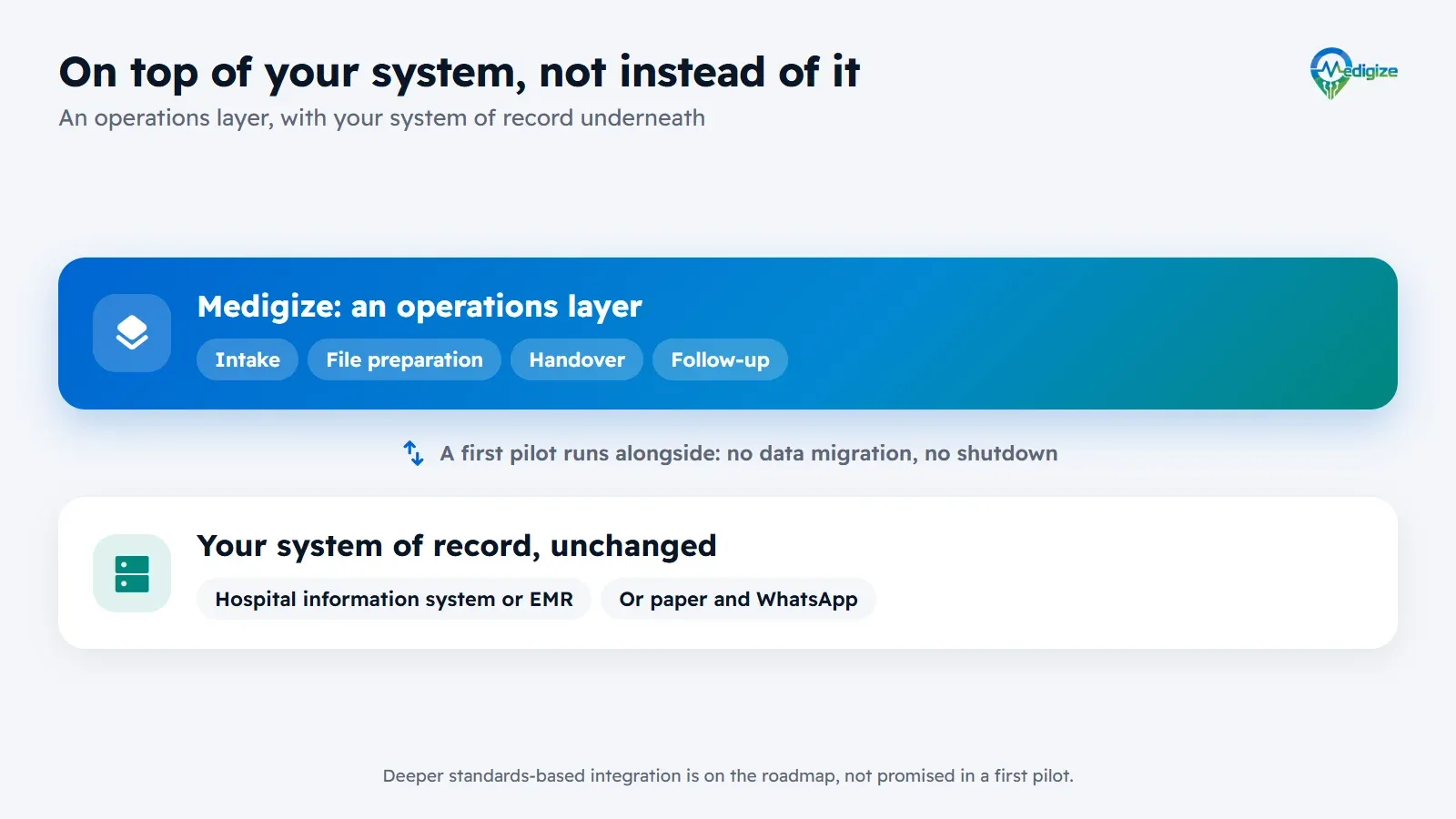
A layer on top, not a replacement underneath.
What do “system of record” and “parallel run” mean? Five terms in plain language
Every conversation about a new system uses these words. This is what we mean by them:
- System of record: the system where the official version of a record is kept. In most hospitals, that is the hospital information system (HIS) or the electronic medical record (EMR).
- Operations layer: software that coordinates the work around the visit, such as who has the case, what is missing and what happens next, without becoming the record itself.
- Parallel run: running a new way of working beside the current one, on real cases, with nothing switched off, so the two can be compared.
- Data migration: moving existing records from one system into another. A first pilot does none.
- Standards-based integration: systems exchanging data automatically through agreed formats. It is on our roadmap, and it is not promised in a first pilot.
If you run a hospital system or EMR
It stays your system of record. We coordinate what happens before and after the visit: intake, file preparation, handover and follow-up.
That is the part of a patient’s journey a system of record rarely sees: the questions before the booking, the file that arrives incomplete, the handover between departments, the follow-up that depends on someone remembering. We described those stages in what care operations means.
The US Agency for Healthcare Research and Quality (AHRQ) lists the activities that live in that space when it describes care coordination: establishing accountability and agreeing on responsibility, sharing knowledge, helping with transitions of care, creating a proactive care plan, and monitoring and follow-up. None of them is a record. All of them are work, and most of it happens between systems.
| What | Where it stays |
|---|---|
| The patient record | Your HIS or EMR |
| Billing | Your billing system |
| Stock | Your inventory system |
| The work around the visit: intake, file preparation, handover and follow-up | Coordinated by Medigize, on top |
If you run on paper and WhatsApp
Medigize Dock is designed to become your case operating system from day one: the case reaches you with a structured file and a documented pathway. Why paper and WhatsApp are the real competitor, and the test we hold ourselves to against them, is in the real competitor.
In plain words, a case operating system is one place where each case is run from intake to follow-up, instead of a chat thread, a paper folder and someone’s memory. For a clinic with no system, there is nothing to sit on top of, so the bar is different: it has to be easier than WhatsApp and safer than paper on the first day, or it will not be used. And if patient details travel by WhatsApp today, the questions in the data-protection law and your clinic apply to them already.
One referral, with and without a layer on top: a composite example
This is a composite example, built from many settings, with no identifying detail. A private hospital with an EMR receives a patient referred by a doctor from outside.
Today. The referral arrives as a photo on a coordinator’s phone. The patient’s earlier results are on paper, in a bag. The coordinator types what they can into the EMR, calls the patient twice for what is missing, and books the appointment. The specialist opens the record and finds the referral note but not the earlier results. After the visit a scan is requested, and whether anyone checks that it happened, and who calls the patient with the next step, depends on who remembers.
With a layer on top. The EMR still holds the record, and the specialist still makes every clinical decision. What changes is around them: the case arrives with a structured file and a documented pathway, what is missing shows before the visit rather than during it, and the step after the visit has an owner written next to it. On the patient’s side, MIHOS, the Medigize app, helps the patient organise the complaint beforehand and shares only what is needed, with their consent.
Whether that saves time is exactly what a first pilot measures. It is not something we claim in advance.
What does a parallel run look like?
A first pilot starts with no data migration and no system shutdown. We work alongside what you have, measure, and decide together. Deeper standards-based integration is on the roadmap and is not promised in a first pilot.
In practice, a parallel run has five steps:
- Choose the scope. Which cases, which team, and beside which system. Small enough to watch closely.
- Measure the starting point. The four measures below, for two ordinary weeks, before anything changes.
- Run alongside. Your system of record keeps doing what it does. Nothing is migrated and nothing is switched off.
- Measure again, with the same definitions, so the comparison is fair.
- Decide together: continue, change something, or stop.
A parallel run has a cost, and it is better named at the start. Without integration, some information may be kept in two places for a while. Agree in advance what goes where, and keep the pilot small enough for that to stay manageable.
Four people make a parallel run work: a clinician who can say whether a case was complete, whoever runs the front desk or coordination, someone from IT who can confirm that nothing in the system of record changes, and whoever looks after data protection. Agree who decides at the end before the first case, not after the last one.
Explicit limits: what Medigize Dock is not
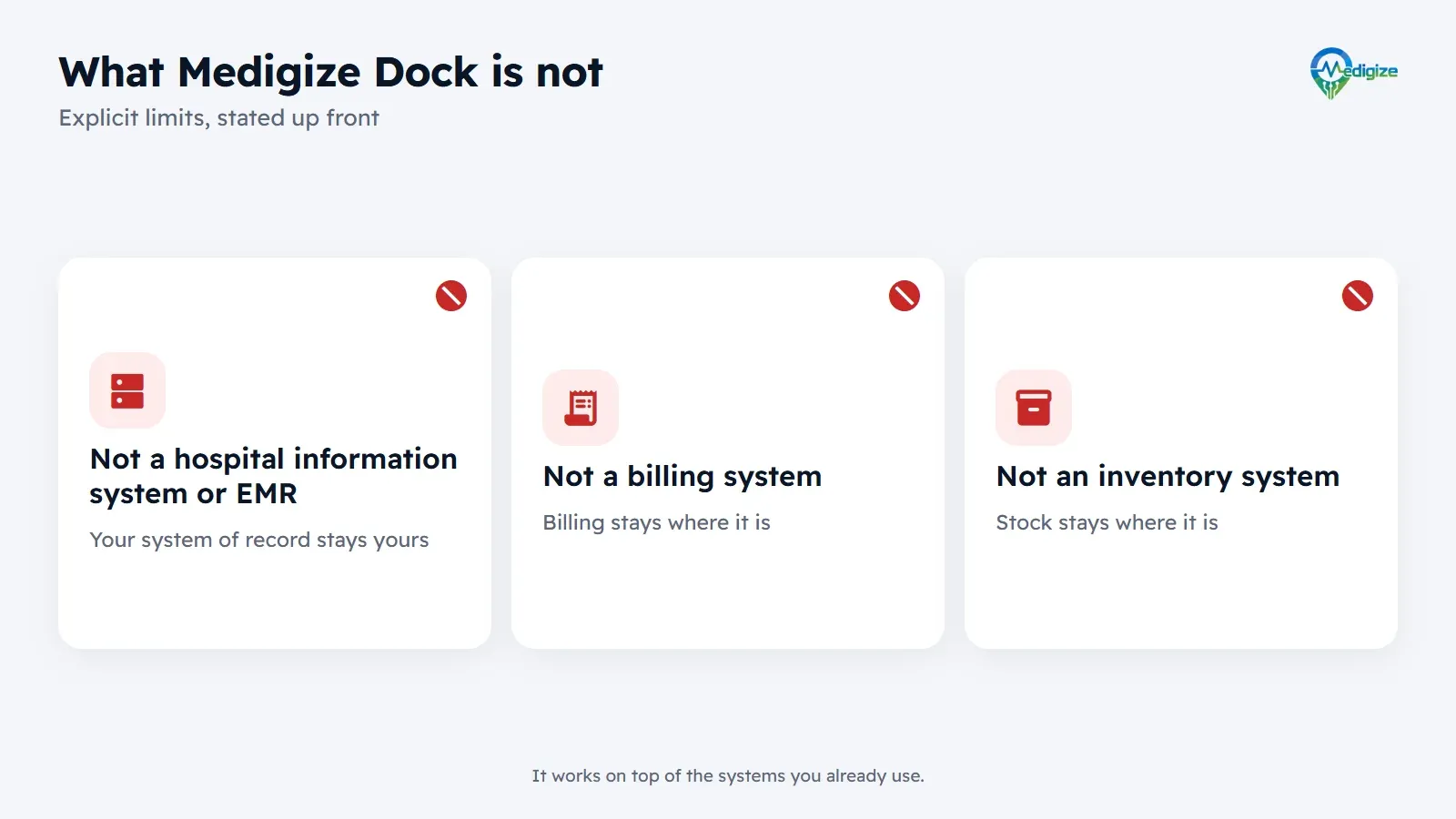
Saying what it is not is part of saying what it is.
- Medigize Dock is not a full hospital information system or EMR.
- It is not a billing system.
- It is not an inventory system.
Each limit protects something you already have. A coordination tool that drifts into keeping the record, the bills or the stock becomes a second system of record, and two versions of the same record are an invitation to error. So the line stays where it is: the case and the work around it on top, everything else where it already lives.
What a first pilot measures
Case completeness at first review, manual handoffs per case, time to the next step, and how often follow-up disappears. We will not promise improvement before we know the starting point.
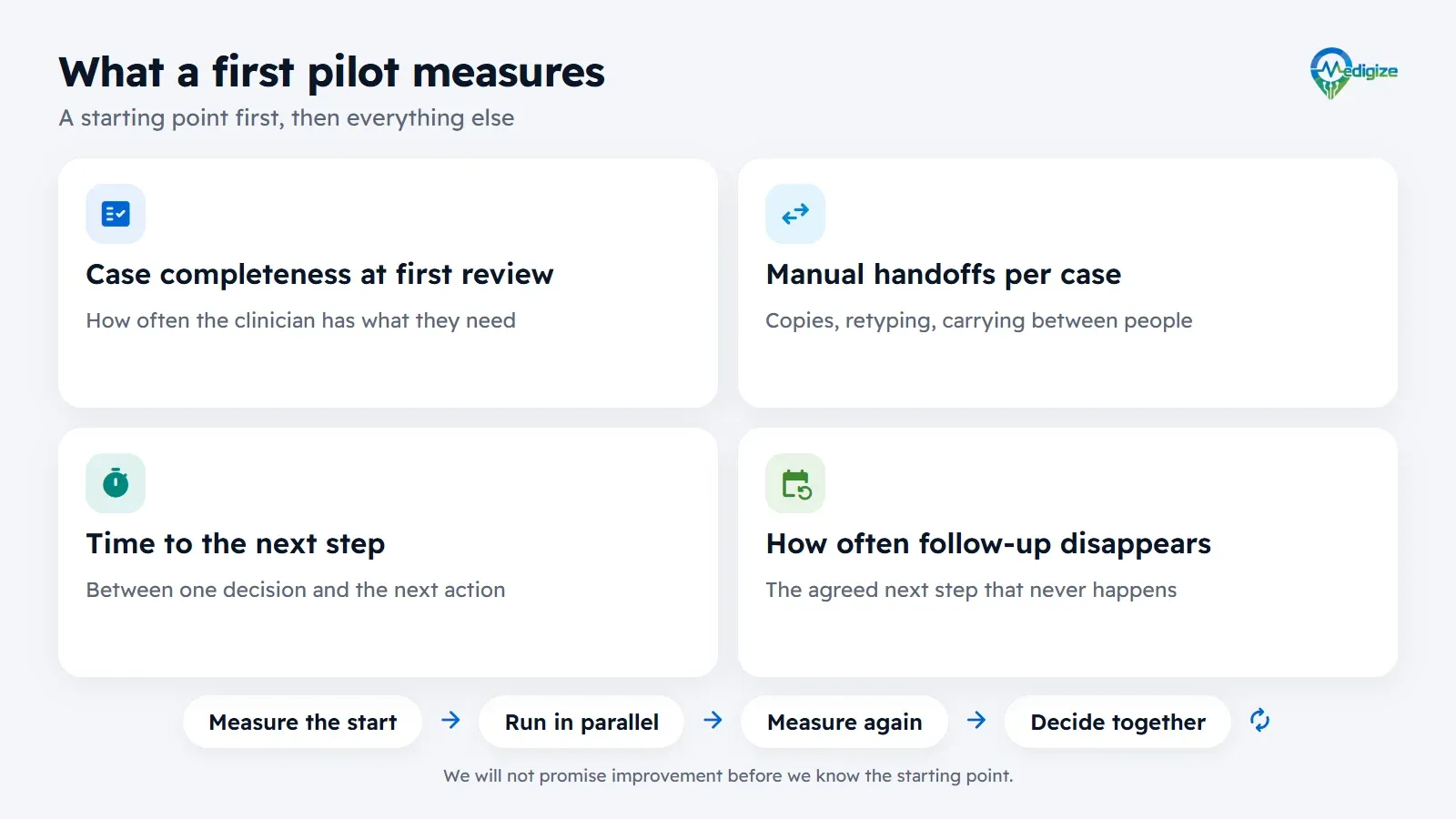
The starting point first, then everything else.
Each measure can be counted without new software, on paper if need be:
- Case completeness at first review: of the cases a clinician opens, how many have what they need at first look. What “complete” means is in what makes a case qualified.
- Manual handoffs per case: how many times a case is copied, retyped or carried between people by hand.
- Time to the next step: from a decision, such as “book the scan”, to the action actually happening.
- How often follow-up disappears: how often an agreed next step never happens. Why that one matters is in why follow-up matters.
Write the definitions down before you count. “Complete” and “next step” mean different things to different teams, and a baseline is only useful if the second count uses the same words as the first.
Do you know your starting point today? Five questions, for a typical week:
Try it
Do you know your starting point?
Five questions before any pilot. Answer for a typical week.
1. Do you know how often a case is complete when a clinician first opens it?
2. Do you know how many times a case is handed over by hand?
3. Do you know how long patients wait between a decision and the next step?
4. Do you know how often an agreed follow-up never happens?
5. Could a pilot run beside your current system, without moving any data?
Answered 0 of 5. Your list appears when all of them are in.
A conversation starter, not an assessment. Your answers stay on this page.
Questions to ask before any pilot, including ours
- What stays our system of record, and does anything in it change?
- Is any data migrated, or any system switched off?
- Which patient data does the pilot need, who sees it, and on what basis? Our answer: sharing by consent, only what is needed, and a trail of who looked.
- How are patients told about the pilot, and what happens if one of them declines to share their data?
- Was the starting point measured before the pilot began, with definitions both sides agreed?
- Who decides at the end, and what happens if the answer is to stop?
- What is explicitly not promised? For us, deeper standards-based integration in a first pilot.
Any supplier, including us, should be able to answer all seven in writing before the first case.
A regional example: what NPHIES shows about integration
Saudi Arabia’s NPHIES platform relies on providers and insurers connecting their systems to it, which shows that system integration is large, slow work. In a 2022 interview about the platform, integrating hospital, radiology and revenue-cycle systems with it was described as part of what providers and payers need in order to use it. The same interview describes NPHIES, the National Platform for Health and Insurance Exchange Services, as having an insurance side and a clinical side that includes unified health records, with an onboarding team that certifies IT vendors’ solutions for integration.
In a 2023 interview, the medical director of the kingdom’s health insurance council described connecting hospitals on the health side as costly and complex, needing manpower, equipment, education, technical implementation and adoption.
None of this is a criticism. It is what connecting systems properly takes, at national scale. A first pilot that waited for that work would never start, and one that skipped it would promise what it cannot deliver. That is why we start with something lighter.
Frequently asked questions
Do we have to replace our hospital system to use Medigize?
No. Your hospital information system or EMR stays your system of record. Medigize coordinates what happens before and after the visit.
What if our clinic runs on paper and WhatsApp?
Medigize Dock is designed to become your case operating system from day one, with a structured file and a documented pathway for each case.
Does a first pilot need data migration?
No. A first pilot starts with no data migration and no system shutdown. It runs alongside what you already have.
Does Medigize integrate with EMRs?
Deeper standards-based integration is on the roadmap. It is not promised in a first pilot, which works alongside your system.
Why not integrate with our EMR from the start?
Because integration is large, slow work, as national platforms such as NPHIES show. A first pilot starts lighter, and measures before it claims anything.
Is Medigize Dock a billing or inventory system?
No. It is not a hospital information system, an EMR, a billing system or an inventory system. Those stay where they are.
What does a first pilot measure?
Case completeness at first review, manual handoffs per case, time to the next step, and how often follow-up disappears, starting from a measured baseline.
What happens at the end of a pilot?
The same measures are taken again and compared with the starting point, and we decide together whether to continue, change something or stop.
Medigize is a non-diagnostic navigation tool. This article is general information, not medical advice. In an emergency, call an ambulance or go to the nearest emergency department.
References
Last updated:
Explore Medigize
Medigize is in development. Explore our current scope and express your interest.