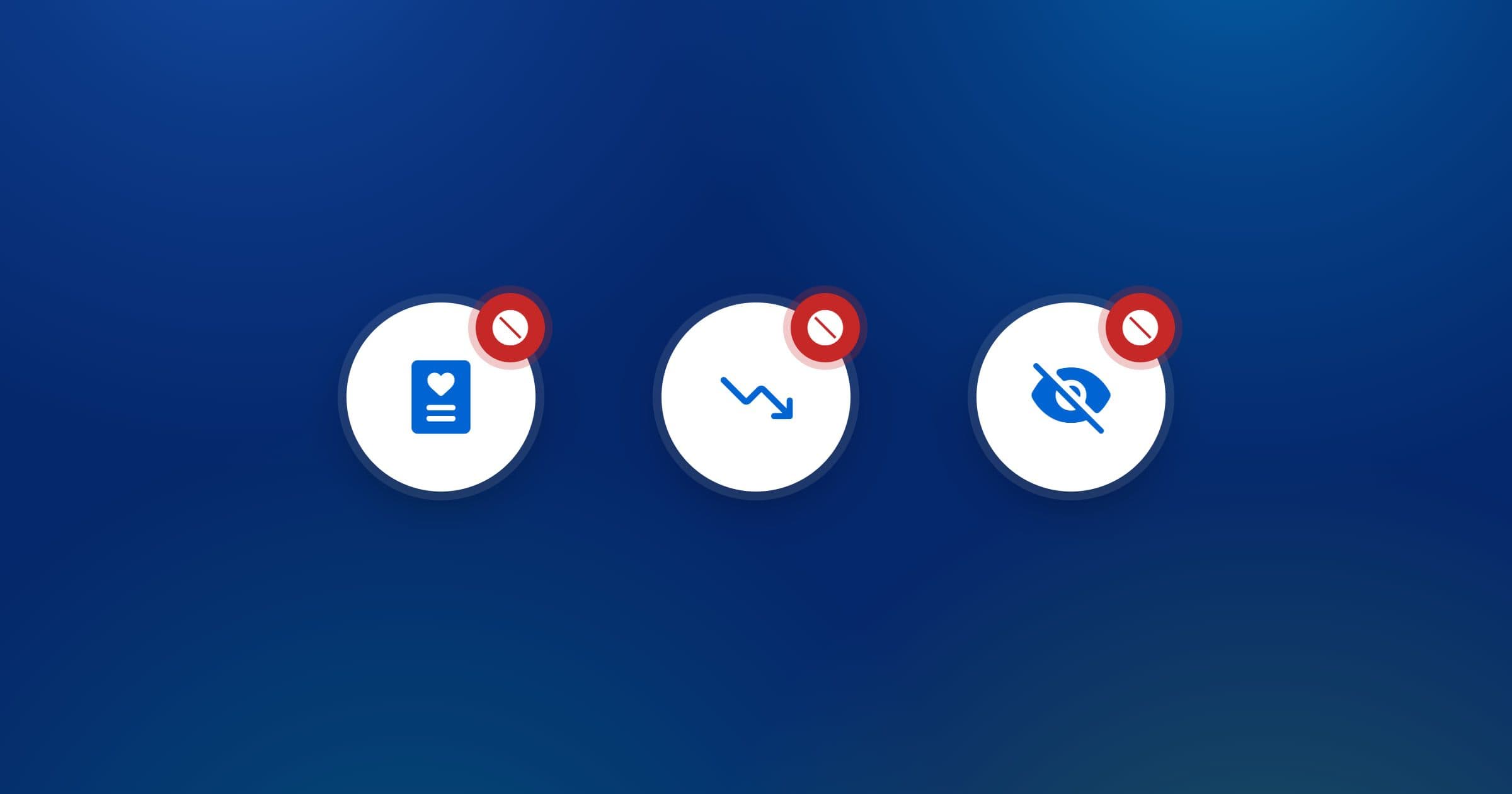
Product decisions are known by what you say no to. Medigize has three: no diagnosis, no lowered urgency, and no silent guessing.
Product decisions are known by what you say no to. Medigize has three.
In short:
- No diagnosis. No screen will tell a patient “you have X”.
- No lowered urgency. When in doubt, priority goes up.
- No silent guessing. Every output passes a validation gate and leaves a review trail.
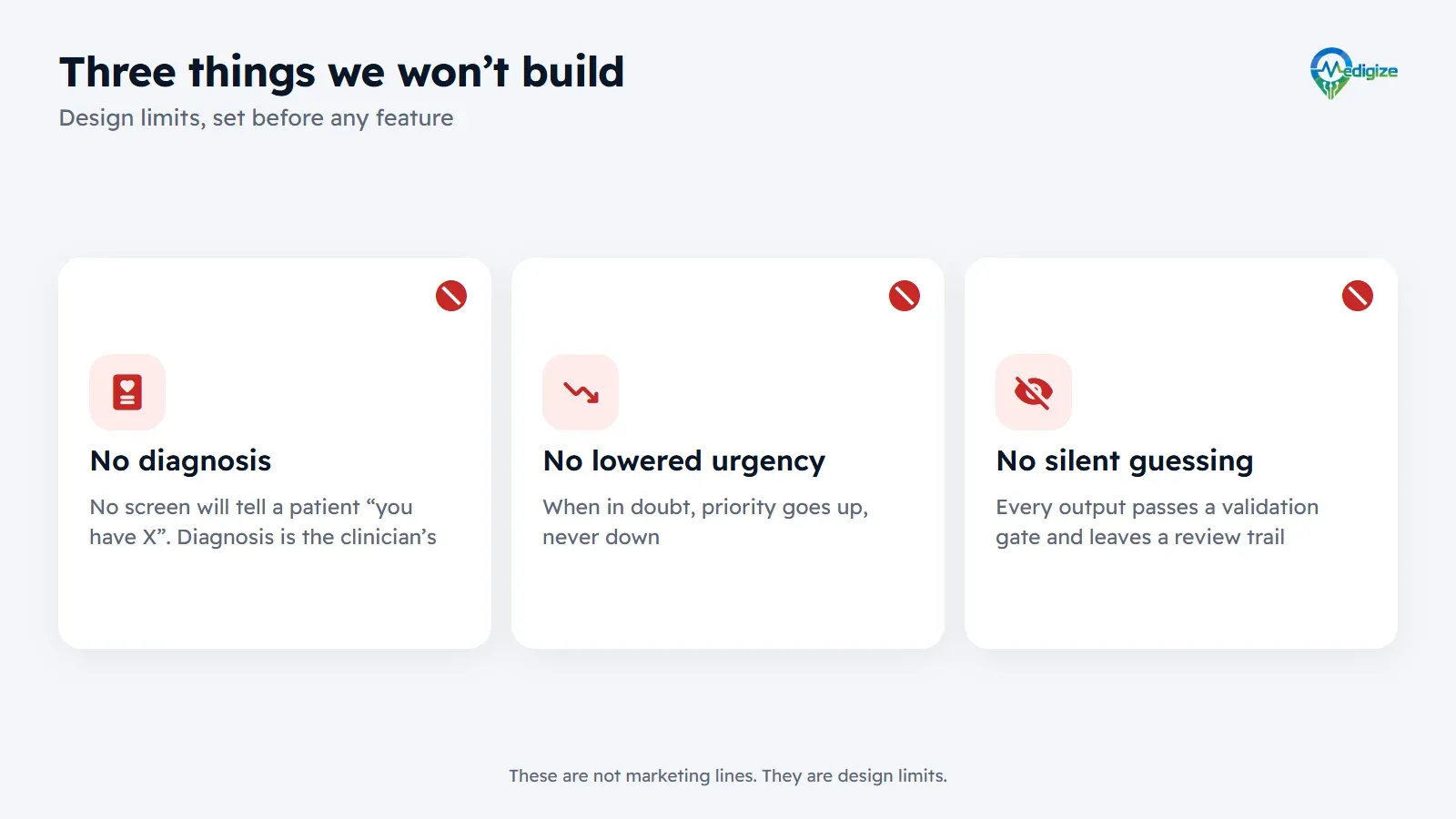
Three limits, set before any feature.
No diagnosis
No screen will tell a patient “you have X”. Diagnosis is the clinician’s responsibility.
What we build sits before and around that decision: organising the complaint, flagging warning signs, pointing to a suitable level of care, and preparing the case so the clinician starts with the information. The diagnosis itself happens with a clinician who can examine the patient.
No lowered urgency
When in doubt, priority goes up. The tool never reduces a case’s urgency because it is “probably minor”.
This is a deliberate trade. A cautious tool will sometimes point someone to more care than they needed, and we accept that cost rather than the opposite one. We set out the reasoning in urgency is the clinician’s call.
No silent guessing
Every output passes a validation gate and leaves a review trail. No decision is taken that nobody can look back at.
It is a commitment about how the system is built: outputs are checked before they are shown, and the way they were reached can be reviewed afterwards. A system that cannot be looked back at cannot be corrected, and in healthcare, being correctable is part of being safe.
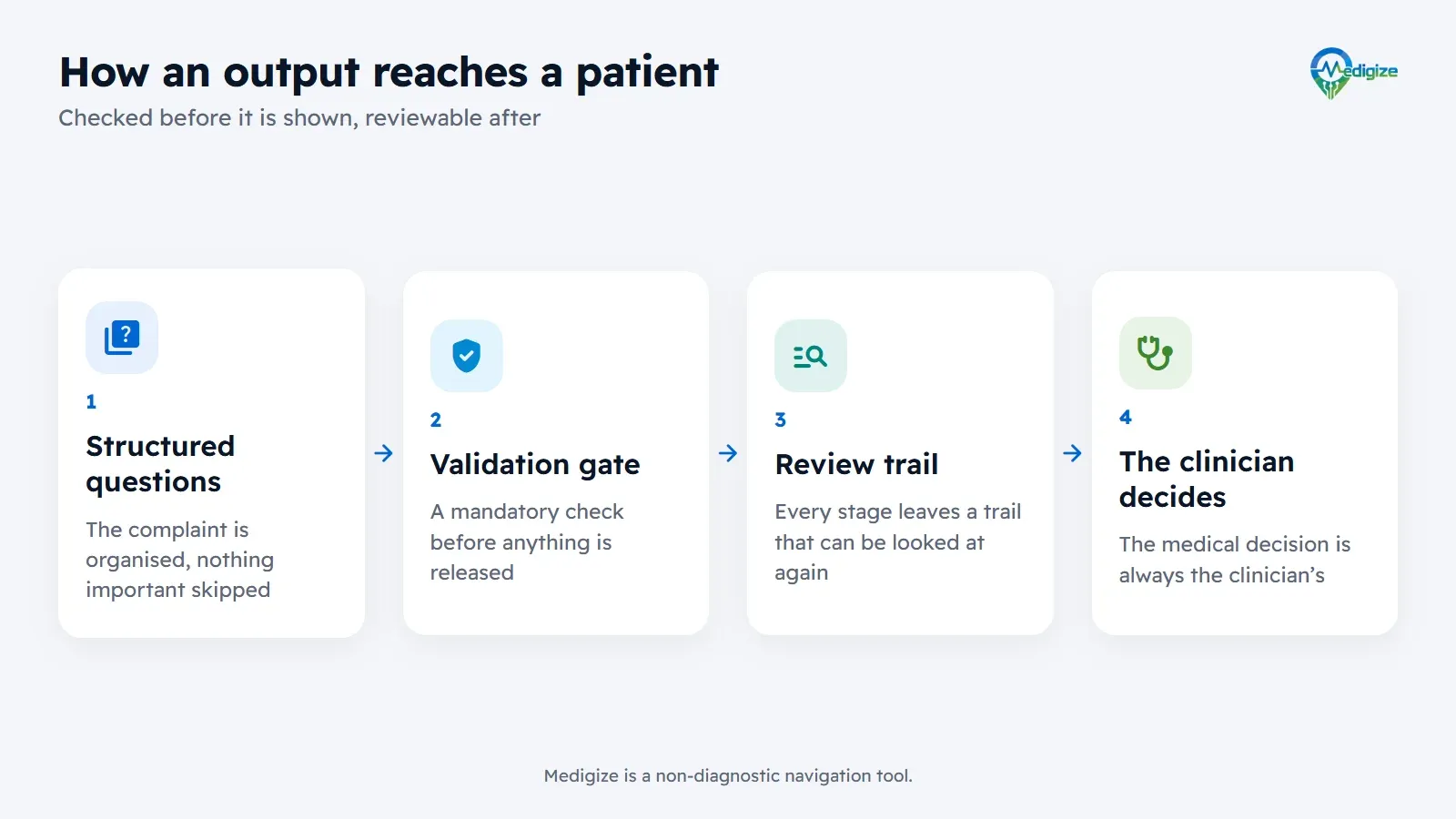
Checked before it is shown, reviewable after.
What we will do, and what we won’t
Saying no is only half of it. The other half is what those limits leave room for:
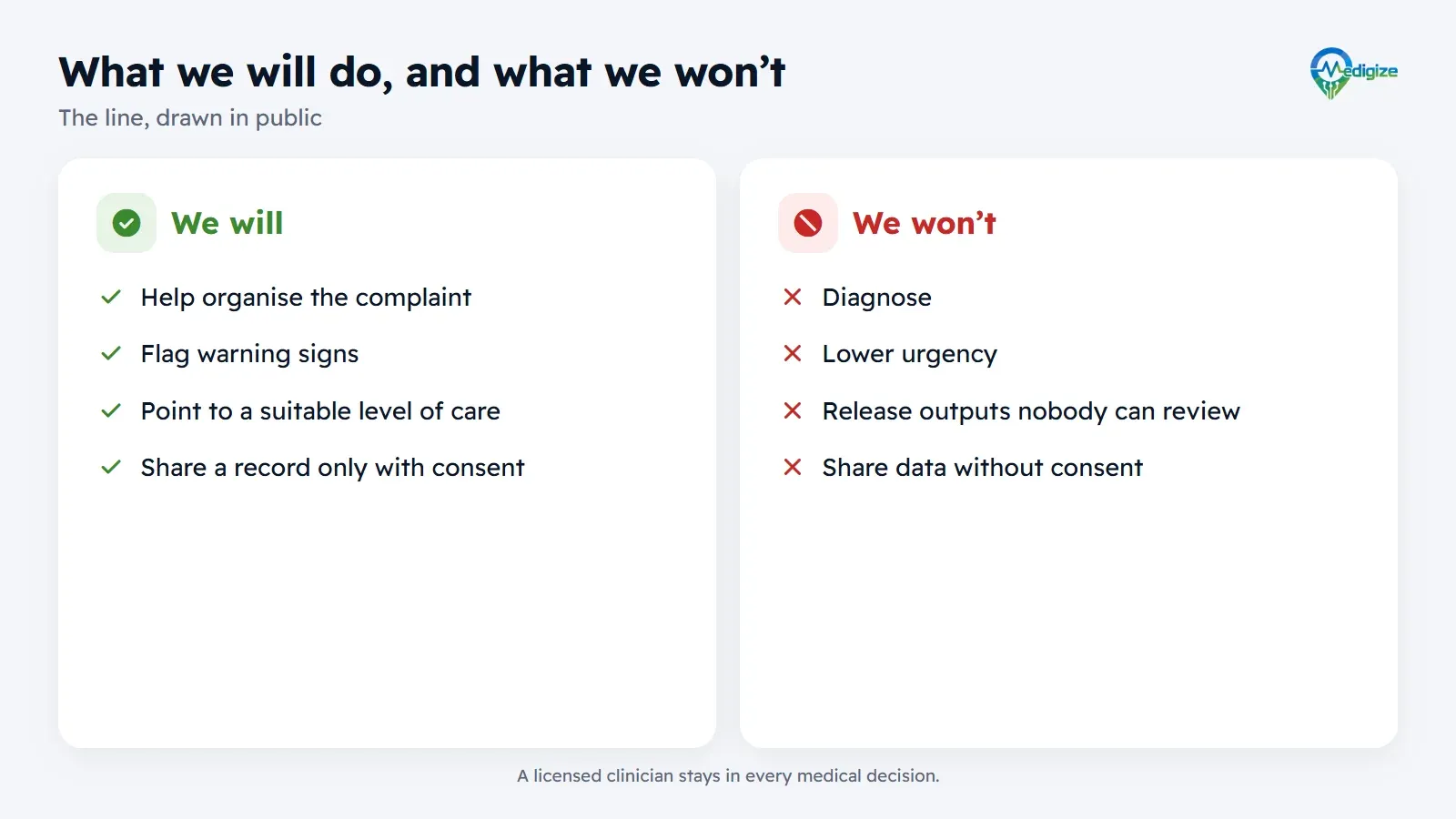
The line, drawn in public.
- We will help a patient organise their complaint, flag warning signs, point to a suitable level of care, and share a record only with their consent.
- We will not diagnose, lower urgency, release outputs nobody can review, or share data without consent.
Would we build it? Test yourself
Six things a health product could do. For each one, decide whether it fits inside these limits.
Try it
Would Medigize build this?
Six things a health product could do. Decide whether each fits inside our three limits.
1. A screen that tells you “you have X”
2. Help you organise your complaint before a visit
3. Lower a case’s urgency because it is probably minor
4. Show an output that never passed a check
5. Share your record with a new doctor without your consent
6. Keep a licensed clinician in every medical decision
0 of 6 answered
Your answers stay on this page.
Why say no in public
These are not marketing lines. They are design limits we commit to before we talk about features.
Writing them down in public does two things. It gives patients and clinicians a way to hold us to them, and it makes every feature we build later pass the same test: does it keep the diagnosis with the clinician, keep urgency from going down, and leave a trail?
For how we approach data and consent, see governance and privacy. For the series so far, start with Every patient journey starts with a question.
Frequently asked questions
Does Medigize diagnose patients?
No. No screen tells a patient which condition they have. Diagnosis is the responsibility of a licensed clinician.
Will Medigize tell me my symptoms are not serious?
No. It will not reassure you about something that needs examination, and it never lowers a case’s urgency because it seems minor.
What is a validation gate?
A mandatory check every output passes before it is shown. Together with a review trail, it means outputs are checked first and can be looked at again later.
Who makes the medical decision?
A licensed clinician, in every case. Medigize prepares the case and organises the journey around that decision.
Is Medigize an AI doctor?
No. Medigize is AI-assisted navigation and care operations software. It does not diagnose or treat, and a clinician stays in every medical decision.
Medigize is a non-diagnostic navigation tool. This is general information, not medical advice. In an emergency, call an ambulance or go to the nearest emergency department.
References
Last updated:
Explore Medigize
Medigize is in development. Explore our current scope and express your interest.