

A patient who travels for treatment faces a non-medical problem: paperwork. What to take, what to ask before you go, and how to bring the file home again.
A patient who travels for treatment faces a non-medical problem: paperwork. Reports in one language, results in one system, imaging on a disc.
A family in Cairo preparing for care in Dubai knows the question that keeps coming back: what do we take, and will they be able to read it?
What documents do you need for treatment abroad? Copies of your medical records, including test results and imaging reports with their dates, the images, a list of your medicines with brand and generic names, any allergies, and copies of your prescriptions. Ask the receiving facility what it needs, and in which language, before you travel, and get copies of everything before you come home. Rules change, so check them with the facility or the authority.
In short:
- Paperwork is the non-medical problem of travelling for care: reports in one language, results in one system, imaging on a disc.
- Ask the receiving facility what it needs before you go, check the rules for any medicines you carry, and get copies of everything before you come home.
- Moving health data across borders is regulated, in Egypt and in the UAE. Whoever moves your file should be able to say how, to whom, and with what consent.
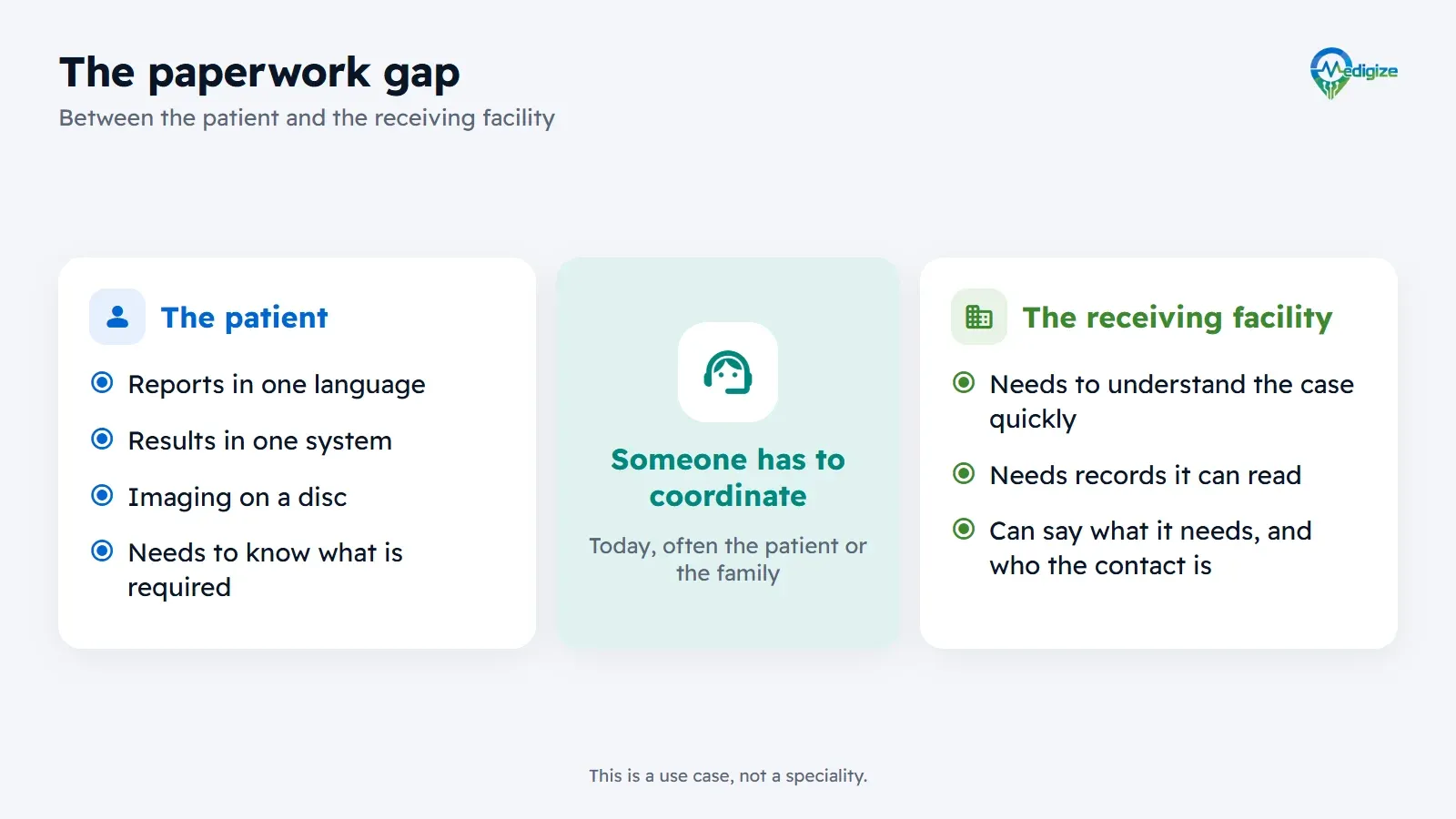
In between, someone has to coordinate.
Why is paperwork the hard part of travelling for care?
Every page in a patient’s file was written for a reader at home. A handwritten report, results from another lab system, a disc with no written report: abroad, each becomes a question.
The World Health Organization’s practice brief on continuity and coordination of care names the risks when care is fragmented, among them failed communication, information not shared and repeated tests. A border adds a language. The US Centers for Disease Control and Prevention (CDC) warns that receiving care where you do not speak the language fluently could lead to misunderstandings about your care, and a 2020 review in the Oman Medical Journal found that language barriers harm the quality of care and patient safety.
The gap: someone has to coordinate
The receiving facility needs to understand the case quickly. The patient needs to know what is required. In between, someone has to coordinate.
Today, that someone is often the patient, or a son or daughter with a phone full of photos. Each side can make the job smaller. The clinic at home can hand over a short report with dates and imaging with its written report. The receiving facility can say, before the patient travels, which records it needs and who the patient’s one contact is. And the patient can keep it all in one folder, as in keep a personal health folder.
What documents should you take for treatment abroad?
CDC advises bringing copies of your medical records, including lab and other test results, telling the staff at your destination about any allergies, and bringing copies of your prescriptions and a list of your medicines with their brand names, generic names, manufacturers and doses. In practice, the file holds six things:
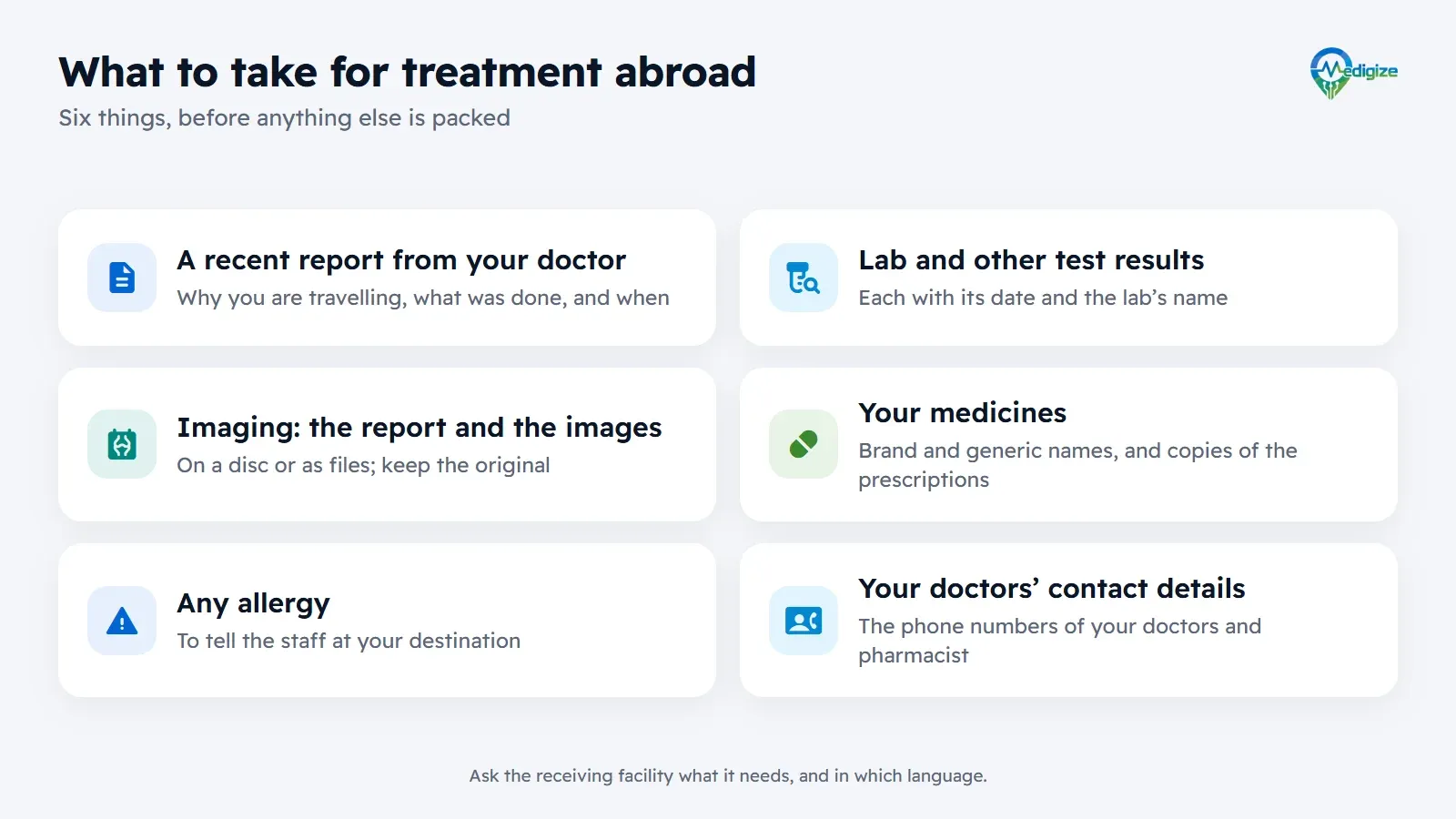
Six things, before anything else is packed.
- A recent report from your doctor at home: why you are travelling, what has been done so far, and when. One or two pages spare the receiving team from rebuilding the story.
- Lab and other test results, each with its date and the lab’s name.
- Imaging: the report and the images, on a disc or as files. Ask whether the facility can open the disc, and keep the original.
- Your medicines. Brand names are not the same everywhere, so write the generic name beside each one, as CDC suggests, and bring copies of the prescriptions.
- Any allergy, written down, to tell the staff at your destination.
- Your doctors’ contact details. The US National Institute on Aging (NIA) suggests carrying the phone numbers of your doctors and pharmacists when you travel.
Check every page for your name and date of birth. Getting the copies is covered in how to get a copy of your medical records.
Before you travel: seven steps
- Ask the receiving facility what it needs: which records, in which language and format, by when, and who your contact is.
- Ask about language: whether reports in Arabic are accepted, and whether a translation must be certified. CDC advises deciding ahead of time how you will communicate.
- Gather the file in one folder, in date order, with your doctor’s report on top.
- Check the rules for any medicines you carry, as in the next section.
- Ask what it will cost: what is included, and what may cost extra. More on comparing facilities is in choosing between providers.
- Arrange follow-up at home before you leave. CDC advises making sure you can get follow-up care after you return, and warns that care for complications can be expensive and may not be covered by insurance.
- Make a second copy of the whole file, and keep it apart from the first.
Not sure what to ask? Tick the questions that apply, add your own, and write the answers as you get them:
Try it
Questions before you travel for care
Tick the questions you want to ask the receiving facility or your doctor at home, add your own, and write the answers as you get them. Then copy, print or send the list to yourself.
5 questions on your list.
What you type stays on this page. Nothing is saved or sent unless you copy, print or send it yourself.
Travelling with medicines: check the rules first
Medicines are part of the paperwork. The Embassy of the United Arab Emirates in Washington says travellers must carry the prescription for the quantity of medicine they bring, and should check with their doctor whether a prescribed medicine is controlled: controlled medication needs approval through the Ministry of Health’s website before the trip, while other medicines, prescription or over the counter, do not need prior approval.
Three habits help on any trip:
- Keep medicines in their original packaging, with enough for the whole trip and a little extra in case of delays (CDC).
- Carry them with you rather than in checked luggage, with a list of everything you take and your doctors’ phone numbers (NIA).
- Write both brand and generic names on the list (CDC).
Rules change, and the list of controlled medicines is the ministry’s, not ours. Check the Ministry of Health and Prevention’s current guidance, or ask the nearest UAE embassy or consulate, before you travel.
At the facility in Dubai: consent, language and copies
The Dubai Health Authority’s standard on health information consent describes NABIDH as its health information exchange connecting public and private healthcare facilities in Dubai. Under that standard, consent should be specific, freely given, informed and unambiguous, given in writing in Arabic or English, in language the patient understands, with a translation if necessary. Patients should be able to object to sharing where the law allows, after the consequences are explained.
Read what you sign, and ask about anything unclear. The authority’s NABIDH patient-rights policy also provides for patients to upload clinical and laboratory documents from treatment outside Dubai and the UAE through its portal, and makes them responsible for uploading the correct ones; ask the facility whether that applies to you.
Before you leave, get copies. CDC advises getting copies of all your medical records from the facility before you return home, and notes they may need translating. Ask for what was done, the results and images, your medicines with any changes, and the plan.
If you become unwell abroad, the rule is the same as at home: with severe chest pain, trouble breathing, fainting or signs of a stroke, call an ambulance on the local emergency number or go to the nearest emergency department. Save that number when you arrive.
Back home: closing the loop
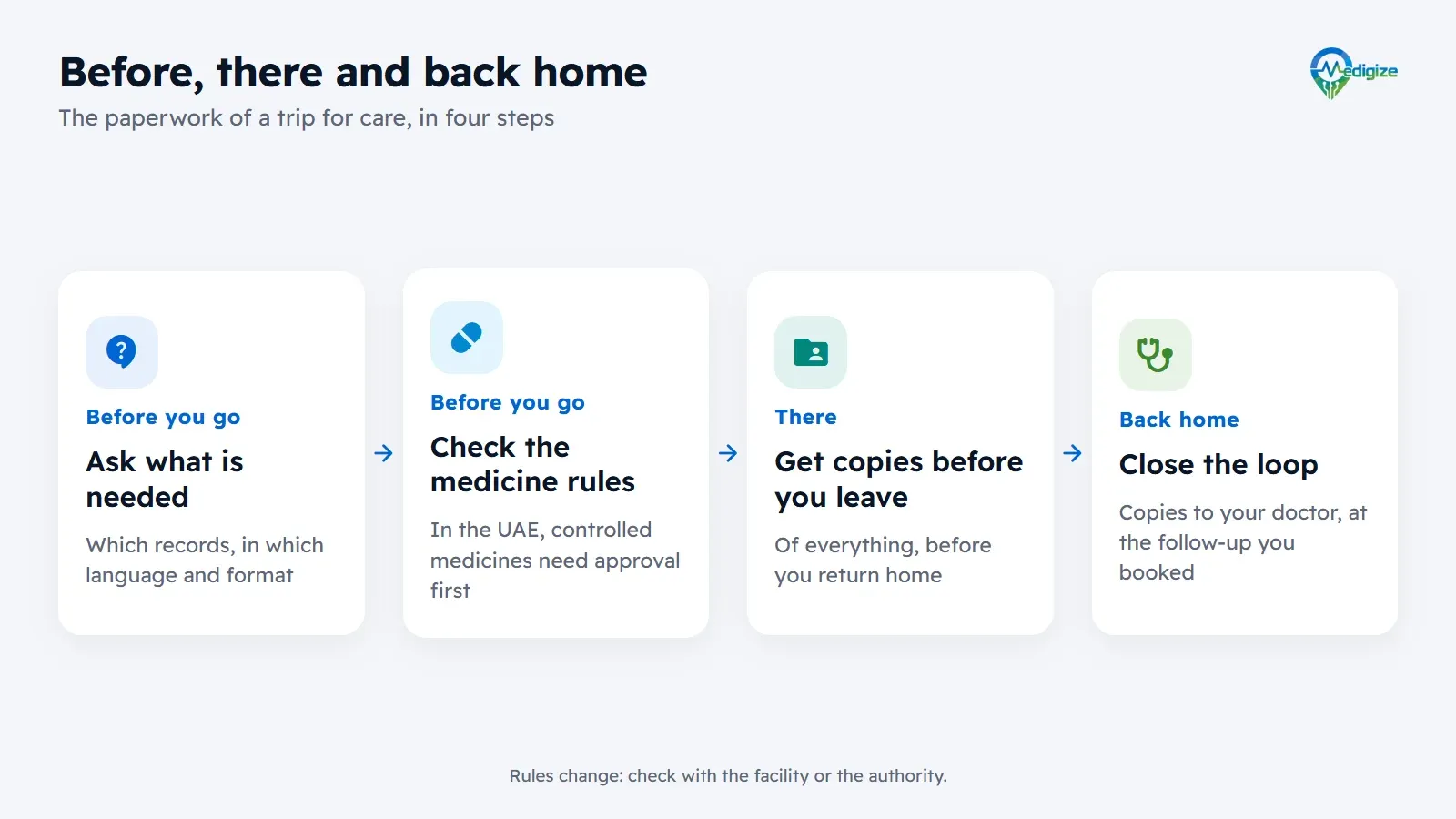
The trip, and the paperwork, in four steps.
The trip is not over at the airport. The report from abroad has to reach the doctor who follows you at home, in a language that doctor reads. Take the copies to the follow-up you booked, add them to your folder, and say what changed; the four lines in why follow-up matters apply here too. For the clinic at home: ask returning patients for their copies, and read the medicines list first.
A legal note: moving health data across borders
Moving health data across borders is regulated, including by Egypt’s data-protection law and its executive regulations. Any tool must respect that by design.
According to published legal commentary on the executive regulations, health data is sensitive personal data, with explicit written consent required to process it, and cross-border transfers are not automatic: a controller must obtain a separate licence or permit from the Personal Data Protection Center before transferring personal data outside Egypt, and the Center assesses whether the destination offers adequate protection. Commentary expects enforcement from 1 November 2026, a timeline the regulator may clarify.
The UAE has rules of its own: the Dubai Health Authority’s consent standard lists among its references Federal Law No. 2 of 2019 on the use of information and communications technology in health care, and a 2021 ministerial decision on the health data that may be stored or transferred outside the country.
When anyone offers to send your file abroad, ask how it will travel, who will receive it, and what you are consenting to. For clinics, see the data-protection law and your clinic. This is general information, not legal advice, and rules change.
A composite example: one file, two countries
A composite example, built from many cases, with no identifying detail. A man in his fifties in Cairo is booked for a specialist consultation in Dubai.
Unprepared. He packs a bag of reports, a disc of images and his medicine boxes in his suitcase. Two reports are handwritten, the disc has no written report, and he cannot remember when he started one of his medicines. Part of the first appointment goes on rebuilding the story, and he flies home with no copies.
Prepared. Two weeks before, he asks the facility what it needs. His doctor writes a two-page report with dates, and his daughter puts the results in one folder, the disc with its report. His medicines travel in his hand luggage with their prescriptions and a list. He reads the consent form before signing, asks for copies before leaving, and takes them to the follow-up he booked before he flew.
The doctors and the treatment are the same in both versions. Only the paperwork changed.
Common mistakes, and how to avoid them
- Medicines in checked luggage. Carry them with you, with the list.
- A disc without its report. Bring both.
- Leaving without copies. Ask before you go home.
- Assuming the rules have not changed. Check them before every trip.
Where Medigize sits
This is a use case, not a speciality. We treat it as one of the cases that benefit from an organised journey.
Cross-border care shows every weak point of a journey at once. That does not make Medigize a medical travel agency. MIHOS, the Medigize app, is building a record that moves with the patient, shared only with their consent, and Medigize Dock runs each case from intake to follow-up on top of the systems providers already use. We do not claim any connection with NABIDH or any other national platform. See Medigize for patients and our governance and privacy page.
Frequently asked questions
What documents do I need for medical treatment abroad?
Copies of your records with their dates, the images, a list of your medicines with brand and generic names, any allergies, and copies of your prescriptions. Ask the facility what else it needs.
Do my medical reports need to be translated?
Ask the receiving facility which languages it accepts, and whether a translation must be certified.
Can I take my medicines with me to the UAE?
Carry the prescription for the quantity you bring. Controlled medicines need approval before the trip, according to the UAE Embassy in Washington. Ask your doctor whether yours is controlled.
How do I take my X-rays and scans abroad?
Bring the written report with the images, and ask which format the facility can open. Keep the originals.
Can a hospital in Dubai see my medical records from Egypt?
Not automatically. NABIDH connects facilities in Dubai. Ask the facility whether you can add documents from abroad, and bring copies anyway.
Is it legal to send my medical records abroad?
For organisations that hold your data, published commentary on Egypt’s executive regulations describes a licence or permit before personal data leaves Egypt. This is not legal advice.
What should I bring back from treatment abroad?
Copies of all your records, including your medicines with any changes and the follow-up plan.
Does Medigize arrange treatment abroad?
No. Medigize is a non-diagnostic navigation tool, not a medical travel agency.
Medigize is a non-diagnostic navigation tool. This is general information, not medical advice. In an emergency, call an ambulance or go to the nearest emergency department.
References
- Centers for Disease Control and Prevention: Medical tourism
- Embassy of the United Arab Emirates in Washington: Permitted prescriptions and drugs while entering the UAE
- Dubai Health Authority: Standards for Health Information Consent and Access Control (2025)
- Dubai Health Authority: NABIDH Policies and Standards, Subject of Care Rights (2020)
- National Institute on Aging: Taking medicines safely as you age
- World Health Organization: Continuity and coordination of care, a practice brief (2018)
- Al Shamsi H, et al. Implications of language barriers for healthcare: a systematic review. Oman Medical Journal (2020)
- Chambers and Partners: A first look at Egypt’s personal data protection executive regulations
- CMS: Egypt’s PDPL executive regulations issued, one-year compliance countdown begins
Last updated:
Explore Medigize
Medigize is in development. Explore our current scope and express your interest.