


When a patient compares two clinics or hospitals, they rely on ratings, reputation and the price they hear. Important information is missing. What to ask, and how to compare fairly.
When a patient compares two clinics or hospitals, they rely on ratings, reputation and the price they hear. Important information is missing: real distance, specialty experience and waiting time.
How do you choose between two doctors or clinics? Start with the right specialty for your complaint. Then compare each option on the same points: whether the doctor often sees problems like yours, the real journey, how soon you can be seen, the total cost, language, and what happens after the visit. Ratings and reputation are a starting point, not the whole picture. In an emergency, do not compare: call an ambulance or go to the nearest emergency department.
In short:
- Ratings, reputation and the price you hear leave out three things that matter: real distance, specialty experience and waiting time.
- Ask every option the same questions and write the answers side by side. The decision stops being a guess.
- There is no single best provider. There is the one that fits what you need, and you are the one who weighs it.
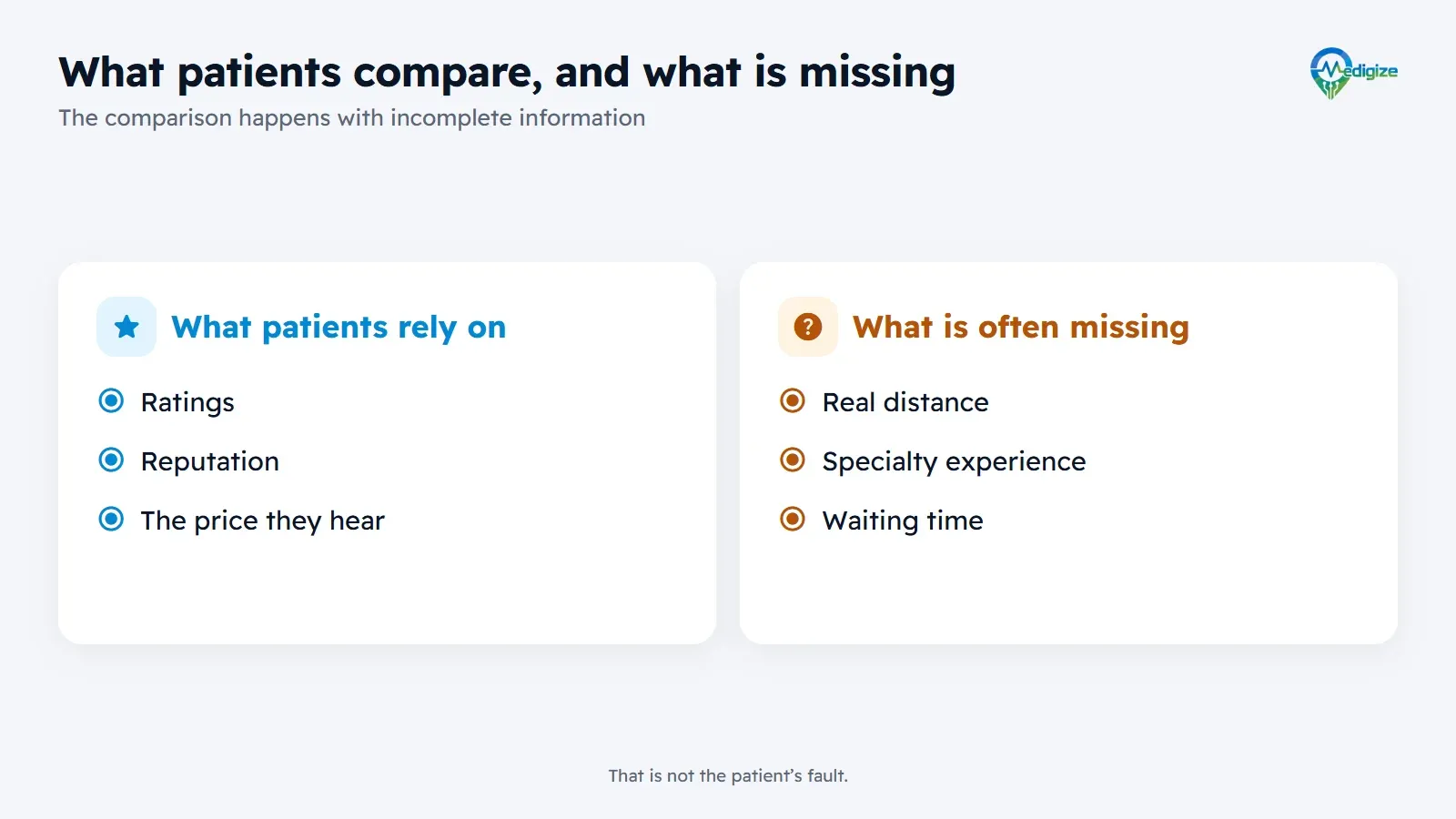
What patients usually compare, and what the comparison leaves out.
The problem: comparing with half the information
The comparison happens with incomplete information, so the decision becomes a guess. That is not the patient’s fault.
The information a fair comparison needs is rarely in one place. Some clinics post their prices and others give them only by phone, waiting times are rarely written down, and whether a doctor often sees problems like yours is often learned only after the visit. MedlinePlus, the US National Library of Medicine’s health site, puts it plainly: we all want high-quality care, but it is hard to know how to choose. It lists some of what there is to weigh: what your insurance covers, whether a provider or service is accredited, where it is, the hours it is open, and whether you like the provider’s personality.
Faced with that, people fall back on what they can see: a star rating, a well-known name, a price a friend mentioned. The strongest, the relative who “knows a good doctor”, is in the real competitor. None of them is wrong. Each answers a different question from the one the patient is asking.
What ratings, reputation and price tell you, and what they leave out
| What you rely on | What it can tell you | What it leaves out |
|---|---|---|
| Ratings | How some patients felt about their visits: the welcome, the wait, the explanation | Whether the doctor often sees problems like yours, how long your wait will be, the total cost |
| Reputation | That people you trust have had good experiences | Whether those experiences were with a problem like yours, and how recent they are |
| The price you hear | Roughly what one consultation costs | What it includes, and what tests, imaging or follow-up visits may add |
Reputation is most useful when you ask a second question. The US National Institute on Aging (NIA) suggests that, rather than just getting a name, you ask about the person’s experience: what do they like about that doctor, and does the doctor take time to answer questions? A name that comes up often, it says, may be a strong possibility.
Qualifications deserve the same care. NIA notes that board certification, the US specialist credential, is one way to learn about a doctor’s medical expertise, but that it does not tell you about the doctor’s communication skills.
The three things that are usually missing
Real distance
Not kilometres on a map, but the door-to-door journey at the hour of the appointment, and how many times you will make it: a first visit, tests, results, a follow-up. NIA’s list of questions for choosing a new doctor asks how far you are willing to travel, whether there is parking or public transport, and whether the building has a lift or ramps. For an older parent, the stairs at the entrance can matter as much as the address.
Specialty experience
First, the right specialty: the first-stop checklist and five questions to ask before your appointment start there. Then, within that specialty, whether this doctor often sees problems like yours. MyHealthfinder, from the US Office of Disease Prevention and Health Promotion, suggests asking a clinic directly whether the doctor has experience treating your condition, and whether they have special training or certifications.
Waiting time
There are two waits, and both count. The first is until the first available appointment: NIA suggests asking how far in advance you have to book. The second is on the day, in the waiting room. Ask about both, and who looks after patients when the doctor is away, which NIA also lists.
Two more worth asking: language, and what happens after
Language belongs on the list. A systematic review in the Oman Medical Journal found that language barriers lead to miscommunication between clinicians and patients, and lower both the quality of care and patient safety. If you are more at ease in Arabic, or in another language, ask whether the doctor or someone at the clinic speaks it. NIA and MyHealthfinder both include that question.
Then ask what happens after the visit: whether tests can be done at the clinic, whether the doctor will see results from elsewhere (both on MyHealthfinder’s list), how results reach you and who to contact with a question. See why follow-up matters.
How to compare two clinics fairly: seven steps
- Write down what you need in one line: the complaint, since when, and whether a doctor has referred you. Your own words are enough.
- Check the specialty before the clinic. A good clinic in the wrong specialty is still the wrong first stop.
- Decide what matters most to you, before you look. NIA suggests listing the qualities that matter to you, such as a man or a woman doctor, the hours, the hospital or the language, then deciding which are essential and which are only nice to have.
- Make a short list of two or three. MyHealthfinder calls a reference from someone you know and trust a great way to find a doctor. Ask about their experience, not only for a name.
- Ask each one the same questions. NIA suggests calling the offices once you have two or three names, and notes that the staff are a good source of information about qualifications, office policies and payment.
- Write the answers side by side, one column per clinic. Mark what you could not find out as unknown, not a guess.
- Decide, and keep the second option. After the first visit, MyHealthfinder suggests asking yourself whether the doctor listened carefully, explained things clearly and gave you a chance to ask questions. If not, you may want to keep looking.
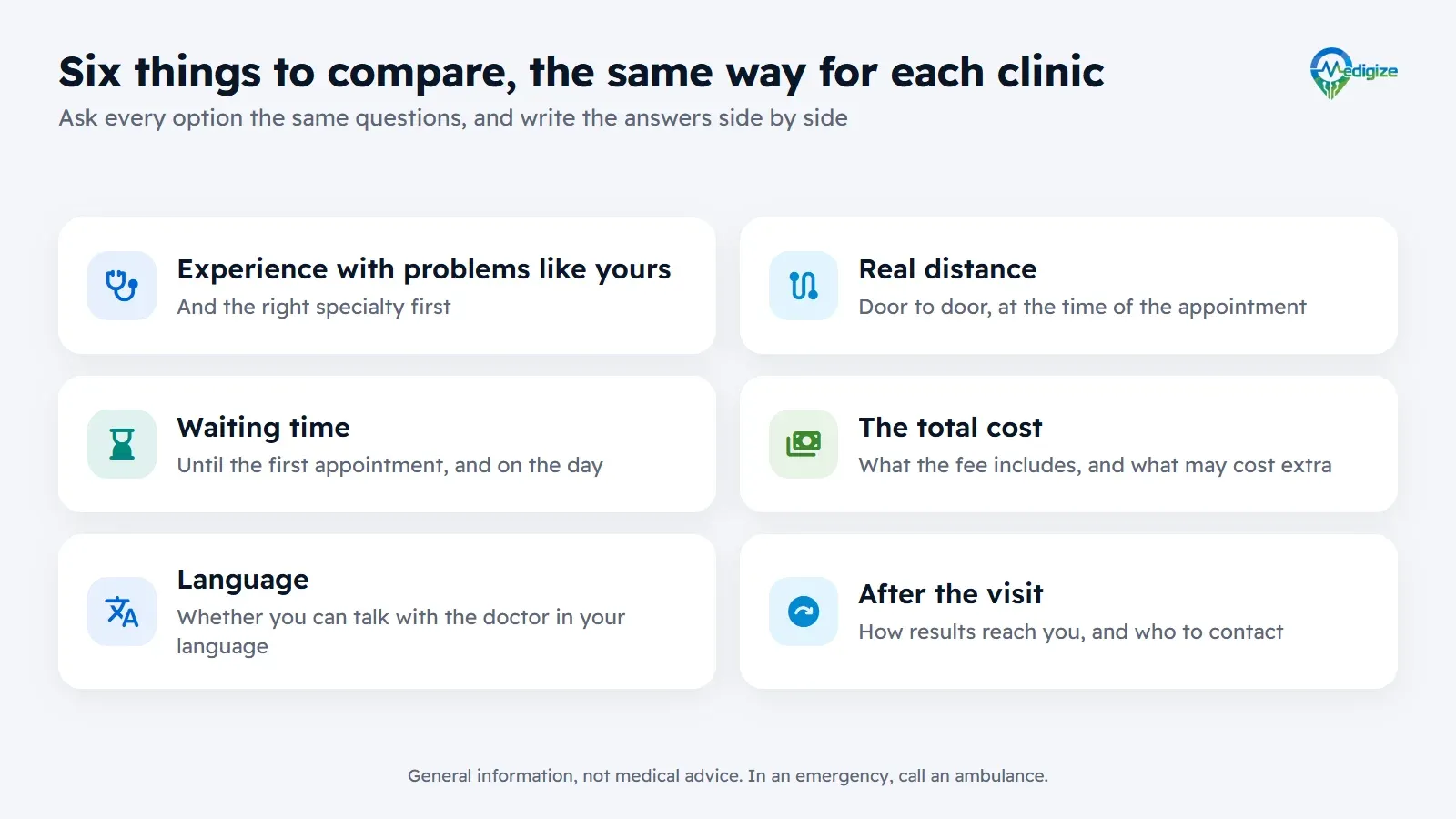
Six things to compare, asked the same way of every clinic.
Build your list here: tick the questions that matter to you, use it once for each clinic, and write the answers as you get them. Nothing you type is saved or sent:
Try it
Questions to ask before you choose a clinic
Tick the questions you want to ask, add your own, and write each clinic’s answers as you get them. Use it once for each option, then copy, print or send the list to yourself.
5 questions on your list.
What you type stays on this page. Nothing is saved or sent unless you copy, print or send it yourself.
Two clinics, one knee: a composite example
A composite example, built from many cases, with no identifying detail. A man in his forties has had knee pain on the stairs for three weeks, and his family doctor suggests he sees an orthopaedic specialist. He has two names.
Clinic A belongs to a well-known doctor with hundreds of five-star reviews, recommended by his cousin. The first appointment is in three weeks, the drive takes 45 minutes at the time he can go, and the fee his cousin mentioned is for the consultation alone.
Clinic B has fewer reviews. It is 15 minutes away and has an appointment this week. On the phone he learns that the doctor sees knee problems most days, the fee includes one follow-up visit, and imaging can be done in the same building.
On ratings alone, Clinic A wins. With the answers side by side, the choice depends on what he needs. If he can wait and wants that particular doctor, A is a fair choice. If he needs to be seen soon and cannot spend an hour and a half in traffic for every visit, B is. Either way he chooses knowing what he is choosing, which is the whole point. And if his knee gets worse while he waits, he does not wait for the appointment: he contacts a doctor.
What can be done: structured, fair information
Structured, fair information for the patient, without the tool favouring one provider over another without transparency, and without claiming that a single best exists.
In practice, four rules, for any website, app or directory that helps people choose, ours included:
- Structured: the same facts for every provider, in the same order, so they can be compared.
- No hidden favouring: if anything changes the order, such as a paid listing, a partnership or a rule, the patient can see what it is and why.
- Gaps shown as gaps: what a provider has not stated is marked as not stated, never guessed or quietly left out.
- No single best: the patient decides what matters most. The tool does not declare a winner.
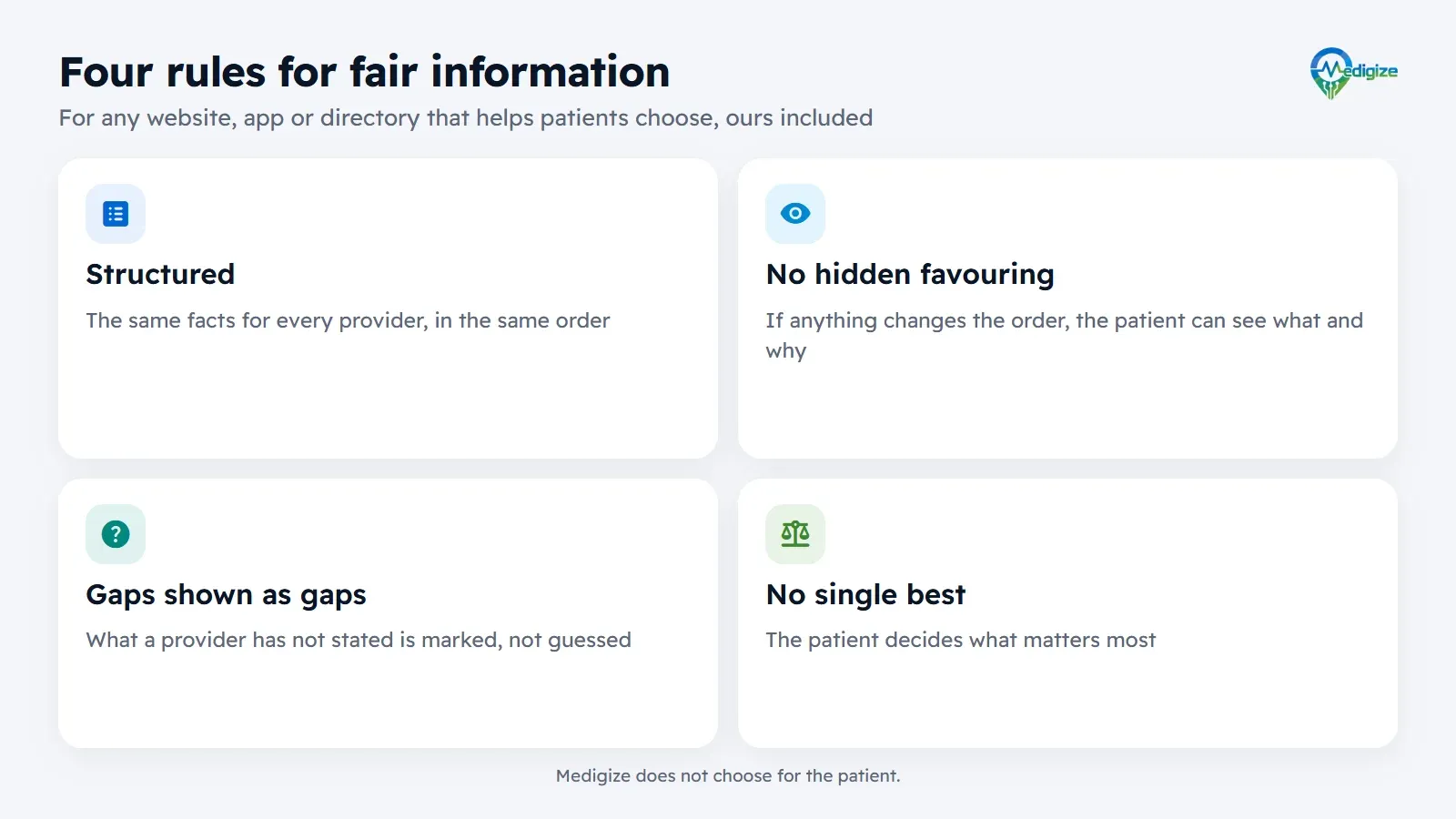
Four rules that keep a comparison fair.
Before you trust any list of “top doctors”, ask what decides the order and whether anyone pays to be shown higher, where the ratings come from and how old they are, and what is missing. A list that cannot answer is a ranking without its reasons. The same test applies to us (see why we build in public).
Medigize is a non-diagnostic navigation tool. It helps understand the complaint, assess urgency and point to the right level of care, and it does not choose for the patient. The choice of provider stays with the person who will sit in the waiting room. See Medigize for patients.
For clinics: make the missing information easy to find
Most of what patients cannot find is information the clinic already has. Publishing it saves the phone calls that ask for it:
- The problems the clinic sees often, in plain words. “We see knee problems every week” can be checked; “the best orthopaedic clinic” cannot.
- How soon a new patient can usually be seen, and the usual wait on the day.
- What the fee includes, and what may cost extra.
- The languages spoken, by the doctor and at the front desk.
- How to get there, and whether there are stairs, a lift or ramps.
- How results are delivered, and how a patient reaches the clinic with a question after the visit.
A patient who chose you knowing all this arrives with the right expectations, which is part of what makes a case qualified. See Medigize for providers.
When not to compare
Comparing takes time, and some moments do not have it. Severe chest pain, trouble breathing, fainting or loss of consciousness, or signs of a stroke: call an ambulance or go to the nearest emergency department. Do not compare clinics, and do not wait for an app. Why a navigation tool can never stand in for that call is in urgency is the clinician’s call.
If it is not an emergency but it is getting worse, speed matters more than the perfect choice: contact a doctor you can reach soon, and keep the comparison for later.
Frequently asked questions
How do I choose the right doctor?
Start with the right specialty for your complaint. Then compare each option on the same points: experience with problems like yours, real travel time, waiting time, total cost, language, and what happens after the visit.
Are online doctor ratings reliable?
They tell you how some patients felt about their visits. They do not tell you whether the doctor often sees problems like yours, how long you will wait or the total cost, so use them as one input among several.
What should I ask a clinic before booking?
How soon you can be seen, how long the wait is on the day, what the visit costs and what may be extra, whether the doctor often sees problems like yours, and how results and questions are handled after the visit.
Is the nearest clinic always the best choice?
In an emergency, go to the nearest emergency department. Otherwise, distance is one point among several: a nearby clinic with a long wait may suit you less than one a little farther away that can see you this week.
Can I change doctors if I am not comfortable?
Yes. NIA notes that people sometimes hesitate because they worry about hurting their doctor’s feelings, but that doctors understand different people have different needs.
Does Medigize recommend doctors?
Medigize does not choose for the patient. Information that helps people choose should be structured and fair, with no hidden favouring and no claim that a single best exists.
Medigize is a non-diagnostic navigation tool. This is general information, not medical advice. In an emergency, call an ambulance or go to the nearest emergency department.
References
- National Institute on Aging: How to choose a doctor you can talk to
- National Institute on Aging: 17 questions to ask when choosing a new doctor
- Office of Disease Prevention and Health Promotion, MyHealthfinder: Choosing a doctor, quick tips
- MedlinePlus: Choosing a doctor or health care service
- Oman Medical Journal (2020): Implications of language barriers for healthcare, a systematic review
Last updated:
Explore Medigize
Medigize is in development. Explore our current scope and express your interest.