“I have a cold in my stomach.” “The boy is hot and not himself.” Any Egyptian doctor understands these sentences instantly. Most health AI tools were built on another language.
“I have a cold in my stomach.” “I feel heaviness in my chest.” “The boy is hot and not himself.”
Any Egyptian doctor understands these sentences instantly. But most health AI tools were built on another language and other patients.
Do Arabic dialects matter in healthcare? Yes. The first clinical information in any journey is the patient’s own description, and most people give it in the dialect they speak at home, not in the standard Arabic of forms or the English of textbooks. A tool that only translates the words, or knows only one dialect, can lose the meaning at the first step, and every step after depends on that one.
In short:
- People describe illness in their own dialect and their own images. Those descriptions are clinical information, not noise.
- Translation moves words; understanding moves meaning. A tool for Arabic speakers has to understand how people actually describe their discomfort.
- Understanding is part of safety, not a feature. And understanding a description is never a diagnosis.
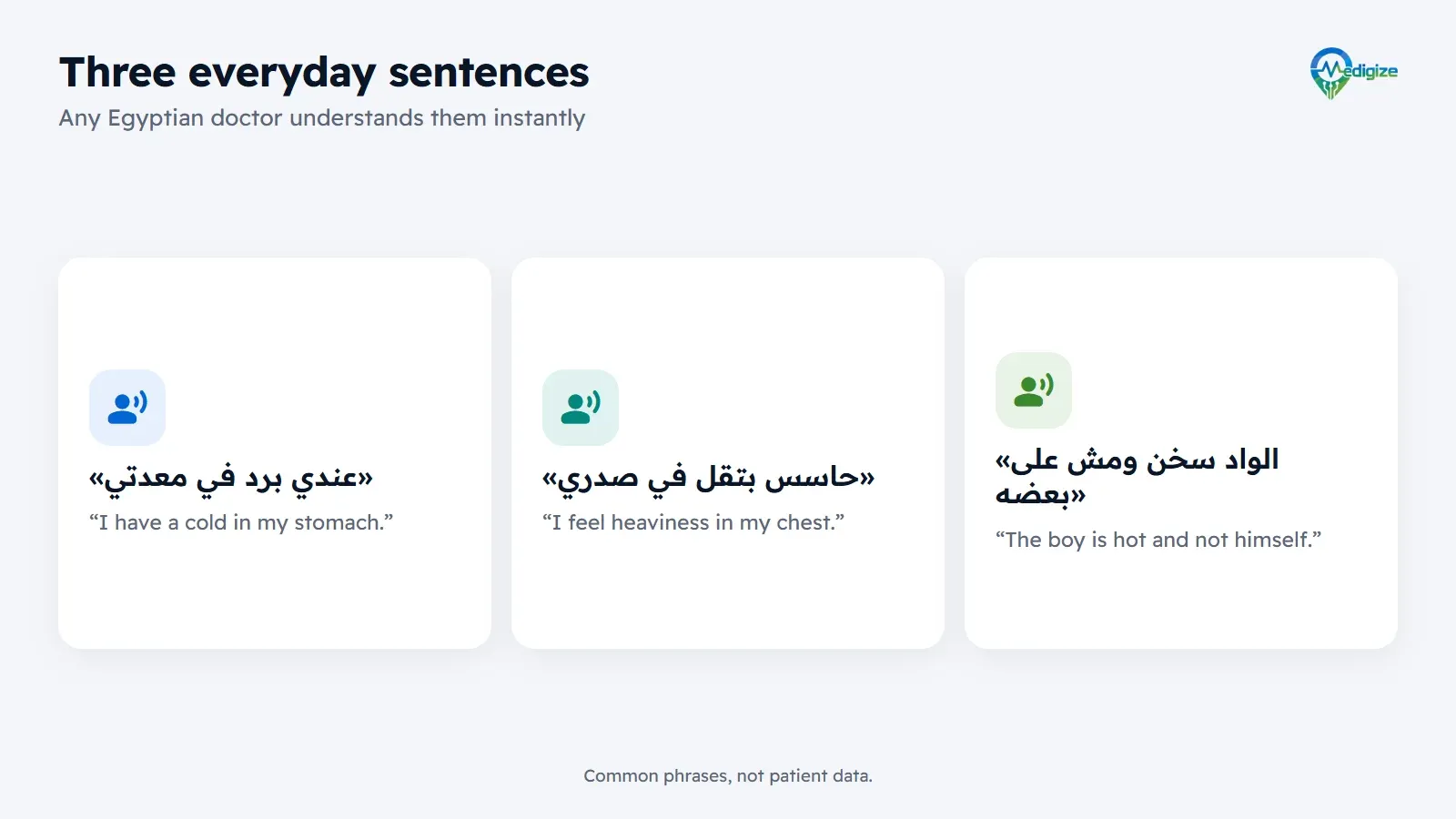
Three sentences any Egyptian doctor understands instantly.
Understanding, not translation
Translation moves words. Understanding moves meaning: how people actually describe their discomfort. Descriptions differ from Upper Egypt to the Delta, the Canal and Cairo, and from one generation to the next.
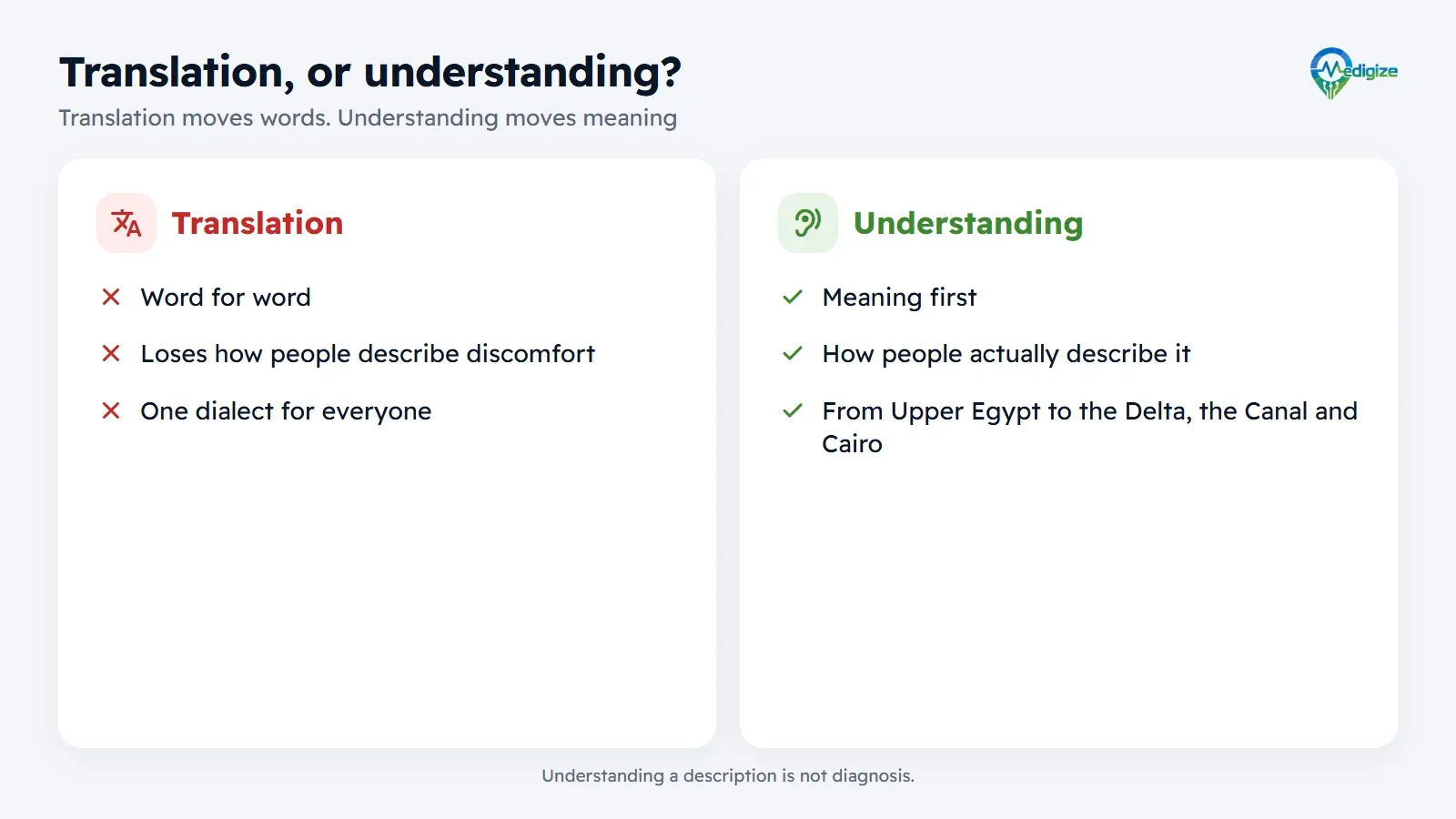
A word-for-word translation of these sentences is accurate, and wrong.
Look again at the three sentences at the top. Translated word for word, every word is correct, and a reader who does not share the dialect is no closer to what the speaker meant. Worse, nothing in the translation shows that anything was lost. Understanding starts from the other end: what is this person trying to say, in the words they chose, and what would a listener from their own town ask next?
Even the standard for human interpreters asks for more than words. The US Agency for Healthcare Research and Quality (AHRQ) describes a qualified interpreter as one who interprets accurately and impartially while preserving the tone, sentiment and emotional level of the original. That is a higher bar than word for word, and the right one for a tool as well.
The World Health Organization made the same point about AI in health in general in 2021: systems trained mainly on data from people in high-income countries may not perform well for people elsewhere, and should be designed to reflect the diversity of the settings they serve.
Why is Arabic hard for health tools? One language, many ways to say it
Arabic speakers live with two registers. Modern Standard Arabic is the language of forms, leaflets, news and most written health information. The dialect is the language people think and feel in, and it is the one they use when something hurts. A tool that understands only the first is speaking to the patient’s forms, not to the patient.
The dialects themselves differ, even for the plainest words. Nothing in this table is medical, and that is the point:
| Everyday meaning | Cairo | Damascus or Beirut | Kuwait or the Emirates | Morocco |
|---|---|---|---|---|
| Now | «دلوقتي» | «هلّق» | «الحين» | «دابا» |
| I want | «عايز» | «بدّي» | «أبي» | «بغيت» |
| Very, a lot | «أوي» | «كتير» | «وايد» | «بزاف» |
If a word as simple as “now” changes four times, so does the way people describe being unwell. Four more things make it harder:
- How time is told. Often by events rather than dates: since Eid, after the noon prayer, since the day of the wedding. A tool has to work with “since Eid” instead of insisting on a date.
- How it is written. Many people type Arabic in Latin letters and numbers, often called Franco or Arabizi, with a 3 for «ع» and a 7 for «ح». Many mix English words into Arabic sentences.
- How it arrives. Often as a voice note or a WhatsApp message, not as a typed form. We looked at that in how patients actually describe symptoms.
- Who is speaking. Often not the patient: a mother describing a child, as in the third sentence above, or a son describing his father.
How do you say it?
Arabic is many dialects. Pick yours, and write how you would say three everyday things. Nothing is saved; share it only if you want to:
Try it
How do you say it?
Pick your dialect, then write three everyday things the way you would say them.
Your dialect
Pick a dialect and write at least one line to see it here.
Common phrases only, please: nothing about a real patient. Nothing is saved or sent unless you share it yourself.
Why this matters for safety
The first step in any journey is the patient describing what they feel in their own words. If the tool misunderstands, everything after is affected. Language understanding is part of safety, not a cosmetic feature.
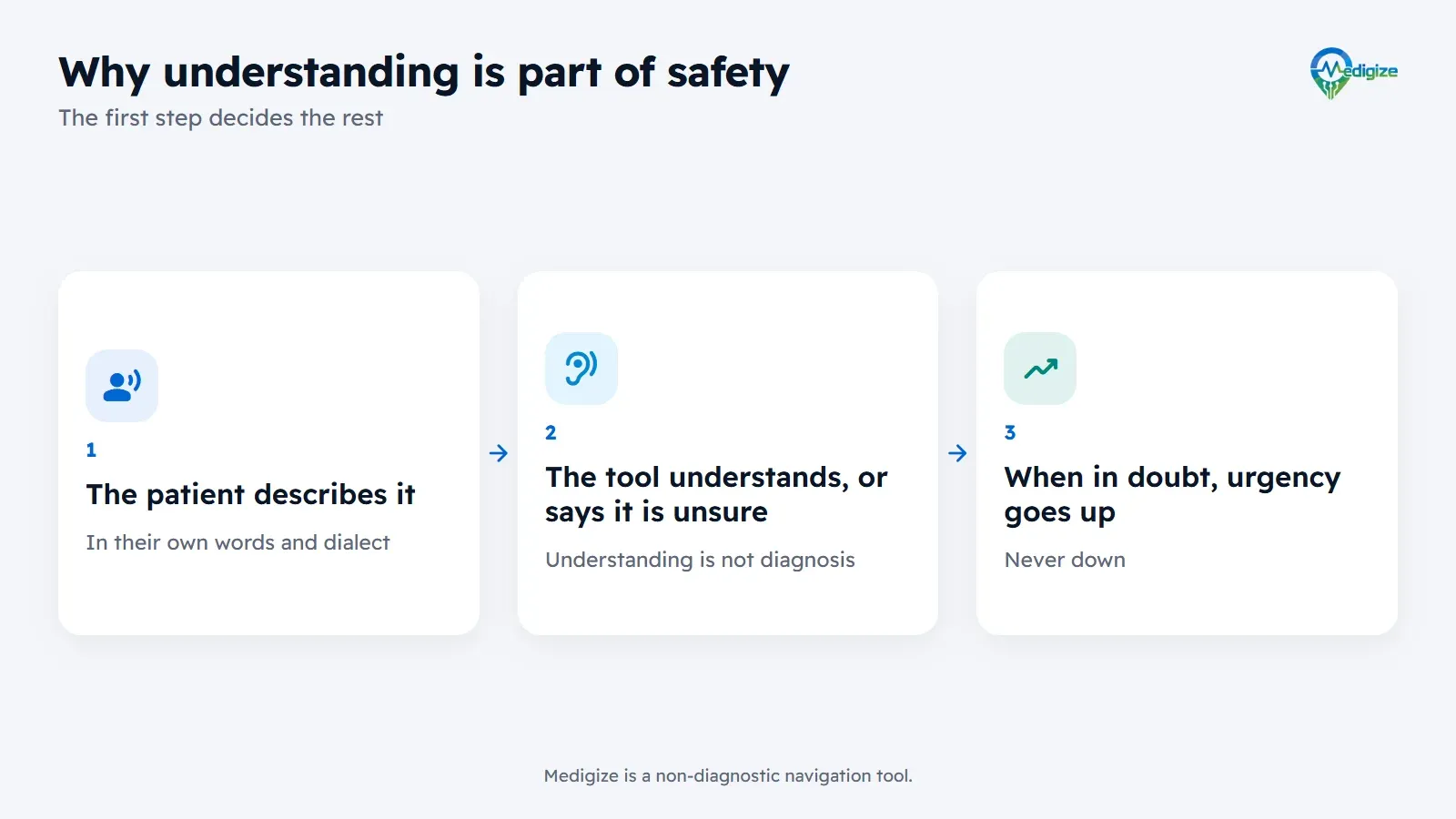
The first step decides the rest.
A misunderstanding at that first step is exactly where a tool has to lean towards urgency: when it is not sure what a description means, it says so, and urgency goes up, never down. The evidence on language barriers points the same way. A 2020 systematic review in the Oman Medical Journal found that they lead to miscommunication between clinician and patient, lower satisfaction on both sides, and harm the quality of care and patient safety. Most of the studies it covers come from the United States and concern patients with limited English, so it says nothing direct about Arabic dialects; the mechanism, a description that does not get across, is the same.
Illness makes it harder still. Writing about US clinics, AHRQ notes that people who normally speak English very well may lose that ability when they are sick, tired or frightened. The same is likely true of anyone describing illness outside the language they think in: a patient who reads formal Arabic or English comfortably may still reach for the dialect at the moment that matters.
One sentence, three ways a tool can handle it: a composite example
This example is built from a common phrase, not from any patient. Late at night, a mother types «الواد سخن ومش على بعضه» into a health tool.
- It translates. The tool now holds “the boy is hot and not himself”. Every word is accurate, nobody has asked the mother anything, and the meaning she would give it is gone.
- It forces a menu. The tool shows a list of medical terms and asks her to pick one. She does not know which term matches what she sees, so she picks the closest-sounding one, and the record now says something she never said.
- It understands. The tool keeps her sentence exactly as she wrote it, asks its next questions in her dialect, and when it is not sure it understood, it says so and leans towards urgency. If anything she says calls for emergency care, it tells her plainly to call an ambulance. What the child has is for the clinician who sees him to decide.
Only the third keeps her meaning, and only the third admits what it does not know. They are the rules we set out for voice notes and everyday descriptions: ask in the patient’s words, never replace them with a label, and keep the original next to anything organised from it.
How to describe what you feel, in any dialect
If you are the patient, or the person speaking for one, the dialect is not the problem. A few habits make it easier to be understood, by a clinician or by a tool:
- Use your own words. You do not need formal Arabic or medical terms. Our one-minute description shows what to cover.
- Add the basics. MedlinePlus, the health site of the US National Library of Medicine, suggests saying when it started and what makes it better or worse.
- Say who is speaking. If you are describing someone else, say so, and separate what you saw yourself from what they told you.
- Check that you were understood. If you are unsure, say it again another way, or ask the clinician to say back what they understood.
- Ask for an interpreter if you need one. MedlinePlus suggests calling the office ahead of time if your doctor does not speak your language.
And in an emergency, do not look for the right words. Severe chest pain, trouble breathing, fainting or signs of a stroke: call an ambulance or go to the nearest emergency department. Do not wait for an app.
For clinics and tool builders: language is part of access
AHRQ’s toolkit for practices calls addressing language differences an essential strategy, and critical for health equity. Its advice translates well to Arabic-speaking settings:
- Ask, and write it down. Ask every patient which language they want to speak and read in, and record it. In Arabic, the question has a second half: whether a form in standard Arabic or English is one they can actually use.
- Use qualified interpreters. AHRQ warns that family members may give their own view instead of the patient’s, and that children should never be used as interpreters.
- Cover the whole path. Booking, the front desk, written instructions, follow-up messages and patient portals all need the same language as the consultation. We covered the follow-up half in why follow-up matters.
- Translate what patients take home. AHRQ advises against assuming that people understand written material in a language they do not read well, and suggests deciding which signs, forms, instructions and reminders to translate, using qualified translators.
Questions to ask any AI tool that says it understands Arabic
- Which dialects was it tested with, and by whom?
- Does it keep the patient’s own words next to anything it organised from them?
- What does it do when it is not sure: ask again, say so, raise urgency?
- Does it ever name a condition? It should not.
- Who decides? WHO’s first principle is that humans should remain in control of health-care systems and medical decisions.
- Is it checked during real use? WHO asks that AI applications be assessed continuously and transparently while they are in use.
We ask the same of ourselves; the model is not the product explains why.
What we do not do
Understanding a description is not diagnosis. The tool understands the complaint, assesses urgency and routes to the right level of care; diagnosis belongs to the clinician. And when in doubt, urgency goes up, never down, the rule we explained in what “AI-assisted” means, and what we will never do.
An honest limit
This is long, ongoing work, and we do not quote accuracy figures. The expressions in this article are common phrases, not patient data.
No tool understands every dialect, every generation and every way of typing on its first day, and any claim that one does should come with how it was measured. What we can commit to is the order: understand, say so when unsure, keep urgency on the safe side, and leave every medical decision to a clinician.
Frequently asked questions
Can health AI understand Arabic dialects?
Only if it is built for them. Understanding how people actually describe discomfort, in their own dialect, is long and ongoing work, and it should be measured rather than assumed.
Why not just translate Arabic into English?
Because translation moves words, not meaning. Many everyday descriptions lose their meaning when translated word for word.
Do I need to speak formal Arabic or use medical terms with my doctor?
No. Your own words, in your own dialect, are what a clinician needs: what you feel, where, since when, and what makes it better or worse.
What should I do if my doctor does not understand my dialect?
Say it again another way, and ask them to say back what they understood. If you do not share a language, ask the clinic ahead of time for an interpreter.
Is understanding my description a diagnosis?
No. The tool understands the complaint, assesses urgency and routes to the right level of care. Diagnosis belongs to the clinician.
What happens if a tool misunderstands?
When in doubt, urgency goes up, never down.
What should a clinic ask before using an AI tool in Arabic?
Which dialects it was tested with, whether it keeps the patient’s own words, what it does when it is unsure, and who makes the decisions.
Are the examples in this article from real patients?
No. They are common phrases, not patient data.
Medigize is a non-diagnostic navigation tool. This article is general information, not medical advice. In an emergency, call an ambulance or go to the nearest emergency department.
References
- World Health Organization: WHO issues first global report on AI in health (2021)
- Oman Medical Journal (2020): Implications of language barriers for healthcare, a systematic review
- Agency for Healthcare Research and Quality: Address language differences (Health Literacy Universal Precautions Toolkit, Tool 9)
- MedlinePlus: Talking with your doctor
Last updated:
Explore Medigize
Medigize is in development. Explore our current scope and express your interest.