

Patients do not write “pressure behind the sternum”. They send a voice note. Why a tool that forces medical terms loses people at the first question.
Patients do not write “pressure behind the sternum”. They send a voice note: “I feel something heavy here for two days”.
A tool that forces medical terms loses people at the first question.
In short:
- People describe what they feel in everyday words, in their own dialect, often by voice and often by pointing: “here”.
- The job is to understand that description and turn it into structured questions without changing its meaning. When understanding is unsure, urgency goes up, not down.
- Even with excellent understanding, the tool organises and does not diagnose. The clinician interprets.
(Severe chest pain, trouble breathing, fainting or signs of a stroke are a reason to call an ambulance or go to the nearest emergency department, not to record a voice note.)
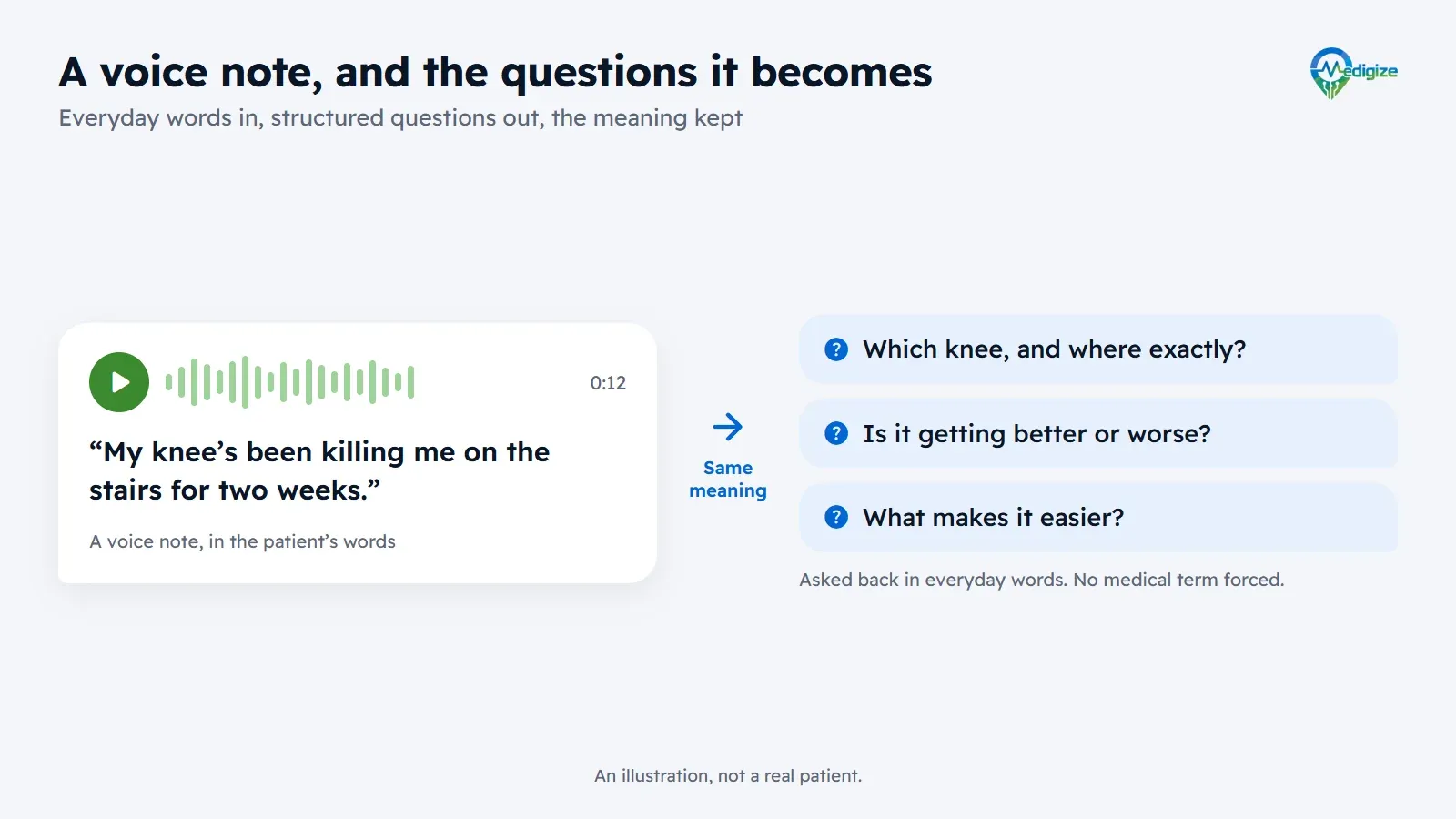
The patient’s words in, structured questions out, and the meaning kept.
How patients actually describe symptoms
Most people describe a symptom as a feeling, a place and a time, in everyday words and in their own dialect, and more and more often by voice. That is enough to start. What a clinician needs is what you feel, where, since when and how it has changed, not the medical name for it.
Listen to how people talk about being unwell and the pattern is clear. They describe a feeling, not a term: heavy, burning, tight, “not myself”. They point to a place instead of naming it. They compare it to something they know. They speak in their own dialect, and often they speak for someone else: a parent describing a child, or a son describing his father.
This is not new, and it is not a failing. A 2006 paper on health vocabulary in the Journal of the American Medical Informatics Association notes that it has long been recognised that patients and professionals express and think about health differently, and that people mix everyday language, technical words they have heard and their own explanations. Medical jargon, it adds, is itself a barrier to health literacy.
None of this is a problem to be corrected. It is the most accurate description the patient has. A 2020 systematic review in the Oman Medical Journal found that language barriers harm both the quality of care and patient safety. A tool that only understands textbook terms builds one of those barriers in.
Why voice notes and WhatsApp?
Because that is where people already are. A 2017 review in the Interactive Journal of Medical Research describes WhatsApp as a way to send messages, photos, video and voice messages over an internet connection, and found it already in use between health professionals and the public. It also called for better research on it. We looked at why these habits are so hard to replace in the real competitor is WhatsApp and paper.
Voice has advantages of its own. It is quicker than typing when you feel unwell. It suits people who find reading or writing hard, and a dialect that is spoken far more than it is written. It keeps the way something was said: the hesitation, the comparison, the “I don’t know how to describe it”. And it lets a daughter describe what she saw in her father in her own words, at the moment she sees it.
Voice has costs too. A voice note cannot point, so “here” arrives without a place. It can be long and out of order. And whatever you send, think about who else will hear it: the same review noted that none of the studies it included discussed ethics or security, and said that anyone using WhatsApp for health must consider security. Send health details only to people and services you trust, and ask who will see them.
What is needed
Understanding dialect and everyday description, and turning it into structured questions without changing the meaning. It is language work and safety work together: if understanding is wrong, urgency must go up, not down.
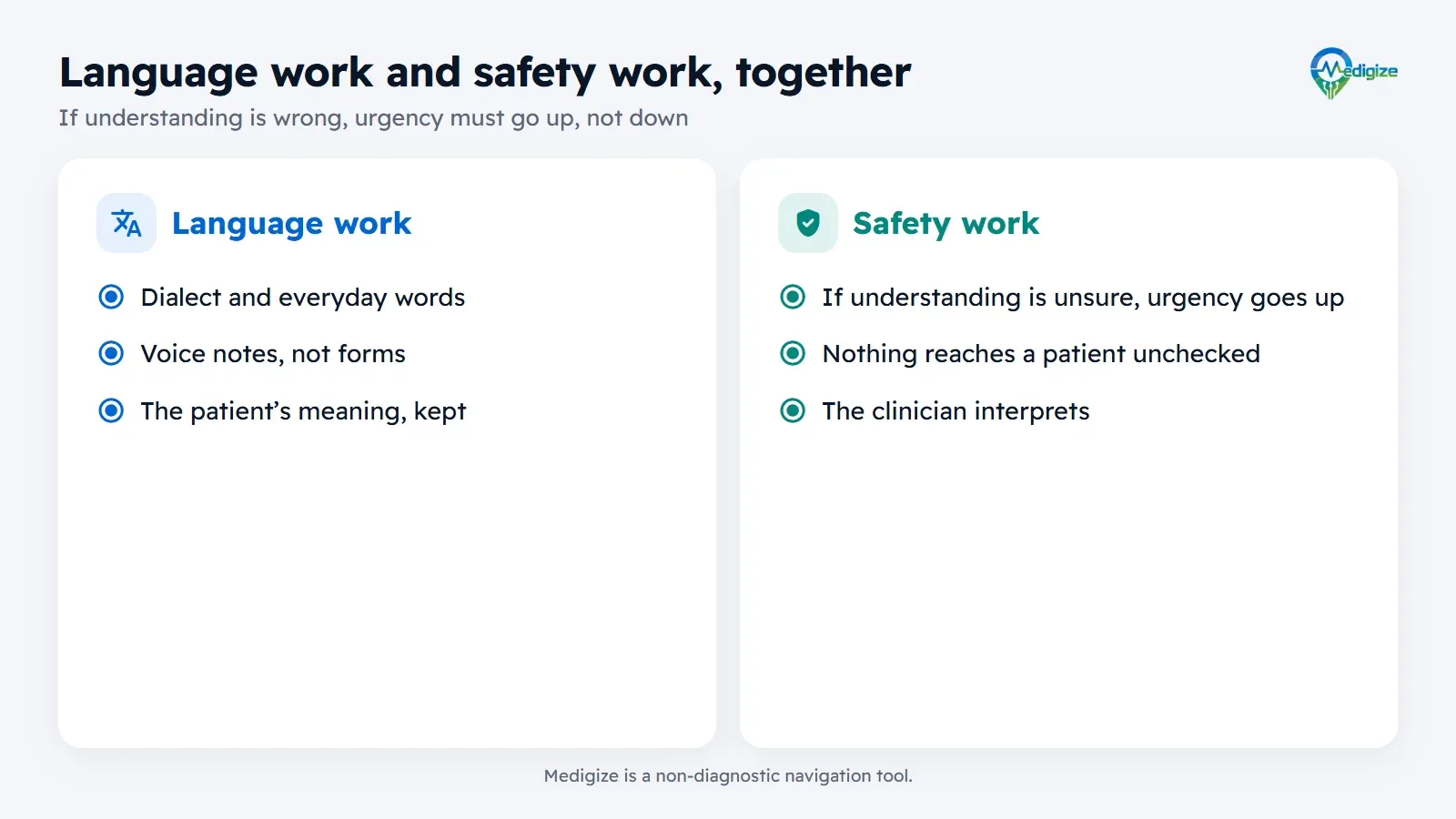
Neither half works without the other.
In practice that means a few rules. Ask in the patient’s words, not in terms they did not use. Never replace what they said with a diagnosis-sounding label. Keep their original words next to anything that was organised from them. And when the tool is not sure it understood, treat that as a reason for more urgency rather than less, as we explained in why the two errors are not equal.
The figure at the top of this article shows the first rule at work. “My knee’s been killing me on the stairs for two weeks” becomes three questions, asked back in everyday words: which knee and where exactly, is it getting better or worse, and what makes it easier. Nothing in the reply asks the patient to learn a term.
Forcing a term costs more than it seems. Asked “is it intermittent?”, a person who does not know the word has three choices: guess, say yes to be polite, or stop answering. The first two put a wrong answer in the file; the third loses the person. “Does it come and go?” asks the same thing and costs nothing.
Clinics can apply the same rules without any tool. Write the complaint down in the patient’s own words, with the date it started, before anything is summarised. It is the first element of a qualified case, and the easiest to lose.
Is this description enough to start?
Six everyday descriptions. Decide whether each one gives a clinician enough to start, or is missing something:
Try it
Is this enough for a clinician to start?
Six everyday descriptions. Decide whether each gives a clinician enough to start, or is missing something.
1. “It hurts.”
2. “My right knee hurts when I climb stairs. Three weeks now.”
3. “A cough for a week. It’s worse at night.”
4. “I’m not myself lately.”
5. “Itchy spots on both arms since Friday, spreading.”
6. “Same thing as last time.”
0 of 6 answered
Your answers stay on this page.
How to describe a symptom in your own words
You do not need medical words. You need a few details, in any order and in any dialect. MedlinePlus, from the US National Library of Medicine, gives the same advice: say when it started, and what makes it better or worse.
- What you feel. In your own words. A comparison to something you know helps more than a term you are not sure of.
- Where. In a message or a voice note, put “here” into words: which side, and where exactly.
- Since when. A day or a date is better than “a while”: “since Friday”, “two weeks now”.
- How it has changed. Better, worse, the same, or coming and going.
- What makes it better or worse, and what you have taken for it. Including medicines, with their names read from the box if you can.
Some everyday words need one more detail to be useful. They are fine to use; just add the missing piece:
- “It hurts.” Add where, and since when.
- “For a while.” Say a day, a date or a number of weeks.
- “Not myself.” Say what feels different, and since when.
- “The usual tablet.” Say its name, as it is written on the box.
- “Same as last time.” The person listening may not know what last time was. Say it again in a sentence.
If you are not sure whether something matters, say it anyway; the clinician can set aside what is not needed. MedlinePlus also suggests writing your questions down before the visit, and asking again until you understand the answer.
A clear voice note in five steps
- Start with who it is about. “It’s about my mother” saves the listener from guessing.
- Say the main thing first. What you feel and since when, before the story around it.
- Put “here” into words. The listener cannot see where you are pointing.
- Read medicine names from the box. Say what was taken, and when.
- Listen back once before sending. If something important is missing, add a second short note rather than starting again.
Before any of this, check how your clinic wants to be contacted, and how to send questions after a visit. The US National Institute on Aging suggests asking exactly that during the appointment. And a voice note is never the way to report an emergency: for severe chest pain, trouble breathing, fainting or signs of a stroke, call an ambulance or go to the nearest emergency department.
Describing symptoms for someone else
Many descriptions come from a relative: a parent for a child, a son or daughter for an older parent. That is normal, and it helps. Three things make it clearer:
- Say what you saw and what they told you, separately. “She said it hurts” and “I saw her stop on the stairs” are both useful, and they are different.
- Use their words when you can. If they said it in a particular way, repeat it the way they said it.
- Bring them into the conversation when they can speak for themselves. Your account adds to theirs; it does not replace it.
The National Institute on Aging also suggests bringing someone to an appointment, to help remember what was said. A relative who describes well before the visit is just as useful during it.
The limit
Even with excellent understanding, the tool organises and does not diagnose. The clinician interprets.
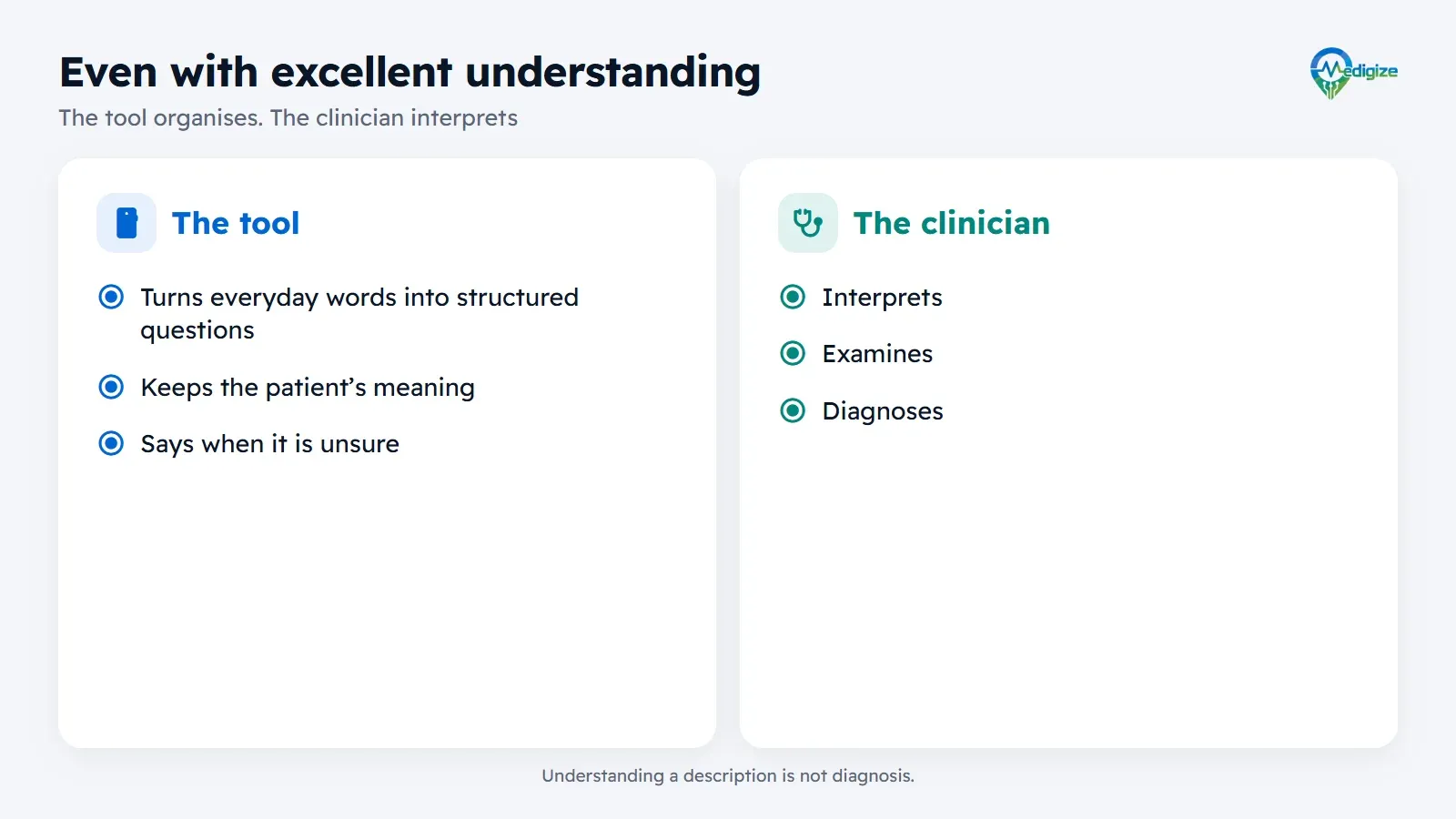
Understanding a description is not interpreting it.
That holds however good the language work becomes. Understanding what someone said is not the same as knowing what it means for their health; that needs a clinician who can ask more, examine and decide. It is the same line we draw around every model in the model is not the product.
The figure lists one more job for the tool: saying when it is unsure. A tool that is not sure it understood should say so plainly, ask again in simpler words, and treat the doubt as a reason for more urgency, never less.
Your own words are enough
If you are the patient: you do not need medical words. Say what you feel, where, since when, and whether it is getting better or worse, in your own dialect. Our one-minute description walks through it. If writing is easier for you, write; if speaking is easier, speak. A good tool, and a good clinic, should be able to take either.
And if you are preparing for a specialist, the same words belong at the top of one page for a specialist visit.
Frequently asked questions
Do I need medical words to describe my symptoms?
No. Your own words, in your own dialect, are what a clinician needs: what you feel, where, since when, and how it has changed.
How do I describe my symptoms to a doctor?
Say what you feel in your own words, where, since when, how it has changed, and what makes it better or worse. Add any medicines you have taken, by name.
Can I send my doctor a voice note?
Ask your clinic first how it prefers to be contacted and who will listen. Where it is accepted, a voice note in your own words is fine. It is never the way to report an emergency.
Can a health tool understand a voice note?
A tool built for it can turn everyday speech into structured questions. It should never change your meaning, and when it is unsure, urgency should go up.
Why do language barriers matter in healthcare?
Because a description that is misunderstood affects everything after it. A 2020 systematic review found that language barriers harm the quality of care and patient safety.
Does understanding my words mean the tool diagnoses me?
No. The tool organises; the clinician interprets and diagnoses.
How do I describe symptoms for a family member?
Say who it is about, what you saw and what they told you, with dates, and use their own words when you can.
What if I think it is an emergency?
Call an ambulance or go to the nearest emergency department. Do not stop to type or record.
Medigize is a non-diagnostic navigation tool. This is general information, not medical advice. In an emergency, call an ambulance or go to the nearest emergency department.
References
- Oman Medical Journal (2020): Implications of language barriers for healthcare, a systematic review
- MedlinePlus, US National Library of Medicine: Talking with your doctor
- Journal of the American Medical Informatics Association (2006): Exploring and developing consumer health vocabularies
- Interactive Journal of Medical Research (2017): WhatsApp Messenger as an adjunctive tool for telemedicine, an overview
- National Institute on Aging: How to prepare for a doctor’s appointment
- National Institute on Aging: Five ways to get the most out of your doctor’s visit
Last updated:
Explore Medigize
Medigize is in development. Explore our current scope and express your interest.