
A specialist visit has limited minutes. Preparation makes them count: six things on one page, and the lines to write before you leave.
A specialist visit has limited minutes. Preparation makes them count.
The specialist has your referral, perhaps a few lines from another doctor, and the time on the clock. Everything else is in your memory, your bag or your phone. One page, prepared before you go, puts it in front of them in the order it is needed.
In short:
- Before the visit, put six things on one page: the complaint, your medicines and doses, any allergy, older tests with their dates, long-term conditions and past surgery, and your top three questions.
- During the visit, ask the most important question first, and take notes or bring someone who can.
- Before you leave, write three lines: what was said, the next step and the follow-up date. If something is unclear, ask before you leave.
How do you prepare for a specialist appointment?
Write one page with six things on it: the complaint, your medicines and doses, any allergy, older tests and imaging with their dates, long-term conditions and past surgery, and your top three questions. Bring the referral letter and the reports themselves. In the room, ask the most important question first, and before you leave, write down what was said, the next step and the follow-up date.
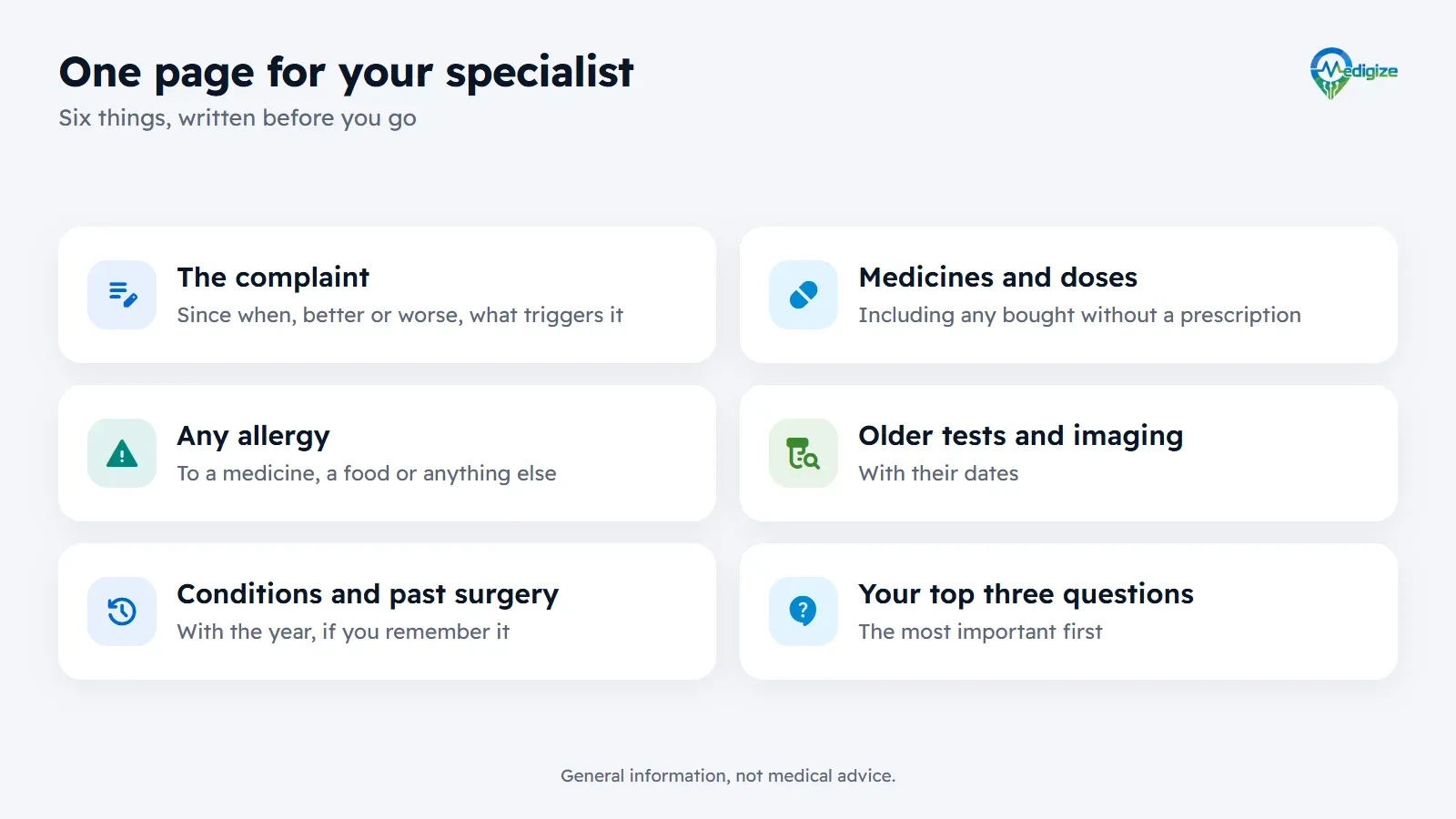
Six things, one page.
Why one page is enough
A specialist does not need your whole story in the order it happened. They need the complaint, what you take, what was already tested, and what you want to know. A page they can read in a minute leaves the rest of the visit for the examination and for your questions.
It also protects you from the visit itself. People forget things in a consultation room, especially when they are worried. A page you wrote at home, calmly, does not forget.
And it is easy to live with: quick to update, quick to photograph, and easy to hand to the relative who comes with you. It is also the opposite of the story told from the beginning at every stop, which we followed in the hidden cost of a fragmented patient journey.
What goes on the page
- The complaint. Since when? Is it getting better or worse? What triggers it, and what eases it? If it comes and goes, how often?
- Current medicines, with names and doses. Including anything bought without a prescription, vitamins and herbal products. The US National Institute on Aging notes that some doctors suggest bringing the medicines themselves in a bag, and others a list of everything you take with the dose.
- Any allergy. To a medicine, a food or anything else, and what happened.
- Older tests and imaging, with their dates. The date matters as much as the result: it is what lets the specialist compare. Bring the reports themselves, not only your summary of them. How to keep them in order is in questions to ask your doctor about your lab results.
- Long-term conditions and past surgery. With the year, if you remember it.
- Your questions: write the top three. The ones you most want answered, most important first. If there is time, ask the rest.
If a doctor referred you, bring the referral letter too. NIA also suggests bringing the names and phone numbers of your other doctors, and your medical records if the doctor does not already have them. We covered describing a complaint in a minute in every patient journey starts with a question, and a summary of the details every form asks for in why every form asks the same questions.
What does a finished page look like?
Here is one, filled in for a composite example built from many cases. Yours will say different things; the shape is what matters.
| On the page | Example |
|---|---|
| The complaint | Pain in my right knee when I climb stairs, for about three weeks. Getting worse. Stairs make it worse; rest eases it. |
| Medicines and doses | A painkiller bought at the pharmacy in week two, with the name and dose copied from the pack. |
| Any allergy | None I know of. |
| Older tests and imaging | Knee X-ray, March 2026. Report attached. |
| Conditions and past surgery | None. |
| Top three questions | What do you think is causing this? Is there anything I should avoid until the next visit? When should I come back, and what would make me come back sooner? |
Notice what is not there: no guesses about the cause, and no long history of unrelated visits. The page reports; the specialist examines and decides.
Now build yours. Fill in what applies to you. The page prints with space at the bottom for what you hear during the visit.
Try it
Build your page
Fill in what applies to you. It prints on one page, with space at the bottom for what you hear during the visit.
Is it…
Your page
Your page appears here as you fill it in.
Nothing you type is saved, not even in this browser, and nothing is sent unless you do it yourself.
The night before, check you have:
- The page, printed or saved on your phone.
- Your reports in one folder, oldest first, with the referral letter on top.
- Your medicines in a bag, or the list with each dose.
- Your glasses or hearing aid, if you use them.
- The clinic’s address, the appointment time and a number to call if you are running late.
During the visit
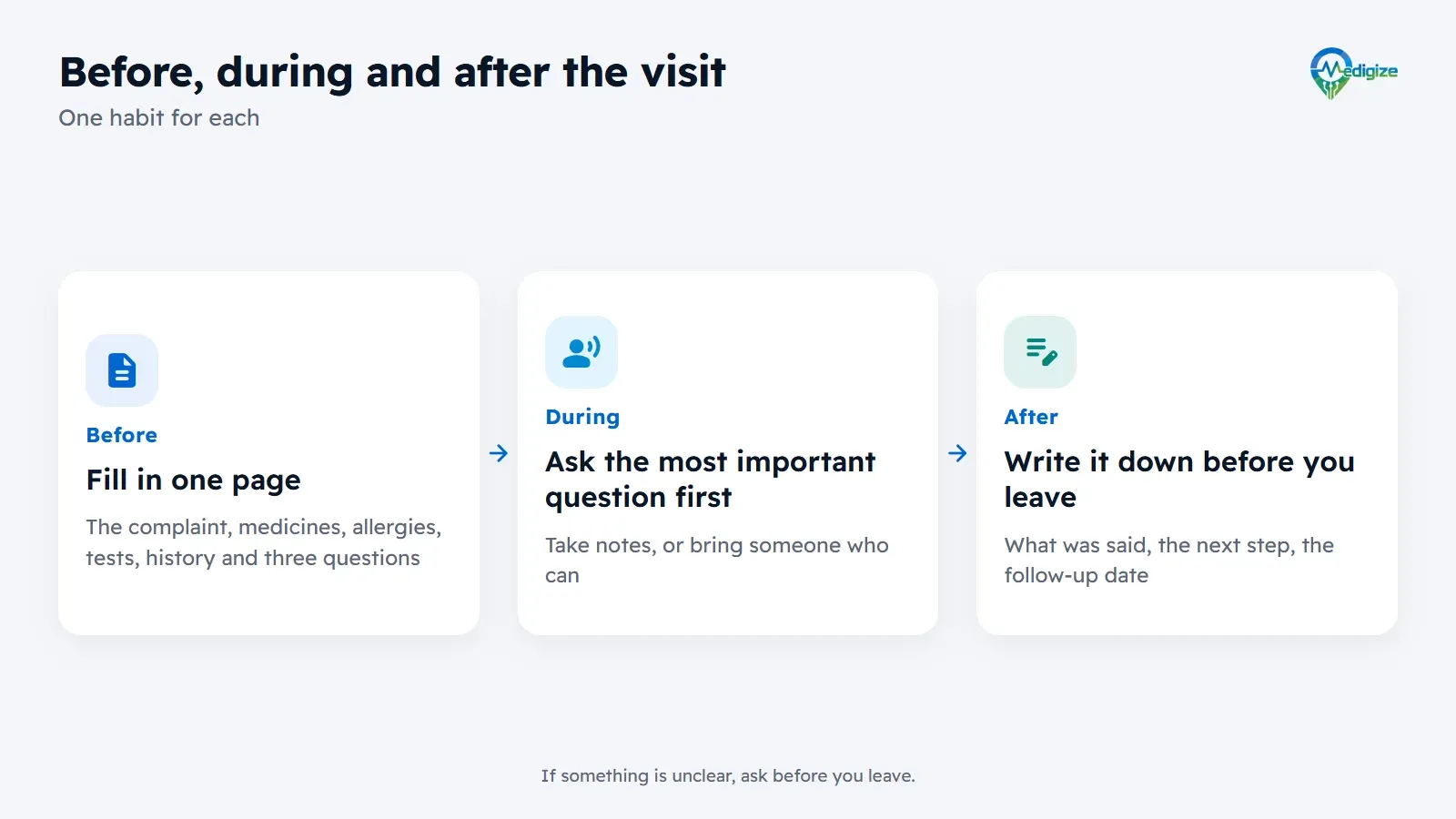
Before, during and after: one habit for each.
- Hand over the page, or read from it. Start with the complaint, then the question that worries you most. The US National Institute on Aging advises bringing up what is really on your mind early, rather than leaving it to the end of the appointment.
- Take notes, or bring someone who can. A family member or friend can help you remember what was said. Tell them beforehand what you want from the visit. If you want a moment alone with the doctor, NIA suggests asking them to wait outside for part of it.
- Be honest about what you actually do. MedlinePlus and NIA both warn against saying what you think the doctor wants to hear. The doctor can only work with what is really going on.
- Ask until you understand. MedlinePlus, the health site of the US National Library of Medicine, puts it simply: if something is unclear, keep asking until it is clear. You can also ask for instructions in writing.
- Check you understood. NIA suggests repeating what you heard in your own words and asking, “Is this correct?” If a word is new to you, say so: “I did not understand that word. What does it mean?”
- Say so if you feel rushed. NIA suggests telling the doctor if you feel rushed, worried or uncomfortable, and offering to come back for a second visit if needed. If you want to record the visit, ask the doctor’s permission first.
After the visit
Write down what was said, the next step and the follow-up date. If something is unclear, ask before you leave.
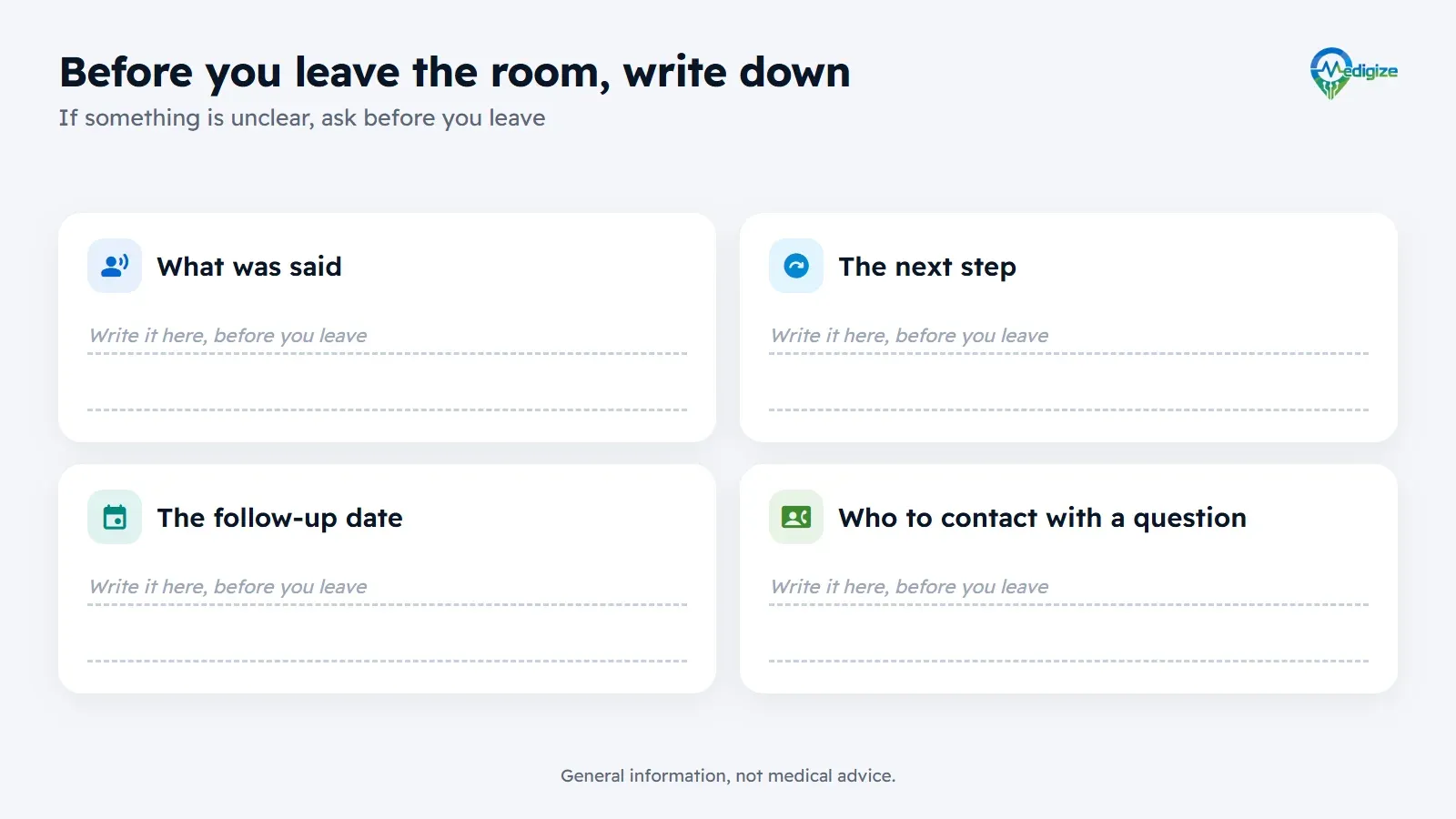
Written before you reach the door.
If a test or another referral was ordered, ask how you will get the result and who will go through it with you. Ask too how to reach the clinic if a question comes up later, and for a copy of any report or result. Keep it with the rest of your records, in date order; a record that moves with you explains how.
At home, update your page: cross out what was answered, add what changed, and file the new report with its date. The next visit starts from there. If you are unsure about an instruction once you are home, NIA’s advice is to call the office, and to ask whether there is an email address or online portal for questions.
Others on the care team can help too: NIA notes that nurses and pharmacists may be able to take more time with you than the doctor. And if you remember a question on the way home, write it on your page and call or message the clinic, rather than waiting for the next visit.
Common mistakes, and how to avoid them
- Leaving the main worry to the end. Say it first, with the complaint.
- A bag of papers with no order. Sort reports by date before you go, and put the page on top.
- Listing only prescribed medicines. Vitamins, herbal products and anything bought without a prescription belong on the list too.
- Not mentioning other visits. If you saw another specialist or went to an emergency department since your last visit, say so early. NIA suggests telling the doctor right away.
- Leaving without the next step. If you cannot write down what happens next and when, the visit is not finished. Ask.
An online visit, an interpreter, or a parent: what changes?
- If things get worse before the appointment. Severe chest pain, trouble breathing, fainting or loss of consciousness, or signs of a stroke: call an ambulance or go to the nearest emergency department. Do not wait for the specialist or for an app. Why is in Urgency is the clinician’s call.
- If the visit is online. Prepare the same way. MedlinePlus notes that being prepared helps whether a visit is in person or through telehealth. Keep the page and your reports beside you during the call.
- If the specialist does not speak your language. Call ahead and ask whether an interpreter can be arranged; both NIA and MedlinePlus suggest it. Tell the interpreter beforehand what you want to talk about.
- If you are going with an older parent. Bring their glasses and hearing aid, and let them speak for themselves first. NIA’s advice to a companion is to help, not to take over: the visit is between the patient and the doctor.
What can a clinic do to help?
Most of this page can be prompted by the clinic before the patient arrives. When you confirm an appointment, ask the patient to bring their medicines or a list with doses, earlier reports with their dates, and the referral letter. NIA even suggests patients ask for the medical history form in advance, to fill in at home with the information to hand; a clinic can simply send it. A short list of what to bring, handed over at booking or sent by message, does the same job for patients who never read an article like this one. End each visit with written instructions and a way to ask a question later. If you run a clinic and want to talk about intake before the visit, see Medigize for providers.
Frequently asked questions
What should I bring to a specialist appointment?
A page with your complaint, your medicines and doses, any allergy, older tests and imaging with their dates, long-term conditions and past surgery, and your questions. Bring the referral letter if you have one, and the reports themselves.
How do I prepare questions for my doctor?
Write them down before the appointment, put them in order, and start with the three that matter most. If time runs out, you will have asked the important ones.
How many questions can I ask in one appointment?
There is no fixed number, but time is limited. NIA suggests choosing the three or four that matter most, naming them at the start, and asking the rest if there is time.
Should I bring someone to my appointment?
It can help. A family member or friend can take notes and help you remember what was said. Tell them beforehand what you want from the visit.
Can I record my appointment?
Ask first. NIA suggests recording only with the doctor’s permission; a recording helps if you want to share the details with family.
What should I write down after the visit?
What was said, the next step and the follow-up date. If anything is unclear, ask before you leave.
What if I don’t understand what the doctor said?
Ask again, and ask for it to be explained another way or written down. That is a normal part of a visit.
How do I prepare for an online consultation?
The same way: one page, your reports and your questions, with the page beside you during the call.
Medigize is a non-diagnostic navigation tool. This is general information, not medical advice. In an emergency, call an ambulance or go to the nearest emergency department.
References
Last updated:
Explore Medigize
Medigize is in development. Explore our current scope and express your interest.