
This team is building a health product, and this field is not built in the dark. Why we share ideas before they are complete, and what we will not say.
This team is building a health product, and this field is not built in the dark. Doctors, patients and providers are the ones who will tell us if we are thinking right.
That is why we share ideas before they are complete: the problems we hear, the decisions we made and the limits we drew.
In short:
- We publish our thinking early, so the people who live the problem can correct it before it is built.
- We share problems, decisions and limits. We do not share patient data, launch dates, partner names or numbers we have not measured.
- If you work in intake, coordination or cross-border care, or you have lived a hard health journey, we want to hear from you.
What does building in public mean?
Building in public means sharing the problems, decisions and limits behind a product while it is still being built, so the people it is for can question them early. For a health product, the point is less publicity than correction: patients, clinicians and providers can say where the thinking is wrong before anything reaches a patient. It never means sharing patient data, launch dates or claims nobody has tested.
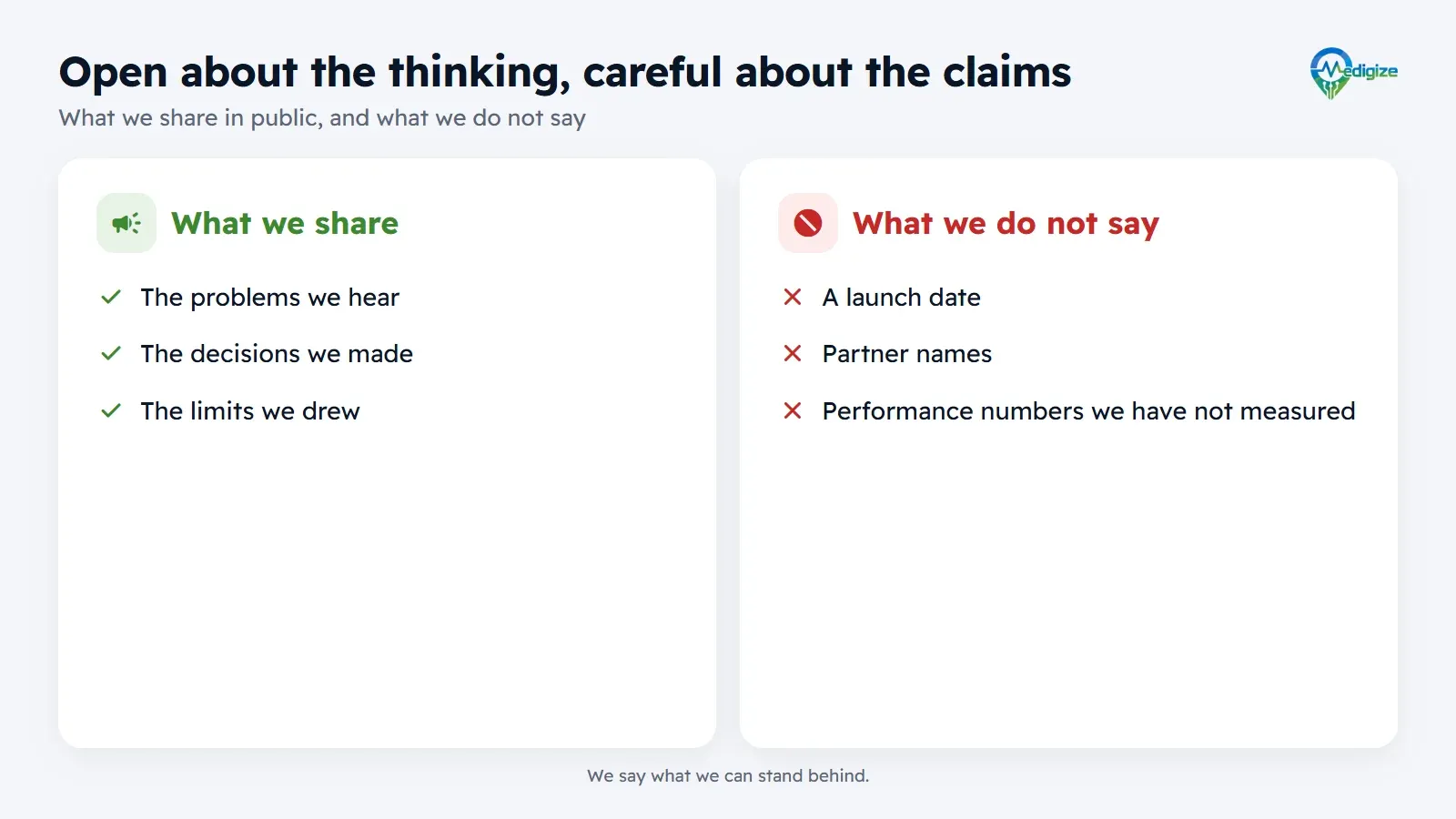
Open about the thinking, careful about the claims.
Why a health product cannot be built in the dark
The people closest to a problem understand it best. A receptionist knows which question every patient struggles with. A coordinator knows where cases get lost. A patient knows which stop of their journey cost them a week. None of that is in a specification until someone asks.
Patient safety work says the same. The World Health Organization’s Global Patient Safety Action Plan makes patient and family engagement one of its strategic objectives, because the people receiving care see things the system does not. Building in public is how a small team listens before it is too late to change course.
Built in the dark, a product tends to solve the problem its builders imagined: a booking screen for a patient who did not yet know which specialty to book, or one more form asking what the last clinic already knew.
WHO’s guidance on the ethics and governance of artificial intelligence for health makes a related point about technology. One of its six principles says transparency requires that sufficient information be published or documented before an AI technology is designed or deployed, in a way that allows meaningful public consultation and debate on how it is designed and how it should or should not be used. Medigize is AI-assisted software, so that principle applies to us directly.
The same guidance warns that systems trained mainly on data from people in high-income countries may not perform well in low- and middle-income settings, and should be designed to reflect the diversity of health-care settings. Language matters too: a systematic review in the Oman Medical Journal found that language barriers lead to miscommunication between clinicians and patients, and lower both the quality of care and patient safety. A product for Arabic-speaking patients in the Middle East and Africa has to be shaped by them, in their own words.
What we share
- The problems we hear. A fragmented journey, the same form filled again and again, results lost between visits, records that never travel with the patient. This series is that conversation, starting with the first question of every patient journey and the costs counted in the hidden cost of a fragmented patient journey.
- The decisions we made. What we chose to build, and why, before it is finished: navigation for patients and operations for providers, explained in what care operations means.
- The limits we drew. What we refuse to build, written down in public in Three things we won’t build, and the rule that urgency goes up and never down, in Urgency is the clinician’s call.
Most articles in this series also come with a small tool that works whether or not you ever use Medigize: count your last journey, write a request for your records, keep a one-page health summary.
What building in public is not
Openness has edges, and in health they matter as much as the openness itself:
- It is not sharing patient data. Nothing we publish identifies a patient. The journeys in this series are composites, built from many cases with identifying details removed.
- It is not a promise. A shared idea is a draft, and drafts change. That is the reason to share them early.
- It is not crowd-sourced medicine. Feedback can change how we understand a problem. Medical decisions stay with licensed clinicians.
- It is not marketing dressed as openness. If we have not measured something, we do not claim it, here or anywhere else.
What we ask for
If you have experience in coordination, intake or cross-border care, talk to us. We are not selling; we are listening.
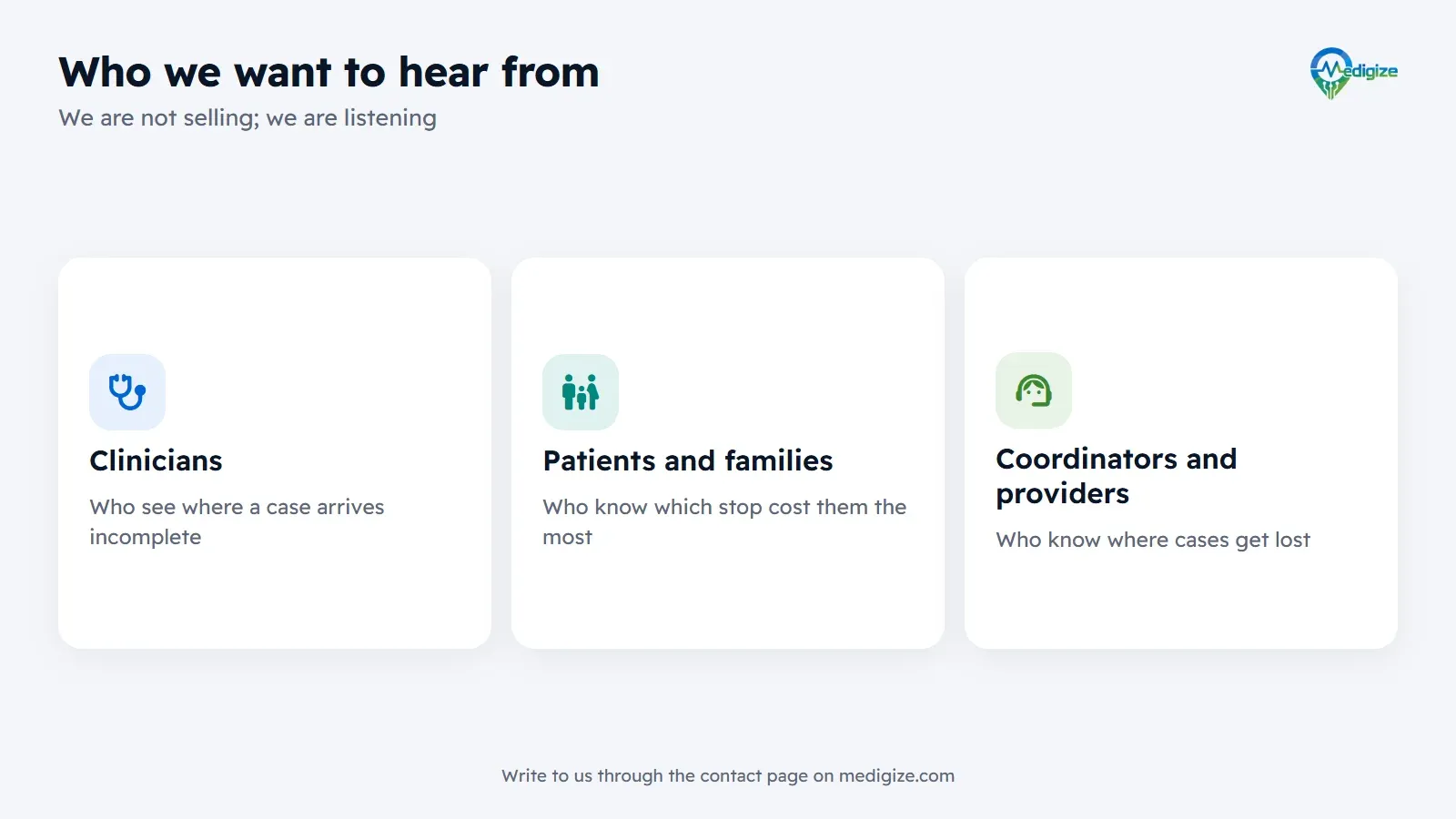
The people who will tell us whether we are thinking right.
Tell us where our thinking is wrong, which stop of the journey we have not understood, or what you would never trust a health product to do. Write to us through the contact page.
The most useful messages are specific:
- One moment, not the whole system: the stop, the form or the phone call where it went wrong.
- What you expected, and what happened instead.
- Where you think we are wrong, in your own words, in Arabic or in English.
The kind of message that helps most sounds like this: “At our clinic, most patients bring results as photos on their phone, and the date is often cropped out.” One sentence like that tells us more than a page of general praise.
Please describe the situation, not the person. Leave out names, record numbers, results and anything else that could identify a patient, including you. We do not need them to understand the problem.
What we do not say
We do not give a launch date, name partners or quote performance numbers we have not measured. We say what we can stand behind.
That is a rule, not a mood. A date we might miss, a partner who has not agreed to be named, or a number from a test that was never run would each borrow trust we have not earned yet. When we have measured something, we will say how.
In health, an unmeasured number is not harmless. A clinic may decide to rely on a tool because of it, and a patient may trust a screen because of it. WHO’s guidance asks the designers of AI technologies to meet regulatory requirements for safety, accuracy and efficacy for well-defined uses, and to keep assessing their applications transparently during actual use. Until we have measurements of that kind, there is nothing honest to quote.
What we say instead:
- Instead of a launch date: Medigize is in development and is not a live clinical service.
- Instead of partner names: “healthcare facilities”, until a partner gives written approval to be named.
- Instead of performance numbers: what we will measure, against which starting point, with the result stated after it is measured.
Questions to ask any health startup, including us
Building in public only works if people can hold us to it. These are the questions we would want a patient, a clinician or an investor to ask any health product. Pick the ones that matter to you:
Try it
Questions to ask any health startup
Tick the ones that matter to you, add your own, and ask them. Us included.
4 questions on your list.
What you type stays on this page. Nothing is saved or sent unless you copy, print or send it yourself.
Ask them early, before you share any health information, and keep the answers. If a company will not answer in writing, that is an answer too.
A good answer is specific and checkable. Three signs that an answer is not good enough:
- A percentage, with no word on how it was measured, or on whom.
- No clear answer to who makes the final medical call.
- No clear answer to who can see your data, or how to say no.
WHO’s guidance also says there should be effective ways to question decisions based on algorithms, so “how do I question a result?” is a fair question too. Here are our own answers to the first five:
| Question | Our answer today |
|---|---|
| Who makes the medical decision? | A licensed clinician, in every case. Medigize does not diagnose. |
| What happens when the tool is unsure? | Urgency goes up, never down. Every output passes a validation gate and leaves a review trail. |
| Who can see my data, and can I say no? | Only the people you choose. A record is shared with your consent, only what is needed, with a trail of who looked. |
| What have you measured, and how? | Nothing we would quote yet. Effects will be measured in a controlled pilot, against a starting point measured first, and stated after. |
| What will you never build? | A diagnosis, a lowered urgency, or an output nobody can look back at. |
How a decision gets made in public
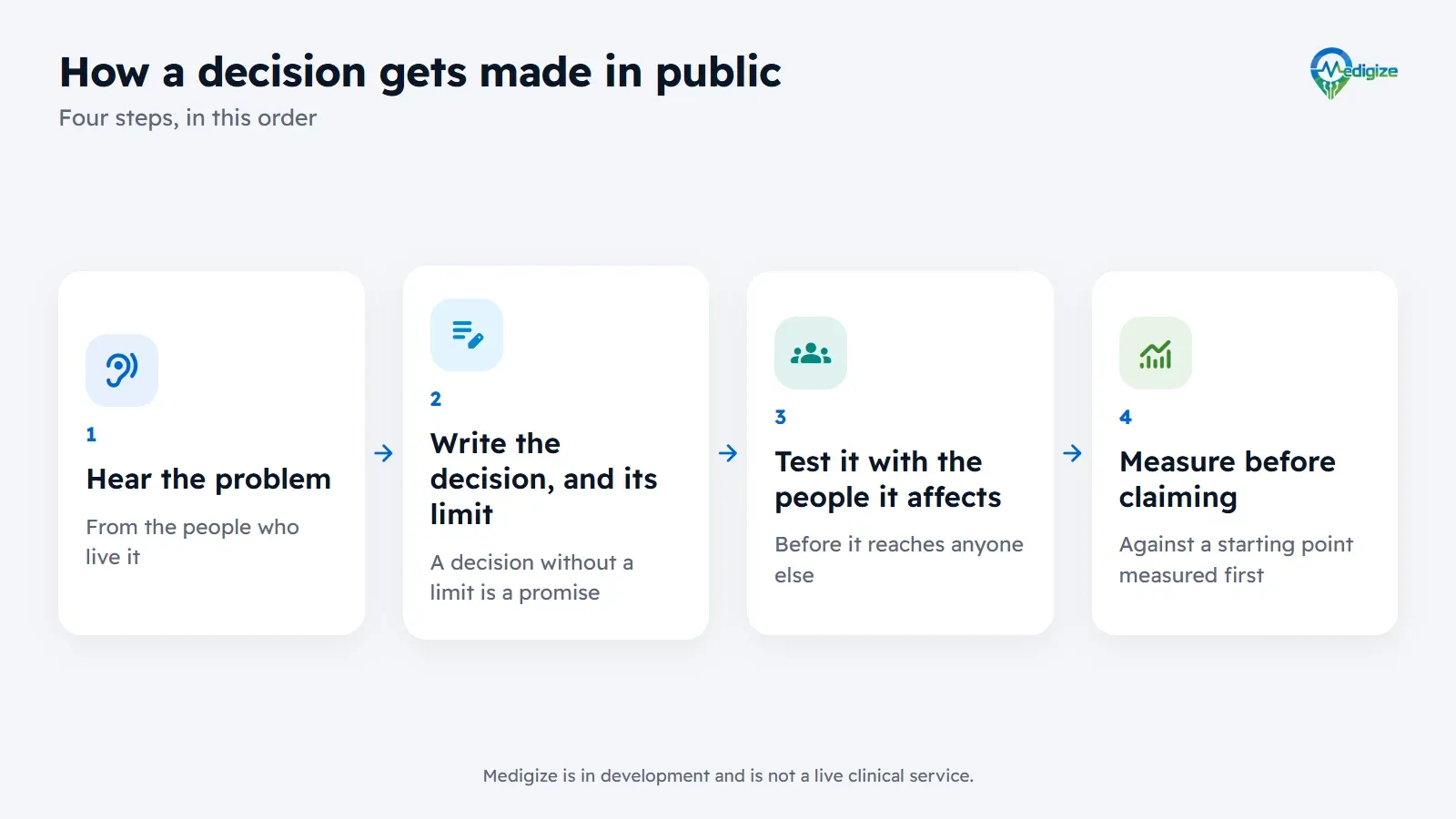
Four steps, in this order.
- Hear the problem from the people who live it, in their words rather than ours.
- Write down the decision, and its limit. A decision without a limit is a promise. “When in doubt, urgency goes up, never down” is a decision with its limit written into it.
- Test it with the people it affects, before it reaches anyone else. A first pilot runs in parallel with a provider’s existing systems, without data migration.
- Measure before claiming, against a starting point measured first. The four baseline measures in how to measure care operations are where that starts.
If you run a clinic or a hospital
A conversation with us is not a sales call. We want to hear where cases arrive incomplete, where they get lost between people, and which part of intake or follow-up takes the most effort. If a conversation leads further, the next step is a controlled pilot that runs in parallel with the systems you already use, without data migration, starting from a baseline measured first.
Medigize Dock works on top of those systems. It is not an EMR, a billing system or an inventory system, and it does not replace any of them. See Medigize for providers.
Frequently asked questions
What does building in public mean?
Sharing the problems, decisions and limits behind a product while it is being built, so the people it is for can question them early.
Is building in public safe for a health company?
Yes, as long as what is shared is thinking, not patient data. We publish problems, decisions and limits, and nothing that identifies a patient.
Why doesn’t Medigize give a launch date?
Because a date we might miss is a promise we cannot stand behind. We will say what is available when it is.
Why don’t you name your partners?
We name a partner only with their written approval. Until then, we describe them as healthcare facilities.
Is Medigize available now?
Medigize is in development and is not a live clinical service. You can register your interest on the patients page or the providers page.
Should I send you medical records or a patient’s details?
No. Describe the situation, not the person. Leave out names, record numbers and results; we do not need them to understand the problem.
Why is this series in Arabic and English?
Because the people we build for live these problems in Arabic, and a product for Arabic-speaking patients has to be shaped in their words. Every article is published in both languages.
How can I tell Medigize what I think?
Through the contact page. Disagreement is as useful to us as agreement.
Medigize is a non-diagnostic navigation tool. This is general information, not medical advice. In an emergency, call an ambulance or go to the nearest emergency department.
References
- World Health Organization: Global Patient Safety Action Plan 2021–2030
- World Health Organization: WHO issues first global report on AI in health and six guiding principles for its design and use (2021)
- World Health Organization: Ethics and governance of artificial intelligence for health (2021)
- Al Shamsi H, et al. Implications of language barriers for healthcare: a systematic review. Oman Medical Journal (2020)
Last updated:
Explore Medigize
Medigize is in development. Explore our current scope and express your interest.