

Before building a tool that touches clinicians’ work, we need to hear their view honestly. What published Egyptian surveys found, who they asked, and what we build because of it.
Before building a tool that touches clinicians’ work, we need to hear their view honestly.
So first, here is what published surveys from Egypt actually found, who they asked, and where their numbers stop.
What do Egyptian clinicians think about AI? The published surveys do not agree, and they asked different people. In one study of 367 healthcare professionals, 51.8% had a positive perception of AI, but 68.7% had sub-optimal knowledge and 53.4% showed low practice. Surveys of medical students and of medical faculty staff found mostly negative attitudes, while another survey of medical students, a preprint not yet peer reviewed, found mostly positive ones.
In short:
- Published Egyptian surveys disagree: in one, 51.8% of 367 healthcare professionals had a positive perception of AI; two found mostly negative attitudes among students, house officers and faculty staff; one, a preprint, found mostly positive attitudes among students.
- The surveys asked different people and drew the line between “positive” and “negative” in different places, so their percentages cannot be compared directly. None set out to survey clinic doctors.
- What we build on: explanation, not slogans; organising the clinic, not “AI”; a non-diagnostic tool; and a licensed clinician who decides.
What a published study says
A study in Frontiers in Artificial Intelligence covered 367 healthcare professionals in Egypt, with data collected between January and June 2024. Results: 51.8% had a positive perception of AI, 68.7% had sub-optimal knowledge, 52.9% expressed negative attitudes, and 53.4% showed low practice.
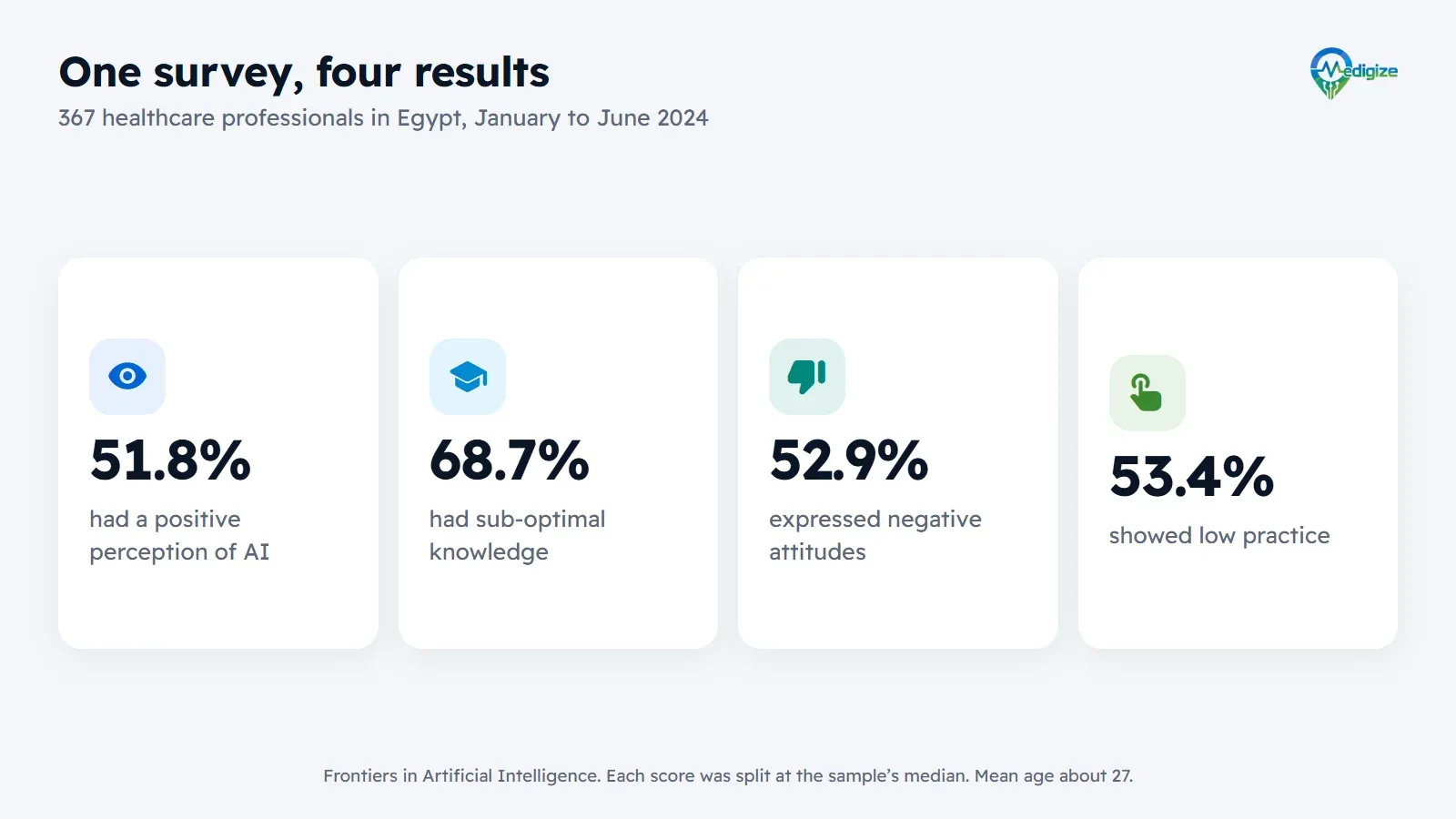
One survey, four results, each split at the middle of its own sample.
The study, published in January 2026, used an online questionnaire: of 446 professionals who received the link, 367 completed it. Physicians were 35.1% of them, pharmacists 19.6%, and nurses and others, such as technologists and technicians, 45.2%. Every participant was listed as working in a hospital: governmental (70.3%), university (18.5%) or private (11.2%).
To read the percentages, note that the authors split each score at its median, the middle score of their own sample, so “positive” means above the middle of this group, not above a fixed standard. A split at the median tends to put about half of a sample on each side, which is why three of the four results sit close to 50%.
Younger participants were more likely to have a positive perception, and physicians had lower odds of a positive attitude than nurses and others. The authors conclude that targeted training is needed, especially for older and female professionals.
Important caveats
- Participants’ mean age was about 27, and the largest group came from radiology and laboratory specialties (36.2%). The results do not necessarily represent clinic doctors or consultants.
- Other studies differ: a 2024 study of Egyptian medical students and house officers found most had a negative attitude (87.4%), while a 2025 study of medical students, posted as a preprint, found 66.8% positive. The picture is mixed.
The authors list their own limits: self-reported answers, which people may over- or underestimate; a survey spread through online organisational groups and answered by volunteers, which may miss professionals who are not active there; and a single snapshot from one geographic and institutional setting. Experience was short, too: a mean of 4.42 years, with half of participants at three years or less.
Four surveys, side by side
Three more Egyptian surveys fill out the picture. Side by side, who they asked explains much of the disagreement:
| Survey | Who answered, and when | Headline result | What counted as positive |
|---|---|---|---|
| Frontiers in Artificial Intelligence (2026) | 367 healthcare professionals in hospitals, January to June 2024 | 51.8% positive perception; 52.9% negative attitudes | Above the sample’s median |
| BMC Medical Education (2024) | 1,346 medical students and house officers, mean age 21, May to October 2023 | 87.4% negative attitude | At least 80% of the maximum score |
| Research Square preprint, not yet peer reviewed | 1,438 medical students from seven medical schools, 2024/2025 academic year | 66.8% positive attitude | More than 50% of the total score |
| Scientific Reports (2026) | 500 medical faculty staff and 2,765 medical students, April to September 2025 | 80.4% of staff and 81.6% of students with negative attitudes | At least 80% of the total score |
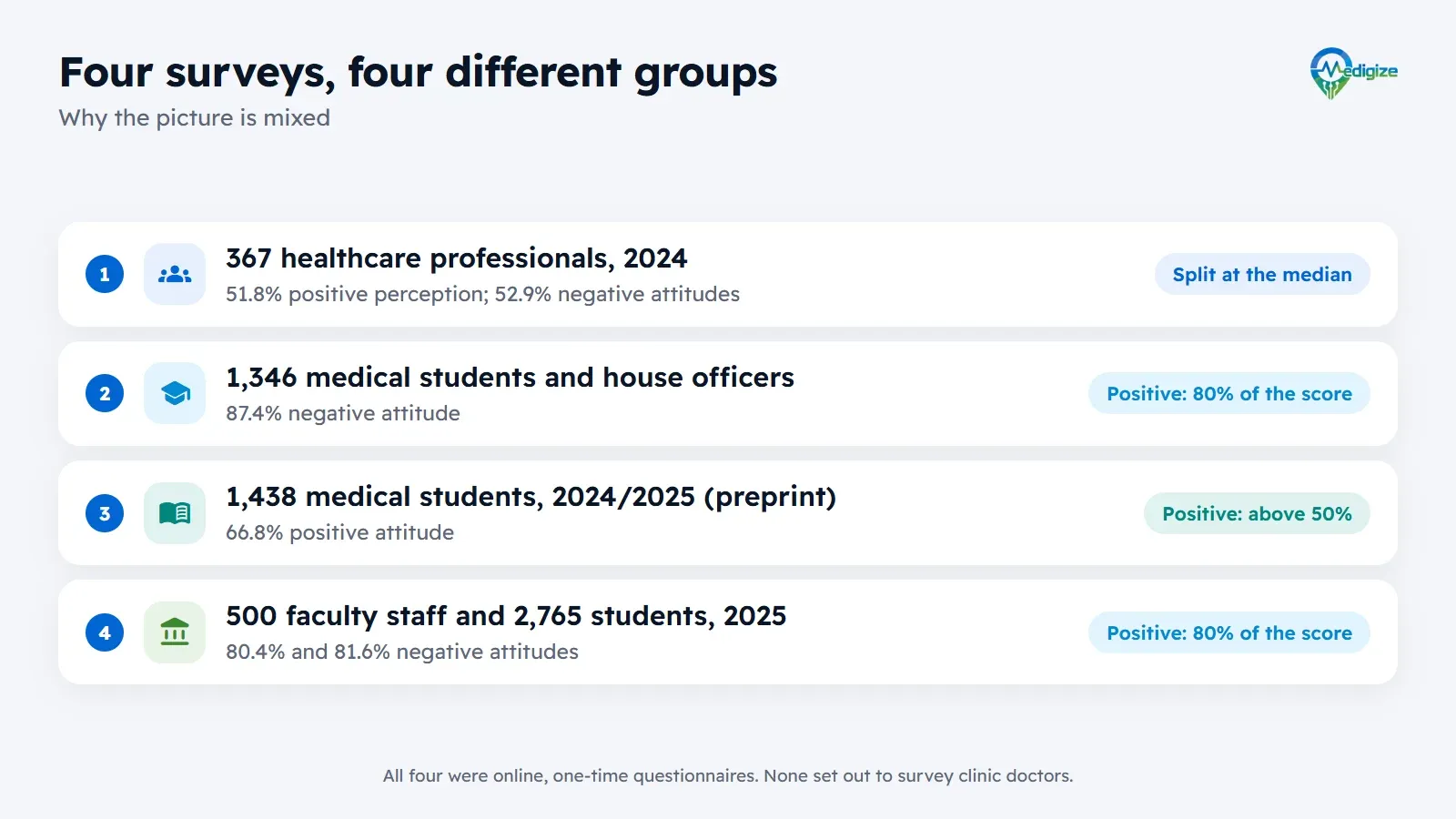
Different people, different years, different lines between positive and negative.
Read that way, the studies contradict each other less. They drew the line between positive and negative in three places: at the median, at 80% of the maximum score, and above 50%. On the same answers, a bar at 80% finds fewer positive attitudes than a bar at 50%. What the four share is more useful than their headlines: all were online questionnaires, each was a single snapshot, and none set out to survey clinic doctors.
Labels need reading too. The BMC paper calls its 1,346 participants medical students and house officers, yet one of its own tables places 723 of them in nursing and 423 in medicine, with the rest in dentistry, pharmacy, physiotherapy and veterinary medicine.
What do clinicians and medical students worry about?
On concerns, the surveys agree more than their headlines suggest. Each figure belongs to the group that gave it:
| Concern | What a survey found | Who was asked |
|---|---|---|
| Complex cases | 74% of staff and 66.1% of students were concerned about AI’s limited capacity to handle complex tasks | 500 medical faculty staff and 2,765 students |
| Empathy | 69.4% of staff and 63.8% of students were concerned about limited emotional intelligence and empathy | The same survey |
| Responsibility | 44.7% named uncertainty about who is liable if something goes wrong; 55.3% said the company that created the AI would be liable for legal problems, 28.3% the doctor in charge | 1,346 medical students and house officers |
| Training | 84.8% had never attended a course on AI | The same survey |
The 1,346-person survey points the same way on empathy: 64.7% of its participants named AI’s inability to develop empathy and consider the patient’s emotional well-being as a disadvantage. Asked what they would follow if a doctor’s judgement and an AI’s judgement differed, 63.5% of those students and house officers chose the doctor’s opinion, 8.2% the AI’s, and 28.2% the patient’s choice. In the 2024/2025 preprint, 70.5% of students agreed that AI should be in their curriculum, but only 43% felt their education prepares them for a future with it.
None of this is a verdict on AI. It is a list of questions any tool in a clinic must answer first: complex cases, the human relationship, and who is responsible. The World Health Organization’s guidance points the same way: AI systems should come with training in digital skills, especially for health workers, and humans should remain in control of health-care systems and medical decisions.
How to read a survey about doctors and AI
Six questions keep a survey percentage honest, in a journal, a news story or a sales deck:
- Who answered? Students, house officers, hospital staff and faculty staff are different groups. Look for age, role and workplace.
- How were they reached? A link shared in online groups reaches the people in those groups, and only the ones who choose to answer.
- Where was the line drawn? “Positive” can mean above the median, above 50% of a score or at least 80% of it. Same answers, different headline.
- What was measured? Perception, knowledge, attitude and practice are what people report about themselves, not a test of whether a tool is safe.
- When? These surveys were published between 2024 and 2026, and AI tools change quickly.
- Was it peer reviewed? A preprint has not yet passed peer review. Read its numbers as provisional.
A worked example: one result, two headlines
Take the 52.9% with negative attitudes in the 367-person study. A headline could say “Most Egyptian doctors are against AI”, and every part of it stretches the study. “Most” is 52.9% of a split at the sample’s own median. “Doctors” were 35.1% of participants. “Against” is an attitude score, not a refusal to use anything. The honest version: in an online survey of 367 mostly young hospital staff in Egypt, just over half fell on the negative side of a median split.
Try it on six statements. Decide whether each is what a survey found, or more than it says:
Try it
Does the survey say that?
Six statements about the Egyptian surveys in this article. Decide whether each is what a survey found, or more than it says.
1. In one survey of 367 healthcare professionals in Egypt, 51.8% had a positive perception of AI.
2. Most Egyptian doctors are against AI.
3. In that survey, 68.7% of participants had sub-optimal knowledge of AI.
4. These surveys show that AI tools are unsafe in Egyptian clinics.
5. A survey of 1,346 medical students and house officers counted an attitude as positive only at 80% of the maximum score or more, and found 87.4% below that.
6. Because these surveys were done online, they represent everyone in the profession.
0 of 6 answered
Your answers stay on this page.
What we build on
Our reading of these studies is ours, not their authors’, and we hold it loosely:
- Curiosity with limited knowledge and limited use. People need explanation, not slogans.
- So we talk about organizing the clinic, not about “AI”.
- The tool is non-diagnostic, and the clinical decision stays with the licensed clinician.
- The file is prepared before the visit, and the clinician decides.
Explanation means saying what the tool does and does not do: it understands the complaint, assesses urgency and routes to the right level of care; it does not diagnose. WHO asks for that openness too: enough information published before a technology is deployed for people to debate how it should and should not be used. Organising the clinic means the work around the visit, set out in what care operations means; why we start from the problem is in the story does not start with AI. Against the surveys’ concerns:
| What the surveys raised | What we build because of it |
|---|---|
| Limited knowledge, little formal training | Plain explanation of what the tool does and does not do, not slogans |
| Doubts about complex cases | A non-diagnostic tool, with a validation gate before any output; when in doubt, urgency goes up |
| Concern about empathy and the human relationship | The clinician always leads; the file is prepared before the visit |
| Who is responsible when something goes wrong | The licensed clinician decides, with a review trail at every stage |
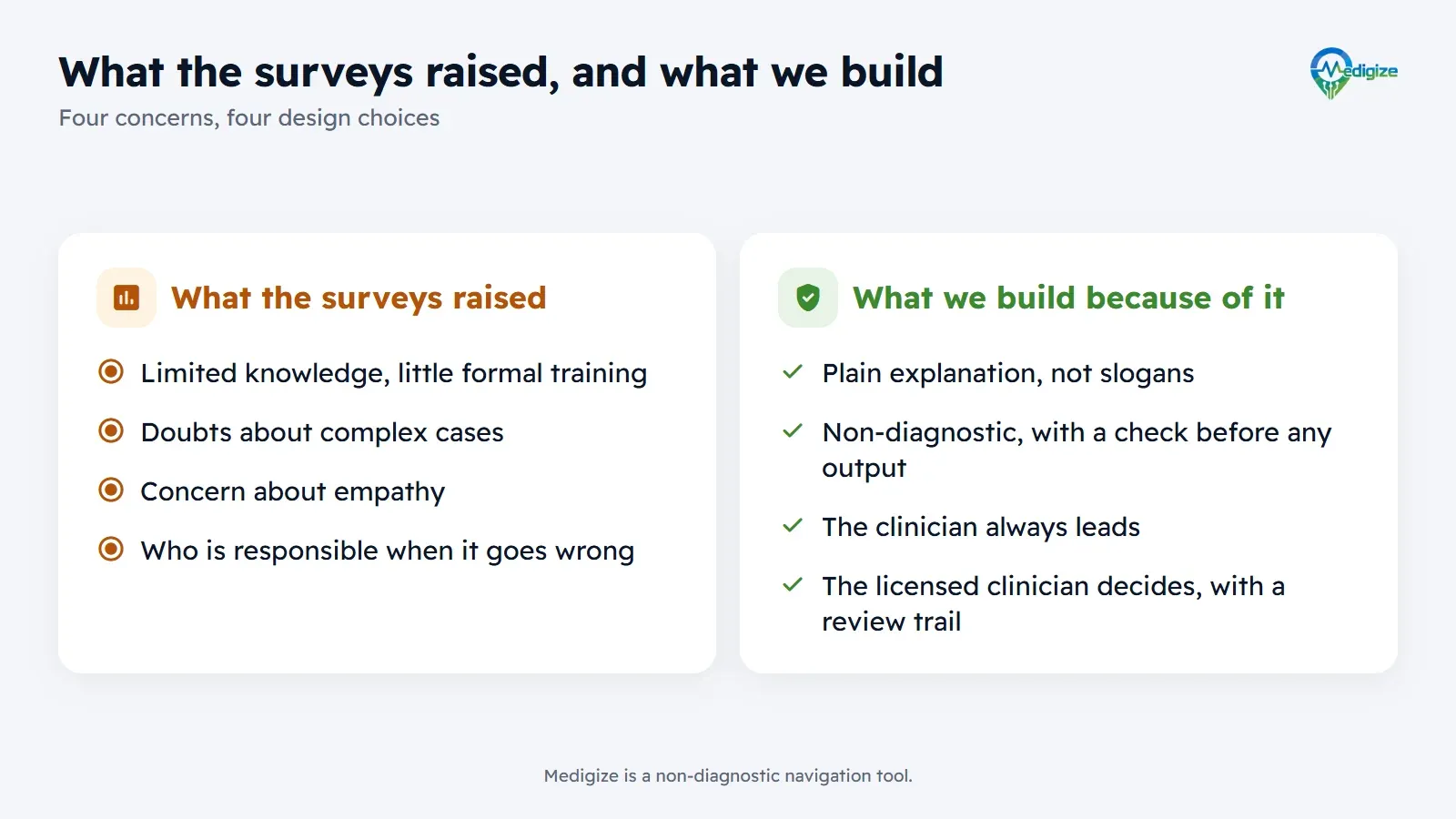
Four concerns, four design choices.
The rules behind the right-hand column are in four rules we do not negotiate, and what a file prepared before the visit holds is in what makes a case qualified. It carries information, not conclusions.
What this means for a clinic considering an AI-assisted tool
If the surveys sound like your team, a few habits help with any tool, ours included:
- Ask the team before the vendor. What should a tool take off their desk, and what should it never touch?
- Ask who decides. If the answer is not a licensed clinician, in every case, stop there.
- Ask what happens when the tool is unsure. The answer should be a rule written in advance.
- Ask what was measured, on whom and how. Read a vendor’s percentage with the six questions above.
- Ask what training it needs. A tool that needs a week of courses competes with habits that need none, as in the real competitor.
- Run it beside what you already have. Ours starts that way: a first pilot runs in parallel with your system, without data migration, as in on top of your system.
An honest limit
We do not generalize these studies to all doctors, and we will ask doctors directly during pilots.
A survey is a snapshot of the people who answered it. These four tell us a lot about hospital staff early in their careers, medical students, house officers and medical faculty staff, and less about a consultant in a private clinic or a family doctor in a small town.
Conversations are not surveys either. What clinicians tell us in meetings shapes our questions, but it is not data, and we will not present it as data. When we ask doctors in a pilot, we will say whom we asked and how, as in why we build in public.
Frequently asked questions
What do Egyptian doctors think about AI?
There is no single answer yet. In one survey, 51.8% of 367 healthcare professionals had a positive perception of AI; surveys of medical students, house officers and faculty staff mostly found negative attitudes; one survey of medical students, a preprint, found 66.8% positive.
Are Egyptian healthcare professionals for or against AI?
The picture is mixed. In the 367-person study, just over half had a positive perception, while most had sub-optimal knowledge and low practice.
Why do surveys about attitudes to AI disagree?
They asked different people, in different years, and defined “positive” differently: at the median, at 80% of a score, or above 50%.
What worries clinicians most about AI in healthcare?
In these surveys, the concerns reported most often were AI’s limits with complex tasks and its lack of empathy. Who is liable when something goes wrong came up too.
Do Egyptian medical students learn about AI?
Few had formal training. Of 1,346 medical students and house officers, 84.8% had never attended a course on AI.
Will AI replace doctors?
Not in anything we build. The model suggests and the licensed clinician decides, and WHO says humans should remain in control of medical decisions.
Does Medigize’s tool diagnose?
No. It understands the complaint, assesses urgency and routes to the right level of care. The clinical decision stays with the licensed clinician.
Will Medigize ask doctors what they think?
Yes, directly, during pilots. We do not generalize these studies to all doctors, and we do not present our own conversations as survey data.
Medigize is a non-diagnostic navigation tool. This article is general information, not medical advice. In an emergency, call an ambulance or go to the nearest emergency department.
References
- Frontiers in Artificial Intelligence (2026): Perception and awareness of healthcare professionals toward the applications of artificial intelligence in Egyptian healthcare settings
- PubMed: record of the same study, with its abstract
- BMC Medical Education (2024): Medical students and house officers’ perception, attitude and potential barriers towards artificial intelligence in Egypt, cross sectional survey
- Scientific Reports (2026): Dual dimensions of artificial intelligence use among medical academia: related knowledge, attitudes and ethical concerns, a national survey, 2025
- Research Square (preprint, not peer reviewed): Knowledge and attitude of Egyptian medical students towards artificial intelligence application in medical practice, a national cross-sectional study
- World Health Organization: WHO issues first global report on AI in health and six guiding principles for its design and use (2021)
Last updated:
Explore Medigize
Medigize is in development. Explore our current scope and express your interest.