

When we talk about Medigize, people ask about the technology. But the story starts with a lost patient and an exhausted provider. Why we start there, and what it lets us measure.
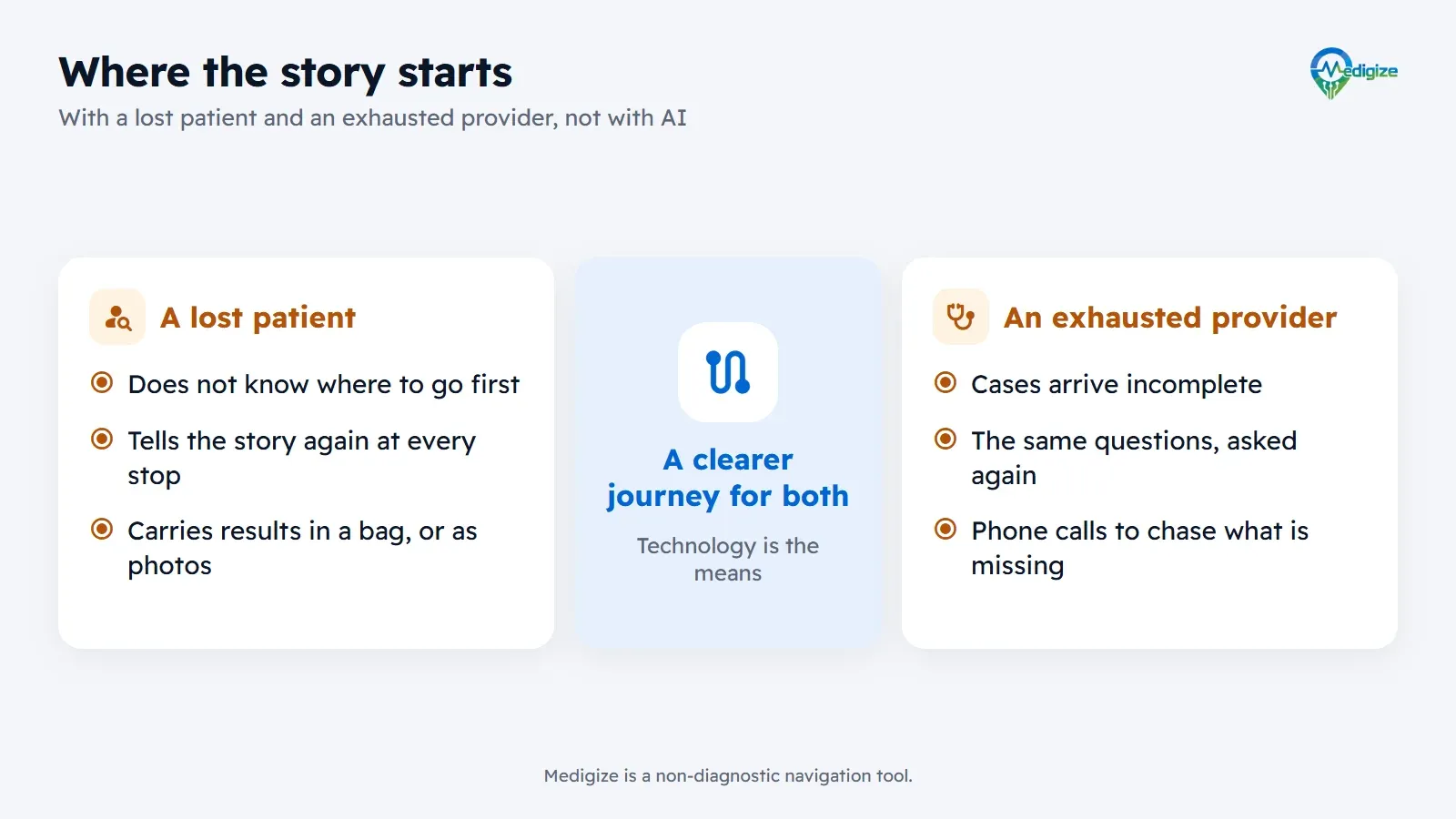
When we talk about Medigize, people ask about the technology. But the story starts with a lost patient and an exhausted provider.
Technology is the means. The goal is for the journey to be clearer for both.
Why start with the problem and not the technology? Because a problem can be measured, while a technology on its own can only be demonstrated. Starting with where a patient’s journey breaks, and with what that costs the people working in it, keeps every promise small enough to check. AI is one of the means we use, and a clinician makes every medical decision.
In short:
- Medigize’s story starts with a lost patient and an exhausted provider. AI is one of the means, not the beginning.
- Starting with technology promises magic. Starting with the problem builds something measurable: less time, less repetition, clearer cases.
- Those are things a pilot measures against a starting point measured first. They are not results we claim today.
The goal is a clearer journey for both. Technology is the means.
Who is the lost patient?
Lost does not mean careless. The patient we have in mind is doing everything they can: asking the family group, trying a pharmacy, booking the specialist a relative recommends. What they cannot see is the path. They do not know which door to knock on first, so they try several, which is where the first question of every patient journey comes from.
At each stop they tell the story again, a little shorter each time. Results travel in a plastic bag, or as photos on a phone with the date cropped out. Nobody at any single stop did anything wrong, and that is exactly why the problem is hard to see from inside one clinic. We followed one composite journey through seven stops, every one of which worked, and counted the hidden costs of a fragmented journey.
This is more than an inconvenience. The World Health Organization’s practice brief on continuity and coordination of care says that without good continuity or coordination, many patients, carers and families experience fragmented, poorly integrated care from multiple providers, with a risk of harm from failures of communication, inadequate sharing of clinical information, poor reconciliation of medicines, duplicated investigations, and avoidable hospital admissions or readmissions.
Who is the exhausted provider?
On the other side of the desk, the picture is a mirror image. The receptionist asks the questions every form has already asked (see why every form asks the same questions). The doctor opens a case with half the information and spends the first minutes rebuilding what happened before. A coordinator chases a result that was sent as a photo to somebody’s phone. After the visit, the next step depends on whoever remembers it.
None of that is clinical work, and all of it takes time from clinical work. The US Agency for Healthcare Research and Quality (AHRQ) describes care coordination as deliberately organising care activities and sharing information among everyone involved, so that the patient’s needs and preferences are known ahead of time and communicated at the right time to the right people. When that does not happen by design, someone on the team makes up for it by phone, every day.
WHO’s fact sheet on patient safety lists the factors that can lead to patient harm. Among them are disruptions in workflow and care coordination, communication breakdown among health workers and with patients and their families, and fatigue and burnout. It also says that most mistakes that lead to harm come from system or process failures, not from the practice of one person or one group. An exhausted provider is a signal about the system, not a verdict on the people in it.
Why does starting with technology promise magic?
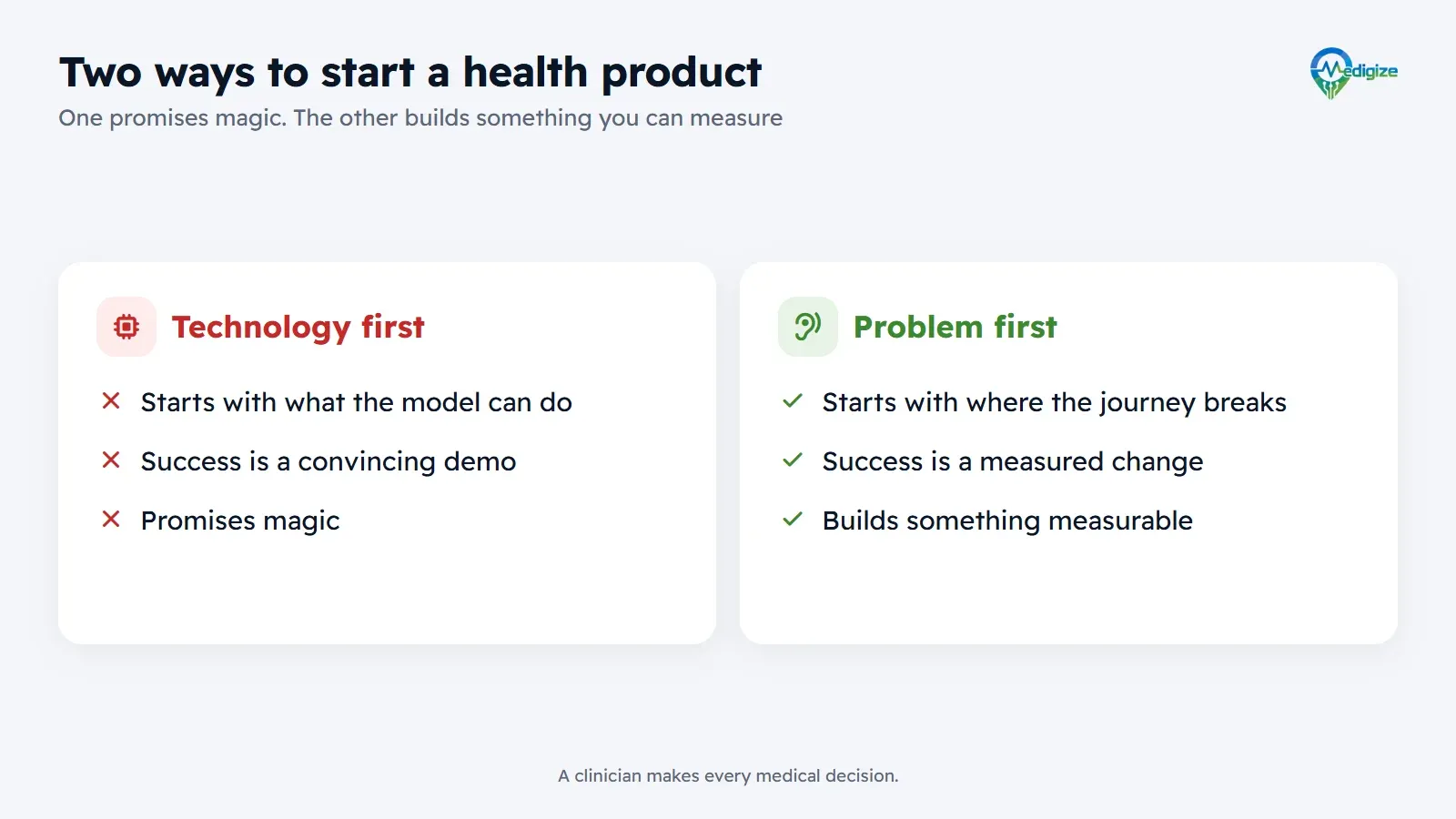
Starting with technology promises magic. Starting with the problem builds something measurable: less time, less repetition, clearer cases.
A technology-first story starts with what a model can do, then looks for somewhere to put it. The demo becomes the proof, and the promise grows to fit the demo: faster, smarter, everything at once. Nobody can check a promise like that, so nobody can hold anyone to it.
A problem-first story starts with one moment where the journey breaks, names who it hurts, and asks what would have to change for it to stop happening. The technology is chosen later, to serve that change, and it may turn out to be a better form, a checklist or a phone call rather than a model.
Two ways to start, and what each one can promise.
| Question | Technology first | Problem first |
|---|---|---|
| What is asked first? | Where can we use AI? | Where does the journey break, and for whom? |
| What counts as proof? | A convincing demo | A measured change at a real facility |
| What does it promise? | Everything, eventually | One change that can be checked |
| Who makes the medical decision? | Often left unclear | A clinician, stated up front |
Global guidance points the same way. In its 2021 report on AI in health, WHO says humans should remain in control of health-care systems and medical decisions. It also warns that systems trained mainly on data from people in high-income countries may not perform well for people in low- and middle-income settings. A tool chosen first and fitted to a problem later may have been built for somebody else’s patients. That is part of why we wrote the model is not the product, and why we explain what “AI-assisted” means to us.
What does “measurable” mean here?
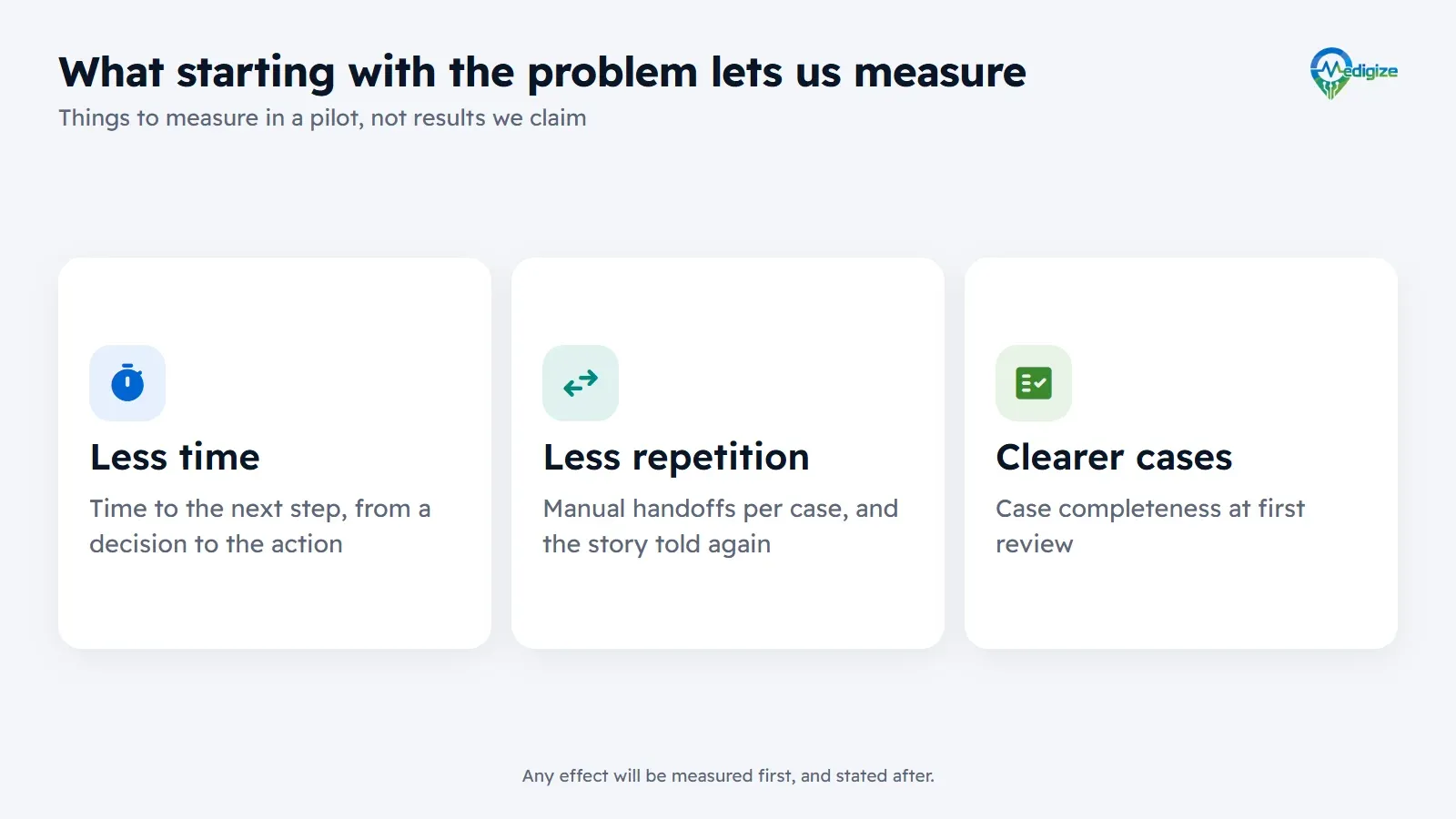
Less time, less repetition and clearer cases stop being slogans once each can be counted. In care operations terms, each maps onto a measure any clinic can take on paper:
- Less time is the time to the next step: from a decision such as “book the scan” to the scan actually happening.
- Less repetition is the number of manual handoffs per case: how many times the same information is copied, retyped or carried between people, and how often the patient retells the story.
- Clearer cases is case completeness at first review: how often the clinician has what they need when they first open the case. What makes a case qualified describes what “complete” means.
A fourth measure sits behind all three: how often follow-up disappears, meaning the agreed next step that never happens (see why follow-up matters).
Things to measure in a pilot, not results we claim.
None of these is a claim about Medigize. They are the questions a pilot answers, at one facility, against a starting point measured before anything changes. Any effect will be measured first and stated after.
One clinic, two ways to start: a composite example
A composite example, built from many settings, with no identifying detail. A busy outpatient clinic decides it needs “something with AI”.
Technology first. A chat window goes on the website and answers questions at any hour. It looks impressive in the demo. Three months later, the front desk still retypes the same history, results still arrive as photos, and doctors still open cases with half the information. Is anything better? Nobody can say, because nothing was counted before.
Problem first. The same clinic spends two ordinary weeks counting: how many cases reached the doctor with what was needed, how many times each case was retyped or carried by hand, and how long patients waited between a decision and the next step. The count shows that most of the delay sits in one place: earlier results that never arrive with the patient. The change the clinic tries is aimed there, and a second count, with the same definitions, says whether it helped. If a model turns out to be useful, it is chosen last, to serve that one change.
Same clinic, same budget. Only the first question changed.
How can you tell whether a health product started with a problem?
You do not need to understand the technology to judge the story. Six questions work for a patient, a clinician or an investor:
- Ask for the problem in one sentence, without the words AI, platform or app. If it cannot be said simply, it may not be known yet.
- Ask who they heard it from: patients, front desks and clinicians, or a market report? We explain why we listen in public in why we build in public.
- Ask what they will measure, and against which starting point.
- Ask what they will not build. Ours are in three things we won’t build.
- Ask who makes the medical decision. The answer should be a licensed clinician, every time.
- Ask what happens when the tool is unsure. Our rule: urgency goes up, never down.
Try it on six sentences of the kind heard in health technology pitches: does each one start with the problem, or with the technology?
Try it
Problem first, or technology first?
Six sentences from health product pitches. Decide whether each one starts with the problem or with the technology.
1. “Patients tell their story again at every stop.”
2. “Our platform runs on the latest language model.”
3. “Cases often reach the doctor without earlier results.”
4. “AI will transform healthcare in the region.”
5. “After the visit, nobody owns the next step, so follow-up disappears.”
6. “Our chatbot answers patients any time, day or night.”
0 of 6 answered
Your answers stay on this page.
Where does AI fit, then?
As one means among several. Medigize is AI-assisted: it helps understand the patient’s complaint, assess urgency and route the patient to the right level of care. The medical decision, including the diagnosis, belongs to the clinician.
Around the model sit the parts that make it safe to use. Every output passes a validation gate before it is released and leaves a review trail, and when in doubt, urgency goes up and never down, as urgency is the clinician’s call explains. For patients, MIHOS, the Medigize app, is building a record that moves with them, shared only with their consent. For providers, Medigize Dock runs each case from intake to follow-up, on top of the systems already in use, not instead of them.
The team: clinical, technical, commercial and marketing experience
A team combining clinical, technical, commercial and marketing experience, trying to stay honest about what it knows and what it has not yet confirmed.
Each kind of experience guards a different part of a problem-first story:
- Clinical experience knows where cases arrive incomplete and what a clinician needs before deciding, and keeps medical decisions where they belong.
- Technical experience builds what sits around the model: the gate, the trail, and the rule that urgency only goes up.
- Commercial experience knows how clinics and hospitals actually run, and what a team can change on a busy day without a new system.
- Marketing experience keeps the story in the patient’s own words, in Arabic and English, and keeps it from growing into claims.
What we know, and what we have not yet confirmed
Honesty is easier to promise than to show, so here is the line as it stands today:
| What we can stand behind | What we have not yet confirmed |
|---|---|
| Care from several providers can be fragmented and poorly integrated, with a risk of harm from failures of communication, as WHO’s practice brief on continuity describes. | How much a better-prepared case changes that at any one clinic. |
| Patients describe symptoms in everyday words and their own dialect, as we wrote in how patients describe symptoms. | Which phrasings still defeat a tool. Where understanding is unsure, urgency goes up. |
| Many people run their health journey on WhatsApp and paper today, as the real competitor describes. | Whether a new tool is easier than WhatsApp on the first day, which is the test we hold ourselves to. |
| Communication breakdown is among the factors that, WHO says, can lead to patient harm. | Whether fewer handoffs follow in practice. A pilot measures it, and we state it after. |
Medigize is in development and is not a live clinical service. When we have measured something, we will say how. If you work at one of the stops and think we have the problem wrong, tell us; see also Medigize for patients and Medigize for providers.
Frequently asked questions
Is Medigize an AI company?
Medigize builds care navigation and care operations software for the Middle East and Africa. It is AI-assisted: AI is one of the means, and a clinician makes every medical decision.
What problem is Medigize trying to solve?
A fragmented patient journey: patients who do not know where to go and retell their story at every stop, and providers who receive incomplete cases and chase what is missing.
Does Medigize diagnose?
No. It helps understand the complaint, assess urgency and route to the right level of care. The clinician makes the diagnosis and every medical decision.
Will AI replace my doctor?
Not in anything we build. WHO’s guidance says humans should remain in control of health-care systems and medical decisions, and that is our rule too.
Who is behind Medigize?
A team combining clinical, technical, commercial and marketing experience, trying to stay honest about what it knows and what it has not yet confirmed.
How will you know whether it works?
By measuring a starting point at a real facility, running a pilot alongside the systems already in use, and measuring again with the same definitions. Any effect will be stated after it is measured.
Medigize is a non-diagnostic navigation tool. This is general information, not medical advice. In an emergency, call an ambulance or go to the nearest emergency department.
References
- World Health Organization: Continuity and coordination of care, a practice brief (2018)
- World Health Organization: Patient safety (fact sheet)
- Agency for Healthcare Research and Quality: Care coordination
- World Health Organization: WHO issues first global report on artificial intelligence in health and six guiding principles for its design and use (2021)
Last updated:
Explore Medigize
Medigize is in development. Explore our current scope and express your interest.