


Before a visit, a few simple questions can save time, money and stress. Five organizing questions, and a list to take with you.
Before a visit, a few simple questions can save time, money and stress. This is not medical advice. These are organizing questions that help you get more from the appointment.
In short:
- Before you book, ask: is this the right specialty for my complaint, and what will it roughly cost?
- Before you go, ask: do I have my file with me?
- Before you leave, ask: what happens after the visit, and what do I do if it gets worse or changes?
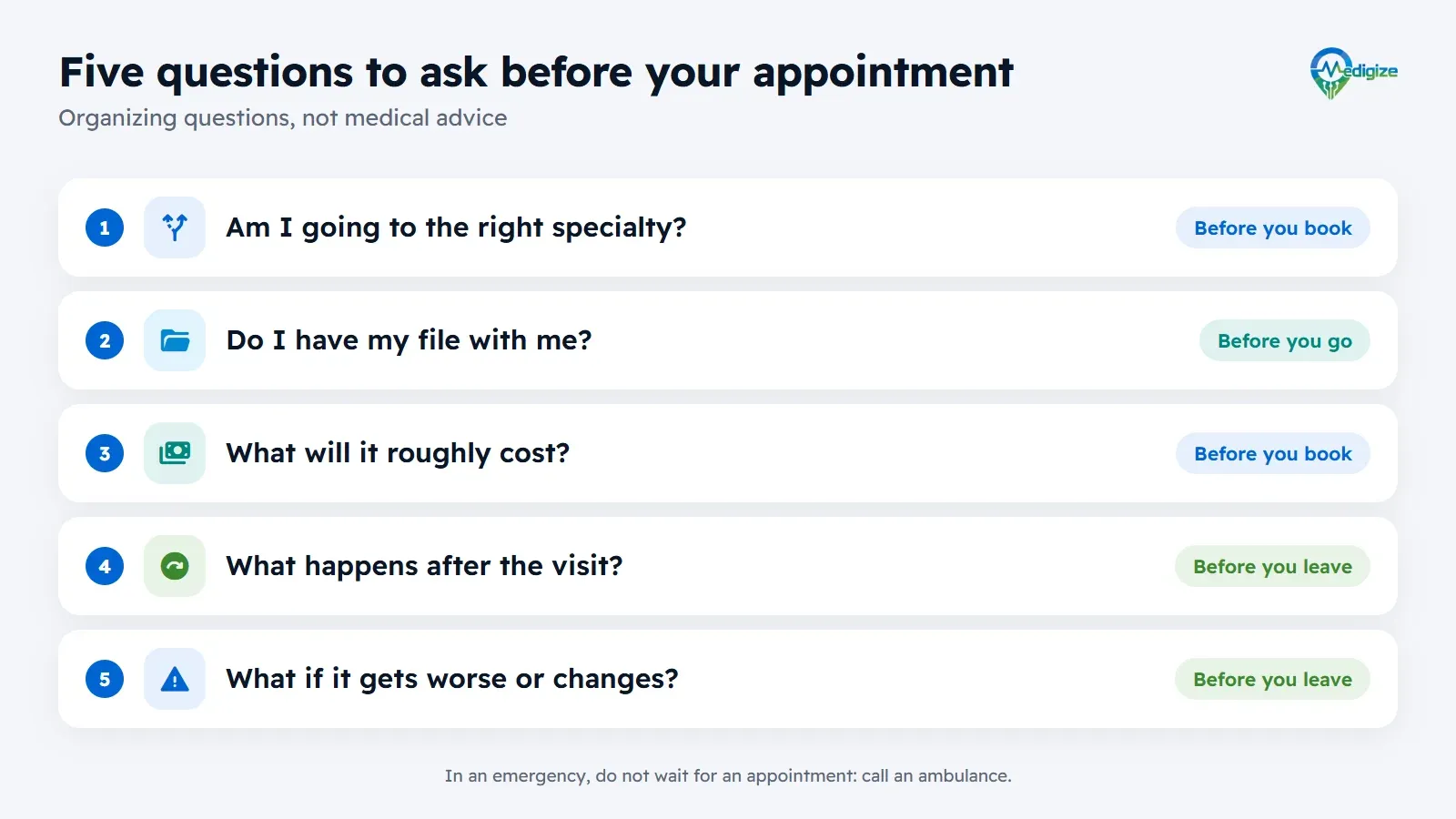
Five questions, three moments: booking, going, leaving.
What should you ask before a doctor’s appointment?
Ask five questions at three moments. Before you book: am I going to the right specialty, and what will it roughly cost? Before you go: do I have my file with me? Before you leave: what happens after the visit, and what do I do if it gets worse or changes?
None of the five asks the doctor to explain your health in advance. They are about the journey around the visit: the right door, the right papers, the price, the next step and the way back. So they fit any specialty, and any visit: yours, a parent’s or a child’s.
Asking is not a nuisance. The US Agency for Healthcare Research and Quality (AHRQ) puts it plainly: patients who ask questions and make sure they understand the answers tend to get more timely, accurate diagnoses and have better outcomes.
Am I going to the right specialty?
Ask the pharmacist, the clinic or someone you trust whether this specialty handles your complaint. If you are unsure, ask before you book. When the specialty is not clear at all, a general practitioner or family doctor is a usual first stop: they can examine you and refer you on. Our first-stop checklist walks through it.
A wrong first door costs a second booking, a second fee and a second telling of the same story. A short call to the clinic can prevent all three. Describe the complaint in one sentence, then ask:
- “Does the doctor see this kind of complaint?” If not, ask which specialty does.
- “Should I bring or prepare anything?” Earlier results, a referral letter or a form: the US National Institute on Aging (NIA) suggests asking for the medical history form in advance.
- “Can I speak with the doctor in a language I am comfortable in?” NIA and MedlinePlus both suggest calling ahead to ask for an interpreter if you need one. A 2020 review in the Oman Medical Journal found that language barriers lead to miscommunication and lower the quality of care and patient safety.
If a doctor has referred you, the referral letter names the specialty: take it with you.
Do I have my file with me?
Bring earlier labs, imaging and reports related to the complaint, plus a list of your medications and any allergies. A result the doctor can see, with its date, is one less reason to start from zero.
If your records are spread across places, here is how to ask for them. If you are seeing a specialist, one page is enough. The US Office of the National Coordinator for Health IT notes that your records make it easier to share important information with a new doctor and to coordinate care between clinics.
In practice, the file is five things:
- Results related to the complaint, with their dates, newest on top. Bring the whole report, not only the page that worried you.
- Your medicines, with doses, including anything bought without a prescription, vitamins and herbal products. NIA notes that some doctors suggest bringing the packs in a bag, others a list with the doses.
- Any allergy, and what happened.
- What has changed since your last visit. NIA advises telling the doctor right away about a visit to an emergency department or another specialist, and about any recent change in your medicines.
- Your questions, written down. NIA suggests choosing the three or four that matter most and naming them at the start.
We looked at why patients tell the same story at every stop in seven stops, and every one worked, and at keeping a one-page health summary in why every form asks the same questions.
What will it roughly cost?
Ask about the consultation fee and what might cost extra, instead of being surprised later. Tests or imaging ordered during the visit, a procedure or a follow-up visit can all cost more than the consultation itself. Ask when you book, and ask again if something new is suggested during the visit.
“Roughly” is the honest word: nobody can price a visit fully before the doctor has seen you. But you can learn most of it by asking in pieces:
- “What is the consultation fee, and what does it include?”
- “Is a follow-up visit charged as a new consultation?”
- “If tests or imaging are needed, can they be done here, and at what cost?”
- “Do you accept my insurance, and is approval needed first?”
In the room, keep the habit. When you need a test, AHRQ suggests asking how it is done, how to get ready and how you will get the results; add what it costs. And if you are worried about being able to follow the doctor’s instructions, AHRQ advises saying so. If cost is the worry, say that too.
What happens after the visit?
Ask who will follow up, when, and how to reach them with questions. A phone number, a messaging line or an online portal: know which one before you leave.
Follow-up often fails on two assumptions: the patient expects the clinic to call, and the clinic expects the patient to. Before you leave, settle four things:
- The next step: a test, a referral, a change in treatment, or nothing until the next visit.
- The results: how and when they will reach you. AHRQ advises calling the office to find out test results, and asking what to do about them.
- The follow-up date: booked now, or “call us in two weeks”? If the second, write down the day you will call.
- The contact: who answers questions, by which channel and at what times. MedlinePlus, from the US National Library of Medicine, advises finding out the best way to communicate with your doctor; NIA adds what to do if you need a doctor when the office is closed.
Then repeat the plan in your own words and ask, “Is this correct?” NIA suggests this check: it catches a misunderstanding while the doctor is still in the room. If the next step is a test, see our questions to ask your doctor about lab results.
What if it gets worse or changes?
Ask the doctor which signs mean you should come back or go to emergency, and write them down with the follow-up date.
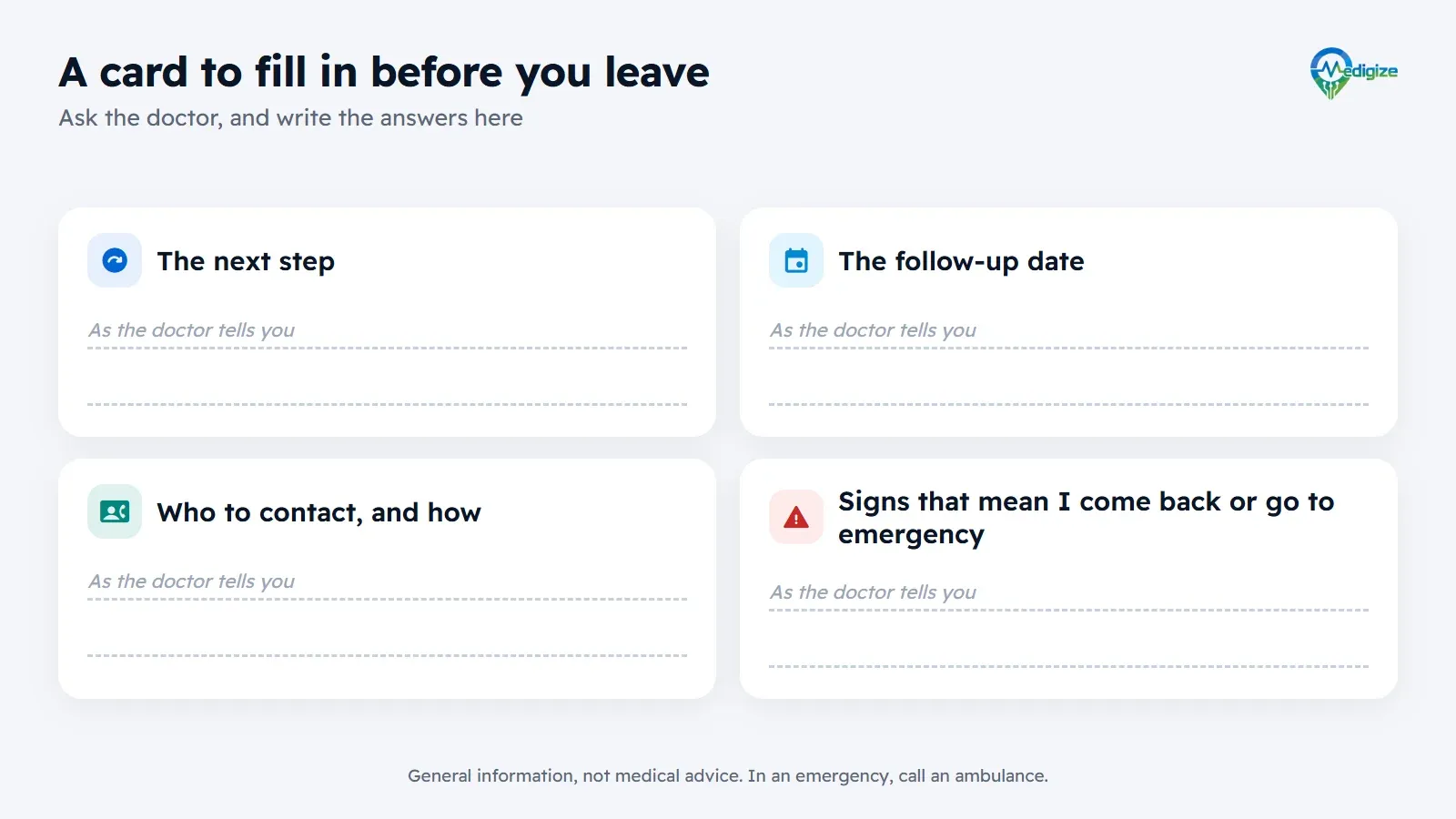
Four lines to fill in with the doctor’s own answers.
This is the one answer that has to come from the doctor who examined you, not from the internet, a relative or us. We explain why in urgency is the clinician’s call. Ask in plain words:
- “What would make you want to see me before the follow-up date?”
- “What should make me go to emergency instead of waiting?”
Write the answers on the card, in the doctor’s words. AHRQ advises calling your doctor if your symptoms get worse, or if you have problems following the instructions.
And if you have signs of an emergency now, do not wait for an appointment: call an ambulance or go to the nearest emergency department. Severe chest pain, trouble breathing, loss of consciousness or signs of a stroke mean an ambulance, not a booking and not an app.
Take the five with you
Tick the questions you want to ask, add your own, and write the answers as you get them:
Try it
Your questions before the appointment
Tick the ones you want to ask, add your own, and write the answers as you get them. Then copy, print or send the list to yourself.
5 questions on your list.
What you type stays on this page. Nothing is saved or sent unless you copy, print or send it yourself.
Three more wait unticked: what to bring, the wait on the day, and a copy of the report.
A worked example: one appointment, five questions
A composite example, built from many cases. A daughter books a visit for her father, whose complaint has come and gone for weeks. The family WhatsApp group has already suggested three doctors in three specialties.
- Before booking, she calls the clinic and describes the complaint in one sentence. Yes, the doctor sees it; bring the earlier results. She also asks the fee for the visit and for a follow-up.
- Before going, she puts two labs’ reports in date order and copies the medicines and doses from the packs, noting one that changed last month.
- In the room, her father tells his own story, and she takes notes. NIA’s advice for companions: help, but the visit is between the patient and the doctor.
- Before leaving, she fills in the card: a test is next, results come by message within the week, the follow-up is booked, the clinic answers by phone in the mornings, and the doctor names the signs for coming back sooner or going to emergency.
When the message has not come by the end of the week, she knows who to call.
The common mistakes it avoided
- Asking the price of the consultation only. Ask what might cost extra.
- Bringing results without dates. The date is what lets a doctor compare.
- Saying what you think the doctor wants to hear. NIA and MedlinePlus both ask for honesty.
- Treating no news as good news. Ask how results will reach you, and call if they do not.
Why these questions
Most of the time lost in a health journey is not in the consultation itself but around it: before and after. That is exactly what Medigize is building around: a clearer journey, a record that moves with you by your consent, and documented follow-up.
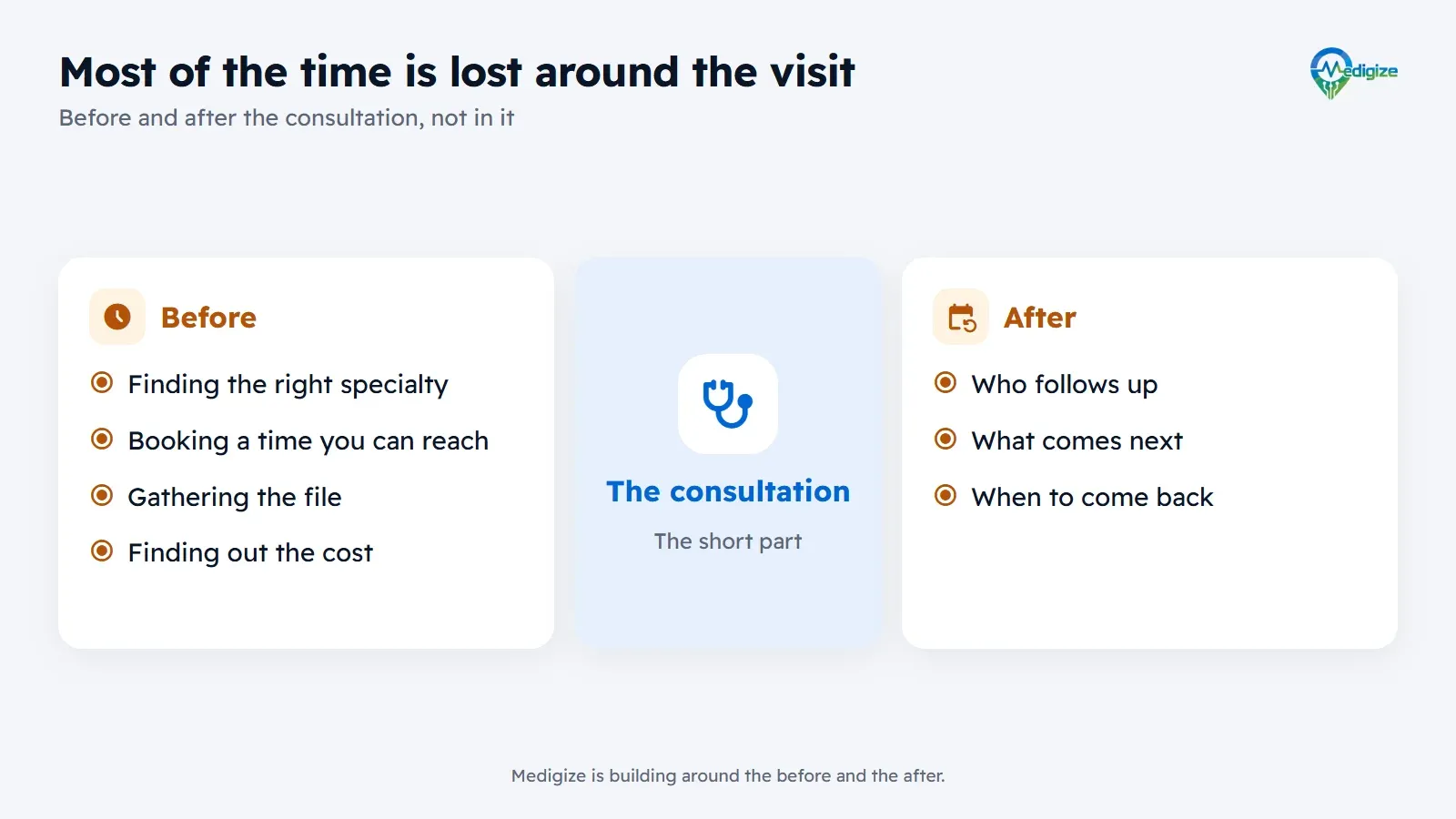
The consultation is the short part.
The World Health Organization counts communication breakdown, among health workers and with patients and their families, among the factors that lead to harm in health care. Five questions do not fix a system, but they close the gaps a patient can close alone.
What it means for clinics
Each of the five is a question a clinic can answer before the patient asks it: at booking, which complaints the doctor sees, what to bring and the rough cost; at the end of the visit, the next step, the date, the contact and the return signs, in writing. AHRQ’s follow-up guide suggests naming who is responsible for each follow-up task, and asking patients how they would like to be contacted. Medigize Dock, our tool for providers, is built around this before and after: see Medigize for providers.
We described the work around a visit in what care operations means, and what a broken journey costs in the hidden cost of a fragmented patient journey. Share this list with someone who needs it.
Frequently asked questions
What questions should I ask before a doctor’s appointment?
Whether the specialty is right for your complaint, whether you have your file with you, what the visit will roughly cost, what happens after the visit, and what to do if things get worse or change.
How do I know which specialist to see?
Ask the clinic, a pharmacist or someone you trust whether the specialty handles your complaint. If it is unclear, a general practitioner or family doctor can examine you and refer you on.
Should I ask about the cost before a consultation?
Yes. Ask about the consultation fee and what might cost extra, such as tests, imaging or a follow-up visit, so that nothing comes as a surprise.
What should I ask at the end of the appointment?
Who will follow up and when, how to reach them, and which signs mean you should come back or go to emergency.
What if I forget to ask something during the visit?
Call the clinic. NIA notes that when you are unsure about instructions after you get home, a nurse or another staff member can check with the doctor and call you back.
Can I bring someone with me to the appointment?
Yes, it can help. A family member or friend can take notes and remind you of your questions. Tell them beforehand what you want from the visit.
Do the same questions work for an online consultation?
Yes: MedlinePlus notes that preparing helps in person or by telehealth. Add how you will join, and how you will receive any report afterwards.
Is this medical advice?
No. These are organizing questions. Decisions about your health are made with your doctor.
Medigize is a non-diagnostic navigation tool. This article is general information, not medical advice. In an emergency, call an ambulance or go to the nearest emergency department.
References
- Agency for Healthcare Research and Quality: Be more engaged in your healthcare
- National Institute on Aging: Five ways to get the most out of your doctor’s visit
- Office of the National Coordinator for Health IT: The guide to getting and using your health records
- National Institute on Aging: How to prepare for a doctor’s appointment
- MedlinePlus, US National Library of Medicine: Talking with your doctor
- Agency for Healthcare Research and Quality: Follow up with patients (Tool 6)
- World Health Organization: Patient safety (fact sheet)
- Oman Medical Journal (2020): Implications of language barriers for healthcare, a systematic review
Last updated:
Explore Medigize
Medigize is in development. Explore our current scope and express your interest.