

A booking is a moment. A journey is a chain, and it is not complete until follow-up is documented. Why counting bookings misleads, and how to measure the journey instead.
A booking is a moment. A journey is a chain: symptoms, intake, records and urgency, then provider review, coordination and care, and it is not complete until follow-up is documented.
That sounds obvious until you look at what gets counted. Bookings are easy to count, so they are often what a dashboard shows. This article is about the rest of the chain, and how to measure it.
Why is a booking not the same as a patient journey? A booking records that an appointment was made. It does not show whether the patient reached the right level of care, arrived with what the clinician needed, left with a next step that someone owns, or was followed up. Counting bookings measures one moment; measuring the journey means following a case from the first symptom to documented follow-up, and comparing it with where it started.
In short:
- A booking is one event. The journey runs from the first symptom to documented follow-up, and much of what goes wrong happens outside the booking.
- Counting bookings can look like success while the journey stays the same: the wrong specialty, an incomplete file, a next step that nobody owns.
- Our rule is fixed: measure the baseline, intervene, measure again, then claim. No result before it is measured.
What happens before and after a booking?
The chain has eight links. In plain words:
- Symptoms: what the person notices, and when it started. Every journey starts with a question, as in every patient journey starts with a question.
- Intake: the complaint, the history and the medicines, collected and written down.
- Records: earlier results and reports, with their dates.
- Urgency: how soon care is needed. When in doubt, urgency goes up, never down, and it is the clinician’s call.
- Provider review: the provider’s team reads the case and decides what it needs.
- Coordination: tests, referrals and handovers lined up, so the next person does not start from zero.
- Care: the clinician examines, diagnoses and treats. This link is the clinician’s alone.
- Follow-up, documented: the next step happened, and someone wrote down that it did.
In a typical journey, the booking sits in the middle of that chain: after the patient knows where to go, and before the provider sees them. It is one event among many, and the easiest one to count.
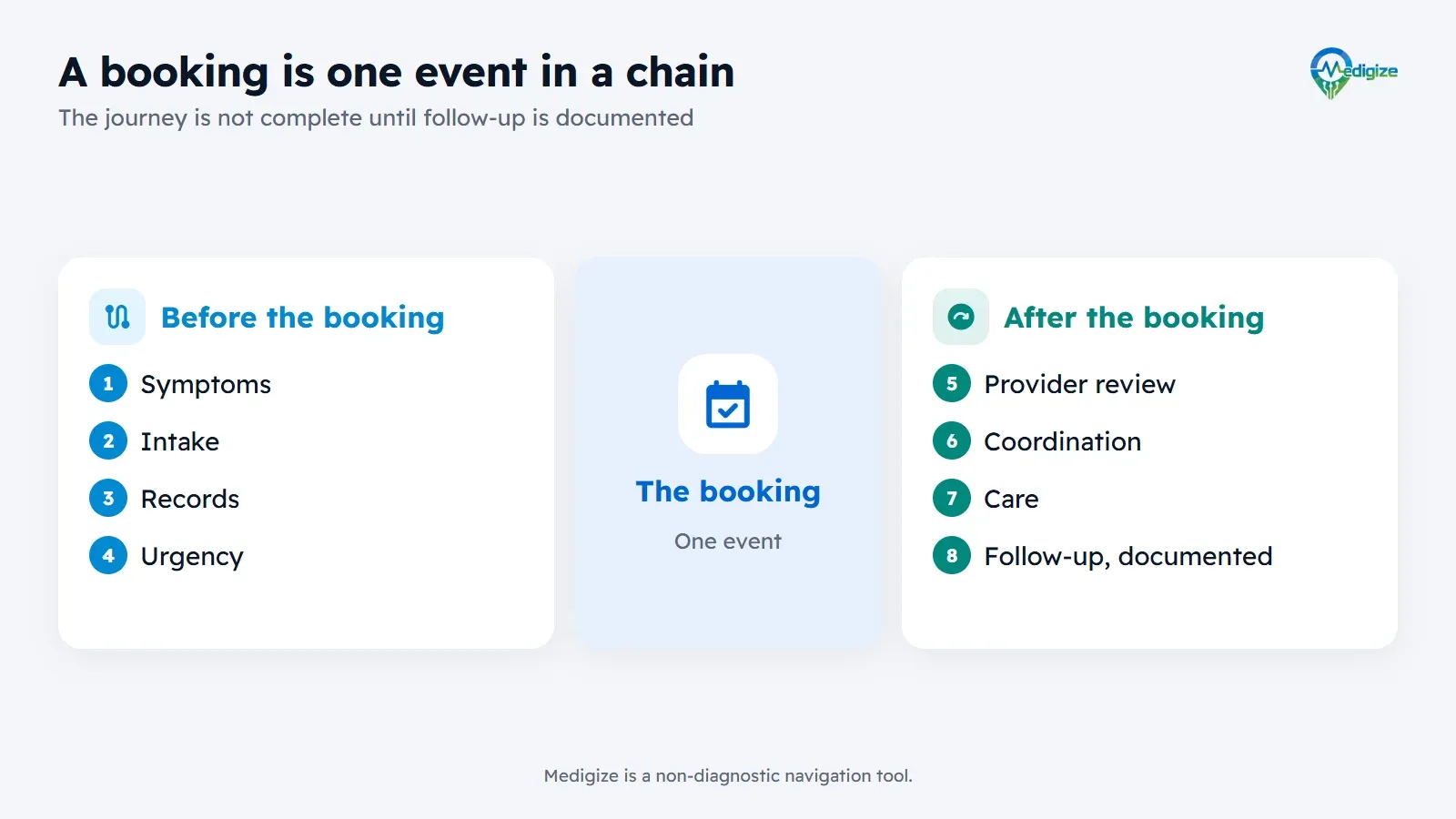
The booking is the short part. The chain is the journey.
Why this matters
If we only measure the booking, we may think we succeeded without knowing whether the patient’s journey improved.
A booking can be a success on a screen and a failure for the patient. The US Agency for Healthcare Research and Quality (AHRQ), describing the American system, lists what goes wrong around referrals: patients are often unclear about why they are being referred, how to make appointments and what to do after seeing a specialist; specialists do not consistently receive clear reasons for the referral or adequate information on tests already done; and primary care physicians do not often receive information about what happened in a referral visit. Each of those can happen to a patient whose appointment was booked perfectly.
The World Health Organization defines continuity of care as the degree to which a series of discrete health care events is experienced by people as coherent and interconnected over time, and consistent with their health needs and preferences. A booking is one of those events. The patient lives the series.
WHO’s practice brief on continuity and coordination also names what is at risk when care lacks them: harm from failures of communication, inadequate sharing of clinical information, poor reconciliation of medicines, duplicated investigations, and avoidable hospital admissions or readmissions. None of that shows up in a count of bookings.
Two bookings, two journeys: a composite example
A composite example, built from many cases, with no identifying detail. Two patients with the same complaint book the same clinic in the same week. Each counts as one booking.
The first booked the specialty a relative suggested. She arrives with no earlier results, the visit is spent rebuilding her history, and she is sent on to another specialty, which means a second booking. A test is ordered, and nobody agrees who will call with the result. Three weeks later she has two bookings on the dashboard and no next step.
The second was helped to the right level of care first. Her complaint, medicines and earlier results arrive with her, so the clinician starts from the case, not from zero. The test is booked before she leaves, with a date and a name next to the follow-up. When the result comes in, the follow-up happens and is written down.
On a booking dashboard, the first patient looks twice as successful. Her journey says the opposite. We followed a journey like hers in seven stops, and every one worked, and what choosing a provider well takes is in choosing between providers.
What a booking count cannot tell you
Appointments booked, visitors to a booking page and confirmation messages sent are all counts of a moment. They are useful for planning capacity. They cannot answer the questions a journey raises, and each question has a measure of its own:
| Question about the journey | What to measure instead |
|---|---|
| Did the case reach the clinician with what they needed? | Case completeness at first review |
| How many times was the case copied, retyped or carried by hand? | Manual handoffs per case |
| How long did the patient wait between a decision and the next action? | Time to the next step |
| Did the agreed next step happen, and was it written down? | How often follow-up disappears |
These are the four measures we use everywhere, set out in what care operations means. Each can be counted by hand, without new software, and what “complete” means for a case is in what makes a case qualified.
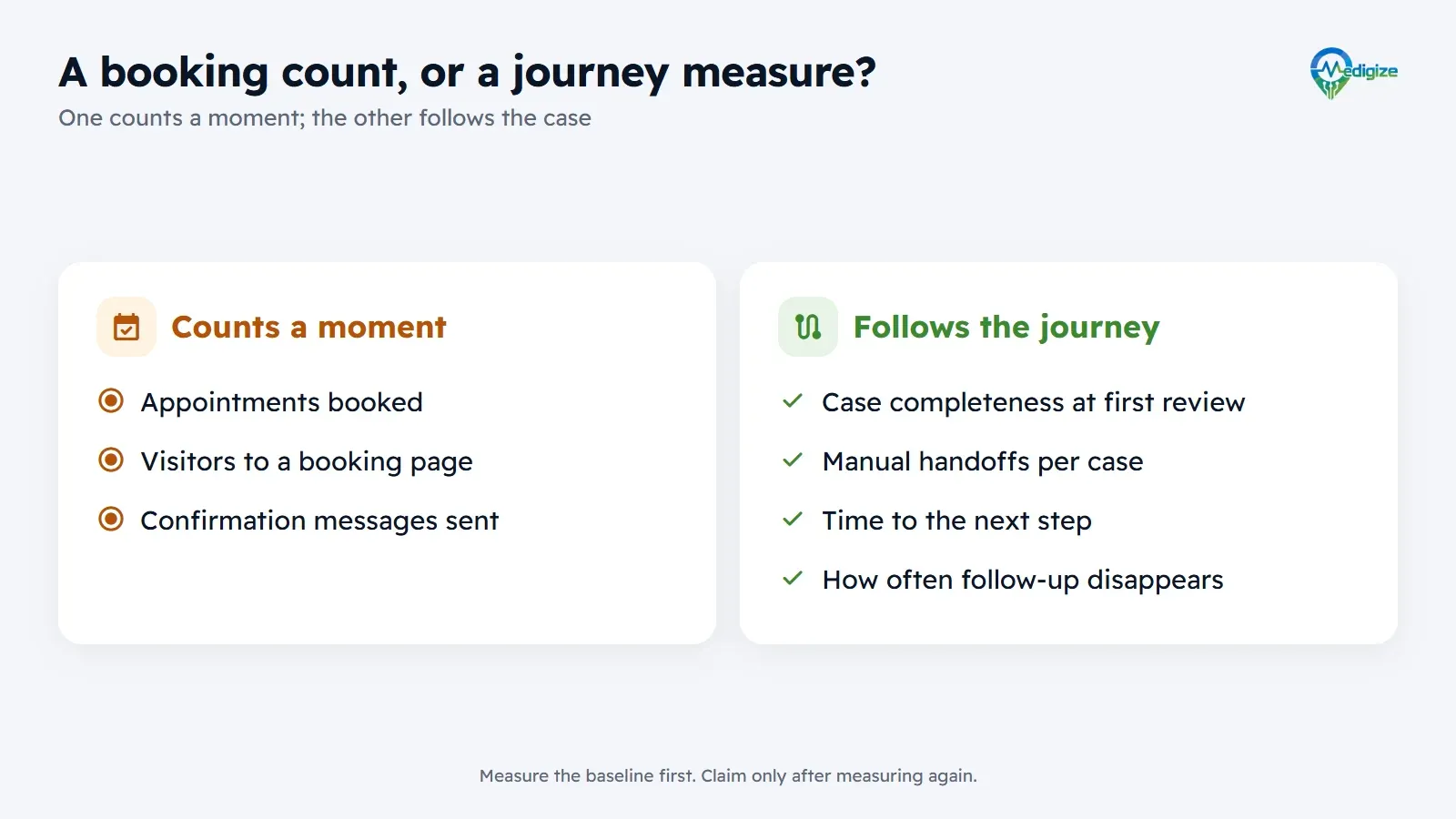
One counts a moment. The other follows the case.
Measurement
We work this way: measure the baseline, intervene, measure again, then claim. We do not state a result before it is measured.
For any provider, it takes six steps:
- Pick a sample of recent cases, routine and difficult, with identifying details removed.
- Write the definitions down: what counts as “complete”, as a “handoff”, as “the next step”. A second count is only fair if it uses the words of the first.
- Measure the baseline for two ordinary weeks, before anything changes.
- Change one thing, and write down what it was, so you can tell what made the difference.
- Measure again, the same way, on the same kind of cases.
- Then claim, with the method beside the result. If nothing changed, say so: that is a result too.
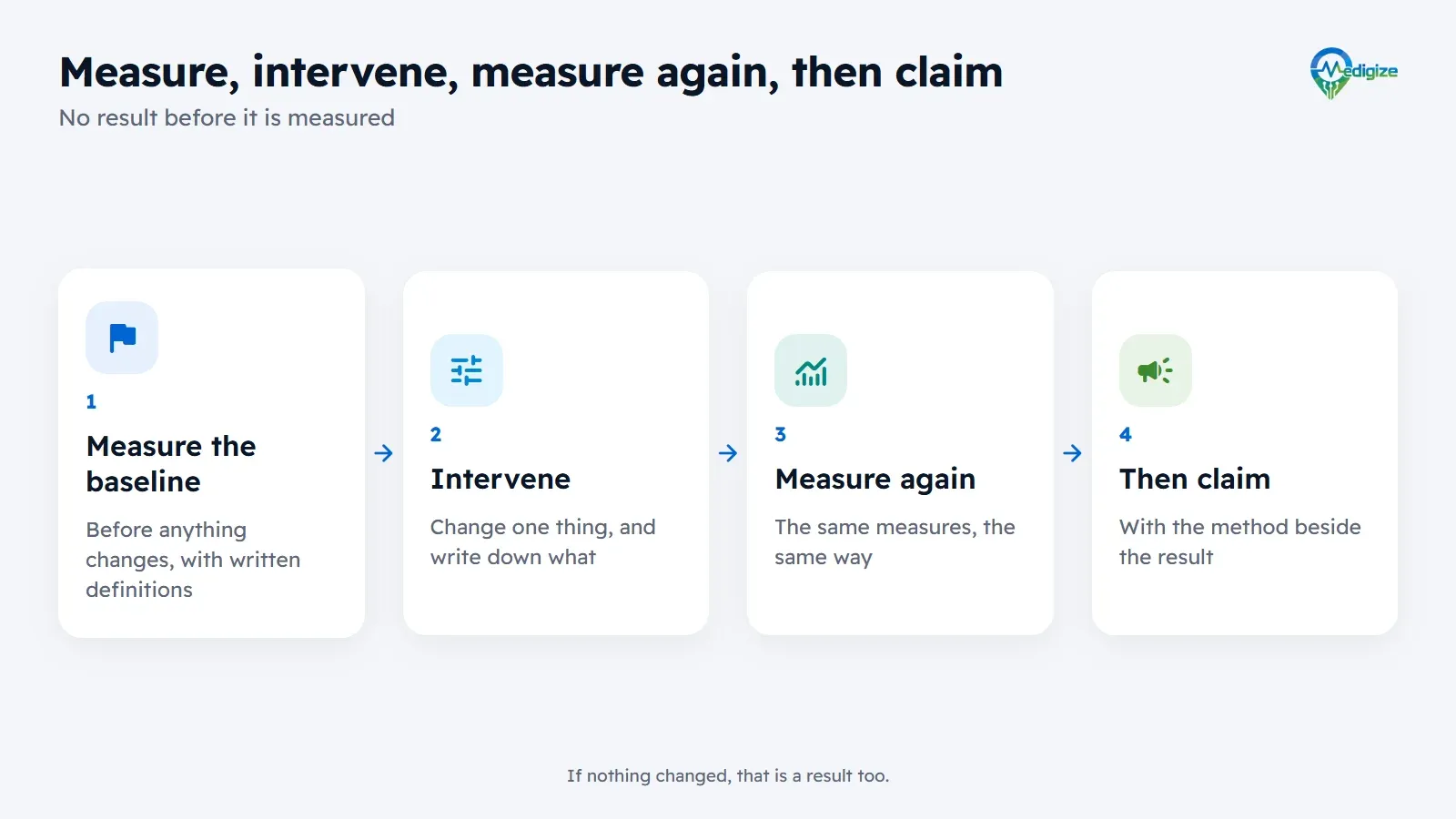
The order is the method.
None of this is our invention. NHS England’s improvement guidance describes Plan, Do, Study, Act cycles, which test the impact of a change on a smaller scale first to minimise risk, “much like a pilot”. The cycles are part of a model for improvement built on three questions: what are we trying to accomplish, how will we know if a change is an improvement, and what changes can we make that will result in improvement? AHRQ’s advice on follow-up includes an audit any clinic can run: select the records of a sample of patients who should have received follow-up after a recent visit, count how many received it, and count how many follow-up actions happened within the desired time frame. Its toolkit even suggests collecting patient feedback before its follow-up tool is put in place, and again 2, 6 and 12 months later.
Try telling the two kinds of number apart. Six numbers a clinic or a health app might report; decide whether each counts a moment or follows the journey:
Try it
A moment, or the journey?
Six numbers a clinic or a health app might report. Decide whether each counts a moment or follows the journey.
1. Appointments booked this month
2. How often a case is complete when a clinician first opens it
3. Visitors to the booking page
4. How long a patient waits between a decision and the next action
5. Confirmation messages sent
6. How often an agreed follow-up never happens
0 of 6 answered
Your answers stay on this page.
Common mistakes when measuring patient journeys
- Reporting bookings as outcomes. A booking says an appointment exists, not what happened around it.
- Changing the definitions between counts. If “complete” means something new the second time, the comparison is not a comparison.
- Changing several things at once. Then nobody can say which change made the difference.
- Measuring only what is easy. Coordination and follow-up are harder to count, and they are where journeys break.
- Borrowing someone else’s number. A figure from an outside study shows that a problem exists. It does not show that a product solved it.
- Stopping at the visit. The journey is not complete until follow-up is documented, which is why follow-up is where care is won or lost.
For patients: a booking is a start, not the finish
If you have just booked an appointment, the booking is the first step of your part of the chain, not the last. Four habits keep the rest connected:
- Bring your file: the complaint written down, your medicines, and earlier results with their dates. Keeping a personal health folder and one page for a specialist visit show how.
- Ask what happens after the visit: who follows up, when, and how to reach them, as in five questions to ask before your appointment.
- Leave with a date and a name, not “come back in a few weeks”.
- If nobody calls with a result, call them. Silence is not an answer.
And a booking is never a reason to wait in an emergency. Severe chest pain, trouble breathing, fainting or signs of a stroke need an ambulance or the nearest emergency department, not an appointment or an app.
Where Medigize stands
We treat the booking as one event in a journey, not the journey. On the patient’s side, MIHOS, the Medigize app, helps a patient organise the complaint and reach the right level of care, with a record shared only with their consent. On the provider’s side, Medigize Dock runs each case from intake to follow-up, on top of the systems already in use.
What a first pilot measures is the journey, not the bookings: case completeness at first review, manual handoffs per case, time to the next step, and how often follow-up disappears, from a baseline measured first and in parallel with the systems a provider already uses. Any claim of improvement will be measured first and stated after. See on top of your system, not instead of it and Medigize for providers.
Frequently asked questions
What is a patient journey?
The whole path from the first symptom to documented follow-up: symptoms, intake, records and urgency, then provider review, coordination and care, then follow-up that is written down.
Why is the number of bookings not a good measure of success?
It counts one moment. It does not show whether the case arrived complete, whether the next step happened, or whether follow-up was documented.
What should a clinic measure instead of bookings?
Case completeness at first review, manual handoffs per case, time to the next step, and how often follow-up disappears.
How do you measure a patient journey?
Pick a sample of cases, write the definitions down, measure a baseline, change one thing, measure again the same way, and report the result with its method.
What is a baseline?
The starting point: how the journey behaves today, measured before anything changes, so that any later change can be compared fairly.
What does “follow-up is documented” mean?
The agreed next step happened, and someone wrote down what was done, when and by whom.
What should I do after booking an appointment?
Bring your file, ask what happens after the visit, and leave with a follow-up date and a name. In an emergency, do not wait for the appointment: call an ambulance.
Does Medigize claim to improve patient journeys?
No. Any claim of improvement will be measured first and stated after.
Medigize is a non-diagnostic navigation tool. This is general information, not medical advice. In an emergency, call an ambulance or go to the nearest emergency department.
References
- Agency for Healthcare Research and Quality: Care coordination
- World Health Organization: Continuity and coordination of care, a practice brief (2018)
- Agency for Healthcare Research and Quality: Follow up with patients (Health Literacy Universal Precautions Toolkit, Tool 6)
- NHS England: Plan, Do, Study, Act (PDSA), improvement learning handbook
Last updated:
Explore Medigize
Medigize is in development. Explore our current scope and express your interest.